


#Short Answer
Explains how to get started with chatbots, including the main process, tools, examples, risks, and practical implementation steps.
#Infobox
#Overview
Chatbots are automated systems that interact with users in natural language, providing instant responses to queries, automating repetitive tasks, and enhancing user engagement. They leverage Natural Language Processing (NLP) to understand and interpret human input, enabling them to respond contextually. Modern chatbots integrate Machine Learning (ML) to improve over time, adapting to user behavior and refining their responses. The adoption of chatbots has surged due to their efficiency in reducing operational costs, improving response times, and providing 24/7 support. Businesses across industries—from e-commerce to healthcare—use chatbots to streamline customer interactions, qualify leads, and even perform transactional tasks like order processing. The rise of messaging platforms (e.g., WhatsApp, Facebook Messenger) has further accelerated chatbot integration, as users increasingly prefer conversational interfaces over traditional apps or websites.
#History / Background
#Early Developments
The concept of chatbots dates back to the 1960s with ELIZA, an early natural language processing program created by Joseph Weizenbaum at MIT. ELIZA simulated a psychotherapist by using pattern matching and substitution methodology, though it lacked true understanding of context. In the 1970s, PARRY was developed to simulate a person with paranoid schizophrenia, marking one of the first attempts to create a more sophisticated conversational agent.
#Commercialization and AI Advancements The 1990s and early 2000s saw the emergence of commercial chatbots, such as SmaterChild (2001), which interacted with users via AOL Instant Messenger. However, these early bots were primarily rule-based, relying on predefined scripts rather than AI. The breakthrough came with the advent of NLP and deep learning, enabling chatbots to understand context, sentiment, and intent more accurately.
#Modern Era
The proliferation of smartphones and messaging apps in the 2010s transformed chatbots into mainstream tools. Companies like Apple (Siri), Google (Google Assistant), and Microsoft (Cortana) introduced voice-enabled assistants, while businesses adopted text-based chatbots for customer service. The launch of Facebook Messenger’s bot platform (2016) and WhatsApp Business API further democratized chatbot development, allowing even small businesses to deploy AI-driven solutions. Today, chatbots are integral to digital transformation, with advancements in generative AI (e.g., large language models like GPT) enabling more human-like and context-aware interactions.
#How It Works
#Core Components A chatbot’s functionality relies on several key components:
- User Interface (UI) - The front-end where users interact with the chatbot (e.g., a website widget, mobile app, or messaging platform).
- Natural Language Processing (NLP) Engine - Processes user input to extract intent (the user’s goal) and entities (specific details like dates, names, or product names). - Uses techniques like tokenization, part-of-speech tagging, and sentiment analysis to understand context.
- Dialog Management System - Determines the chatbot’s response based on the user’s intent and conversation history. - Can be rule-based (follows predefined scripts) or AI-driven (uses ML to generate dynamic responses).
- Integration Layer - Connects the chatbot to backend systems (e.g., CRM, databases, payment gateways) via APIs or webhooks. - Enables actions like fetching order statuses, processing payments, or updating user profiles.
- Machine Learning Model (Optional) - Continuously improves the chatbot’s responses by analyzing past interactions. - Common algorithms include sequence-to-sequence models, transformers, and reinforcement learning.
#Development Approaches Chatbots can be built using different methodologies:
| Approach | Description | Pros | Cons | |--------------------|---------------------------------------------------------------------------------|-----------------------------------|-----------------------------------| | Rule-Based | Uses predefined rules and decision trees to guide conversations. | Simple to implement, predictable | Limited flexibility, no learning | | Retrieval-Based | Selects responses from a predefined database based on input similarity. | Fast, consistent responses | Requires extensive response library | | Generative | Uses ML models (e.g., transformers) to generate new responses dynamically. | Highly adaptable, human-like | Requires large training data | | Hybrid | Combines rule-based and AI-driven methods for balanced performance. | Flexible, scalable | Complex to develop |
#Example Workflow (WhatsApp Chatbot)
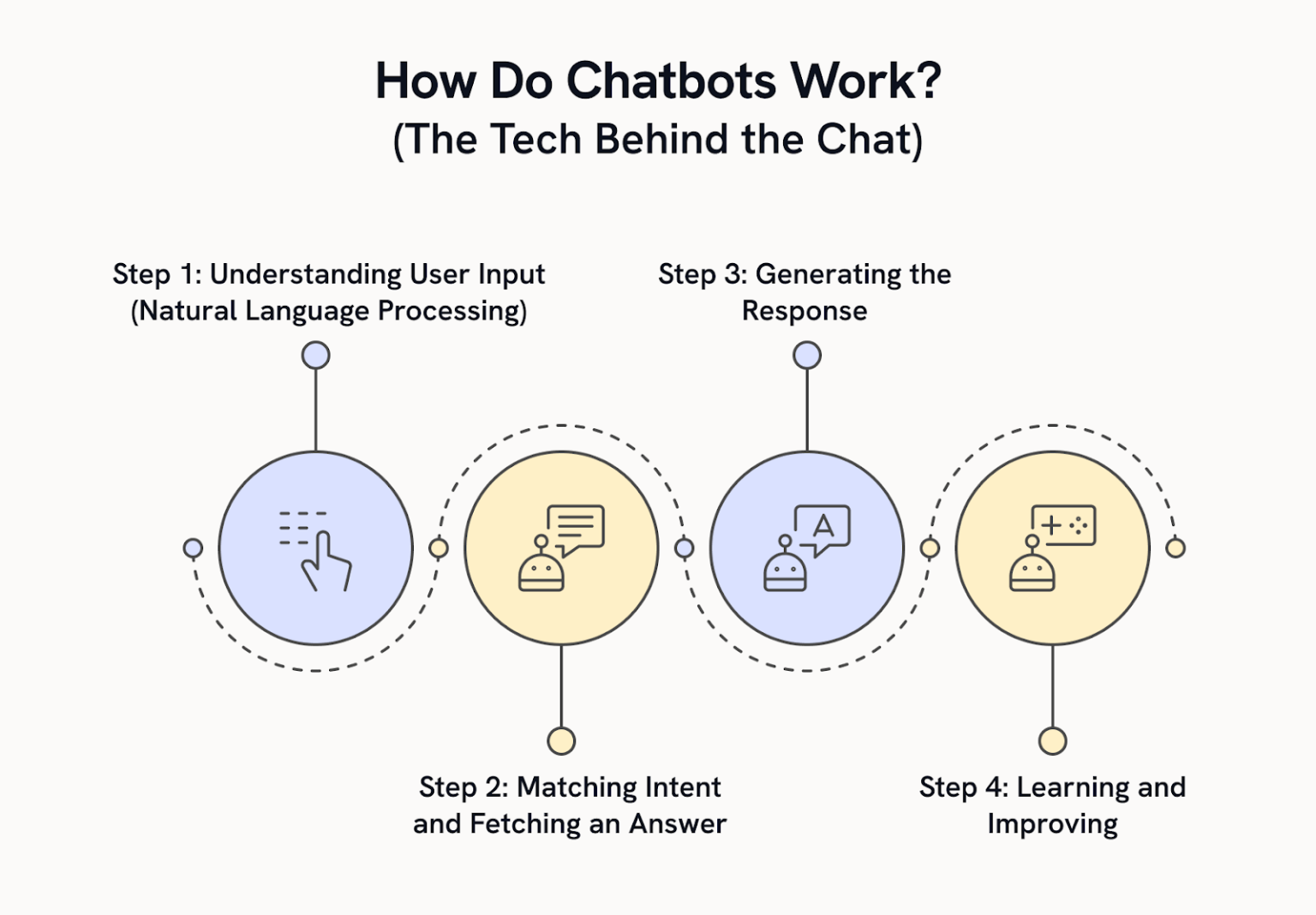
- User Sends a Message: A customer texts, "What are your business hours?"
- NLP Processing: The chatbot identifies the intent ("query business hours") and extracts the entity ("business hours").
- Dialog Management: The system checks the predefined response for business hours or queries a backend database.
- Response Generation: The chatbot replies, "Our business hours are 9 AM to 6 PM, Monday to Friday."
- Integration: If the user asks to book an appointment, the chatbot connects to a scheduling API to confirm availability.
#Important Facts
- Efficiency Gains: Businesses using chatbots report up to 30% reduction in customer service costs (Gartner).
- User Preference: 64% of users prefer chatbots for quick answers over waiting for human agents (Drift).
- Industry Adoption: The healthcare and finance sectors lead in chatbot integration, with 40% of banking customers using them for transactions (Juniper Research).
- Multilingual Support: Advanced chatbots support over 100 languages, enabling global scalability.
- Security Risks: Poorly designed chatbots can expose data breaches or phishing vulnerabilities if not secured with encryption and authentication.
- Future Trends: Voice-enabled chatbots (e.g., Alexa Skills) and emotion-aware chatbots (using sentiment analysis) are gaining traction.
#Timeline
- Foundational ideas
Core concepts and early methods shape How to Get Started with Chatbots.
- Practical use
Tools, examples, and real-world deployments make the topic easier to evaluate.
- Responsible implementation
Current work focuses on reliability, governance, performance, and measurable impact.
#Related Terms
#FAQ
What does How to Get Started with Chatbots cover?
Explains how to get started with chatbots, including the main process, tools, examples, risks, and practical implementation steps.
Why is How to Get Started with Chatbots important?
It helps readers understand key concepts, compare practical use cases, and evaluate how Language AI decisions affect outcomes, risks, and implementation choices.
What should readers verify before applying this topic?
Readers should compare benefits, limitations, data requirements, and related themes such as Get, Started, Chatbots before using the ideas in real projects.
#References
- How to Get Started with Chatbots terminology and background research
- How to Get Started with Chatbots use cases, implementation examples, and limitations
- Language AI best practices, standards, and risk guidance
- Get case studies, benchmarks, and current industry analysis


Comments
No comments yet. Start the discussion with a useful note.