


#Short Answer
Explains how manufacturing uses ai: case studies, including the main process, tools, examples, risks, and practical implementation steps.
#Infobox
#Overview
The integration of Artificial Intelligence (AI) into manufacturing has revolutionized traditional production methods by introducing automation, real-time monitoring, and intelligent decision-making. AI-driven systems analyze vast datasets to predict equipment failures, optimize supply chains, and enhance product quality. This shift from manual and rule-based processes to AI-enabled smart manufacturing has led to significant improvements in productivity and operational resilience. Manufacturers are increasingly adopting AI to address challenges such as rising labor costs, supply chain disruptions, and the need for mass customization. AI-powered tools enable factories to operate with greater precision, adapt to market changes quickly, and reduce waste. As a result, AI has become a cornerstone of Industry 4.0, the fourth industrial revolution characterized by cyber-physical systems and digital transformation.
#History / Background
The application of AI in manufacturing traces its roots to the late 20th century, with early developments in expert systems and rule-based automation. However, the widespread adoption of AI in manufacturing began in earnest during the 2010s, driven by advancements in computing power, the proliferation of sensors, and the growth of big data.
- 1980s–1990s: Early AI applications in manufacturing included expert systems for process control and fault diagnosis. These systems relied on predefined rules and lacked the adaptability of modern machine learning models.
- 2000s: The rise of data-driven approaches and the introduction of industrial IoT (IIoT) enabled real-time monitoring and data collection. Companies began using statistical models for predictive maintenance.
- 2010s: The advent of deep learning and cloud computing accelerated AI adoption. Machine learning algorithms were trained on large datasets to detect anomalies, optimize production schedules, and improve quality control.
- 2020s: AI is now deeply embedded in manufacturing, with applications ranging from autonomous robots to generative design tools. The COVID-19 pandemic further highlighted the importance of AI-driven resilience and automation.
#How It Works
AI in manufacturing operates through several key technologies and methodologies:
#
- Predictive Maintenance AI models analyze sensor data from machinery to predict equipment failures before they occur. By using time-series forecasting and anomaly detection, manufacturers can schedule maintenance proactively, reducing unplanned downtime.
#
- Computer Vision for Quality Control High-resolution cameras and AI-powered image recognition systems inspect products for defects. Convolutional neural networks (CNNs) classify defects with high accuracy, ensuring consistent product quality.
#
- Supply Chain Optimization AI algorithms optimize inventory levels, demand forecasting, and logistics routes. Reinforcement learning and genetic algorithms help balance cost, speed, and reliability in supply chain networks.
#
- Autonomous Robotics Robots equipped with AI and sensors perform tasks such as assembly, welding, and packaging. Collaborative robots (cobots) work alongside human operators, enhancing flexibility and safety.
#
- Generative Design AI-driven generative design tools create optimized product designs based on performance criteria. These tools explore thousands of design variations to identify the most efficient and cost-effective solutions.
#
- Digital Twins A digital twin is a virtual replica of a physical asset or process. AI analyzes data from the digital twin to simulate scenarios, predict outcomes, and optimize performance in real time.
#Important Facts
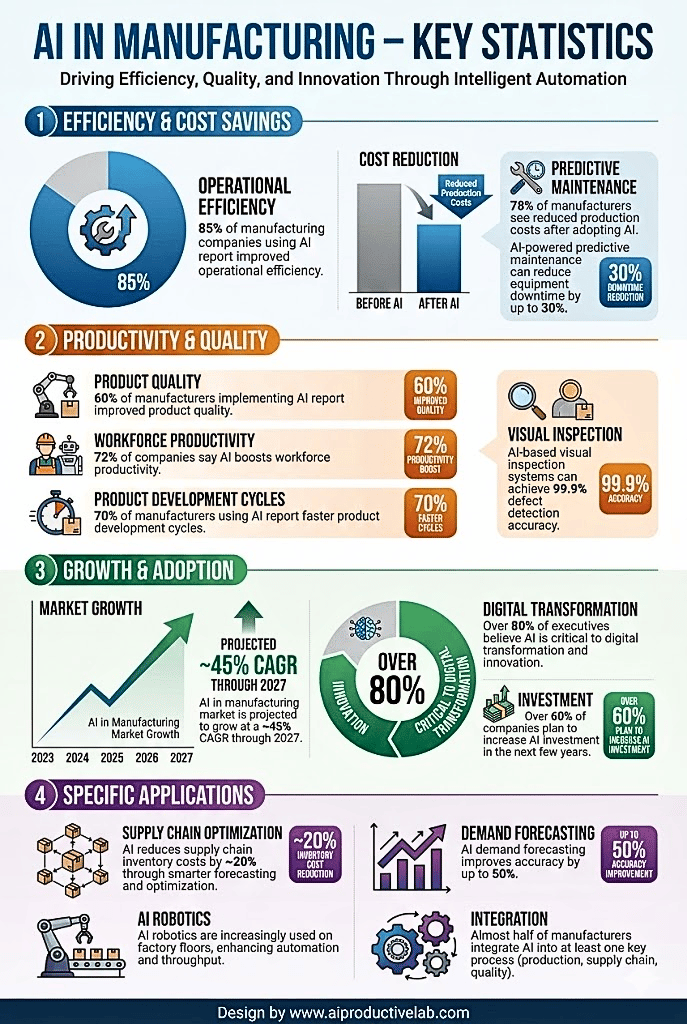
- Efficiency Gains: AI can reduce unplanned downtime by up to 50% through predictive maintenance.
- Cost Reduction: Automating quality control with AI can cut inspection costs by 30–50%.
- Energy Savings: AI-driven energy management systems can reduce energy consumption by 10–20%.
- Labor Impact: While AI automates repetitive tasks, it also creates new roles in data science, AI maintenance, and system supervision.
- Adoption Rates: Over 60% of manufacturers have implemented AI in at least one area of their operations as of 2024.
- ROI: Companies using AI in manufacturing report an average return on investment of 30–50% within three years.
#Timeline
- Foundational ideas
Core concepts and early methods shape How Manufacturing Uses AI: Case Studies.
- Practical use
Tools, examples, and real-world deployments make the topic easier to evaluate.
- Responsible implementation
Current work focuses on reliability, governance, performance, and measurable impact.
#Related Terms
#FAQ
What does How Manufacturing Uses AI: Case Studies cover?
Explains how manufacturing uses ai: case studies, including the main process, tools, examples, risks, and practical implementation steps.
Why is How Manufacturing Uses AI: Case Studies important?
It helps readers understand key concepts, compare practical use cases, and evaluate how Artificial Intelligence decisions affect outcomes, risks, and implementation choices.
What should readers verify before applying this topic?
Readers should compare benefits, limitations, data requirements, and related themes such as Manufacturing, Uses, AI before using the ideas in real projects.
#References
- How Manufacturing Uses AI: Case Studies terminology and background research
- How Manufacturing Uses AI: Case Studies use cases, implementation examples, and limitations
- Artificial Intelligence best practices, standards, and risk guidance
- Manufacturing case studies, benchmarks, and current industry analysis


Comments
No comments yet. Start the discussion with a useful note.