

#Short Answer
Explains how does ai in manufacturing work?, including the main process, tools, examples, risks, and practical implementation steps.
#Infobox
#Overview
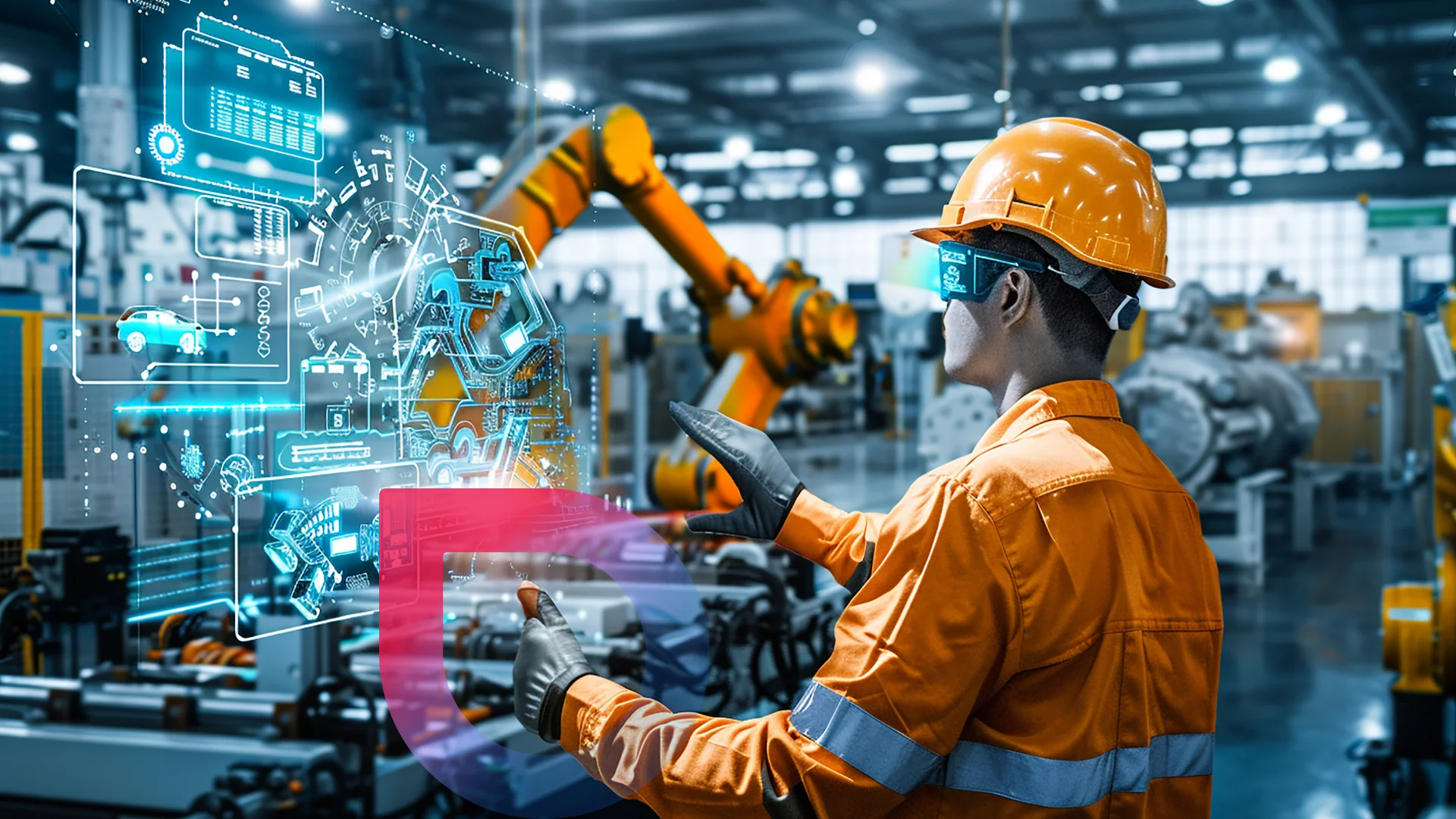
Artificial Intelligence (AI) in manufacturing represents a transformative shift from traditional, human-centric production methods to intelligent, data-driven systems. By leveraging advanced algorithms and real-time data processing, AI enables manufacturers to achieve unprecedented levels of precision, speed, and adaptability. Unlike conventional automation, which follows rigid programming, AI systems learn from data, adapt to changing conditions, and make autonomous decisions, thereby enhancing operational resilience and competitiveness. The integration of AI in manufacturing is part of the broader Industry 4.0 revolution, which emphasizes connectivity, automation, and intelligent decision-making. AI-powered tools are deployed across the entire manufacturing lifecycle—from design and prototyping to production, logistics, and after-sales service. This evolution is driven by the proliferation of Internet of Things (IoT) devices, cloud computing, and advancements in machine learning (ML), particularly deep learning and reinforcement learning. Manufacturers adopting AI solutions experience measurable improvements in productivity, quality, and sustainability. For instance, AI-driven predictive maintenance reduces unplanned downtime by up to 40%, while computer vision systems enhance defect detection accuracy to over 99%. These capabilities are critical in industries such as automotive, aerospace, and electronics, where precision and reliability are paramount.
#History / Background
The application of AI in manufacturing has evolved over several decades, shaped by technological advancements and industrial needs.
#Early Foundations (1960s–1980s)
The roots of AI in manufacturing trace back to the 1960s with the development of early expert systems and robotic arms in automotive assembly lines. One of the first notable applications was the use of rule-based systems for quality control and process optimization. However, these systems were limited by computational power and data availability.
#Rise of Computer-Aided Design and Manufacturing (1980s–1990s)
The 1980s saw the emergence of Computer-Aided Design (CAD) and Computer-Aided Manufacturing (CAM) systems, which laid the groundwork for digital integration in production. Concurrently, advancements in robotics—such as the Programmable Logic Controller (PLC)—enabled more flexible and automated production environments.
#The AI Winter and Revival (1990s–2000s)
During the 1990s, AI research experienced a period of reduced funding and interest, often referred to as the "AI winter." However, machine learning techniques like neural networks began to gain traction, particularly in pattern recognition tasks. The rise of data storage and processing capabilities in the early 2000s enabled the collection and analysis of large-scale manufacturing datasets.
#Industry 4.0 and the AI Boom (2010s–Present)
The 2010s marked a turning point with the advent of Industry 4.0, characterized by the convergence of AI, IoT, and cloud computing. The proliferation of sensors and connected devices allowed manufacturers to gather real-time data from production lines. Machine learning models—especially deep learning—became capable of processing this data to detect anomalies, predict equipment failures, and optimize workflows. Breakthroughs in computer vision enabled AI systems to perform visual inspections with human-like accuracy. Simultaneously, advancements in natural language processing (NLP) facilitated human-machine interaction through voice commands and chatbots in factory settings. Today, AI is a cornerstone of smart manufacturing, with applications spanning from generative design to autonomous robotics.
#How It Works
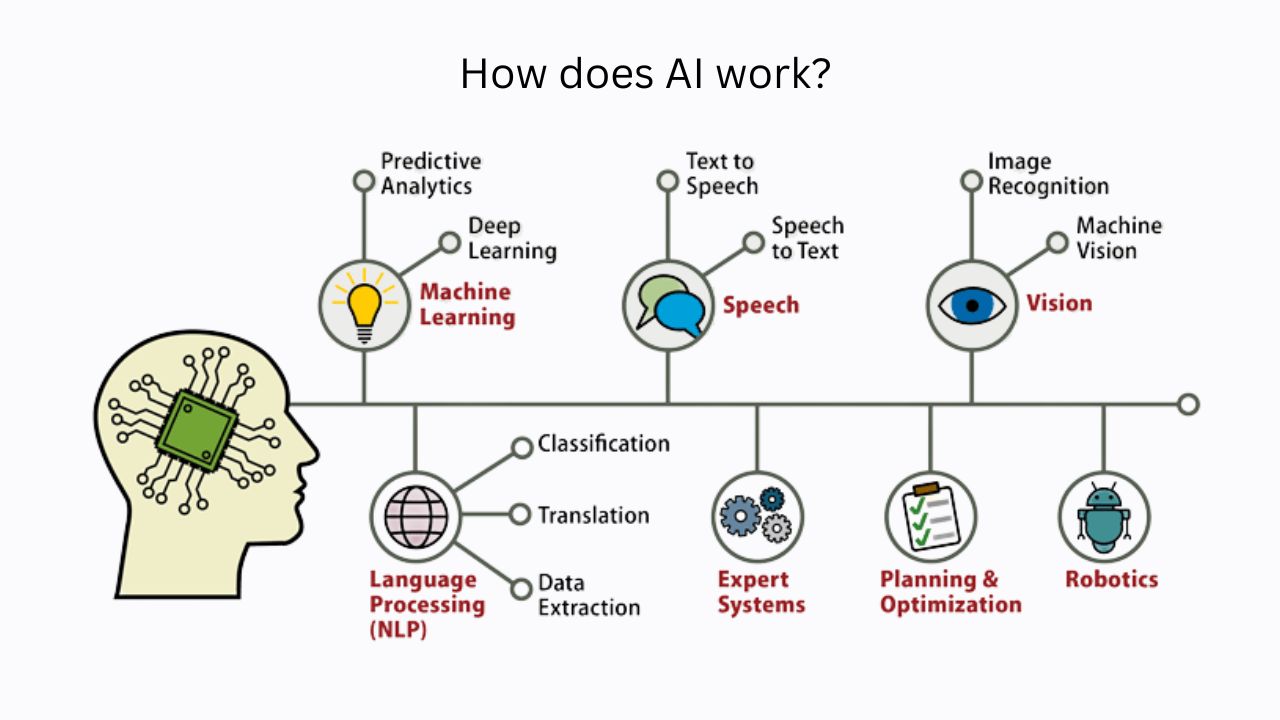
AI in manufacturing operates through a combination of data acquisition, processing, modeling, and actionable output. The process can be broken down into several key stages:
#
- Data Collection AI systems rely on high-quality, real-time data from multiple sources:
- Sensors and IoT Devices: Temperature, vibration, pressure, and flow sensors embedded in machinery provide continuous monitoring.
- Enterprise Systems: ERP, MES (Manufacturing Execution Systems), and SCADA (Supervisory Control and Data Acquisition) systems supply operational and logistical data.
- Historical Records: Past performance data, maintenance logs, and quality reports are used for training predictive models.
#
- Data Preprocessing and Integration Collected data is cleaned, normalized, and integrated into a unified data lake or warehouse. Techniques such as filtering, interpolation, and feature engineering are applied to prepare the data for modeling. Edge computing may be used to process data locally, reducing latency and bandwidth usage.
#
- Model Development and Training AI models are developed using various machine learning techniques:
- Supervised Learning: Used for classification and regression tasks, such as defect detection or demand forecasting. Models are trained on labeled datasets.
- Unsupervised Learning: Identifies patterns and anomalies without prior labels. Common in clustering and anomaly detection.
- Reinforcement Learning: Enables systems to learn optimal actions through trial and error, used in robotic control and dynamic scheduling.
- Deep Learning: Neural networks, including Convolutional Neural Networks (CNNs) for image analysis and Recurrent Neural Networks (RNNs) for time-series prediction, are widely used for complex tasks like visual inspection and predictive maintenance.
#
- Deployment and Real-Time Processing Trained models are deployed on cloud platforms, edge devices, or on-premise servers. Real-time inference engines process incoming data streams to generate predictions or trigger automated actions. For example: - A vibration sensor detects unusual patterns → AI model predicts bearing failure → maintenance alert is sent. - A camera captures a product image → CNN identifies a defect → robotic arm removes the faulty item.
#
- Human-Machine Collaboration AI systems often work alongside human operators. Human-in-the-loop (HITL) models allow workers to validate AI decisions, improving model accuracy over time. Augmented Reality (AR) interfaces may provide operators with real-time guidance based on AI insights.
#
- Continuous Improvement AI models are continuously updated using new data and feedback loops. Techniques like online learning and federated learning enable models to adapt to changing conditions without compromising data privacy.
#Important Facts
- Predictive Maintenance: AI can predict equipment failures up to 30 days in advance with 90% accuracy, reducing maintenance costs by up to 30%.
- Quality Control: Computer vision systems can detect defects with 99.9% accuracy, compared to 80–90% for human inspectors.
- Energy Efficiency: AI-driven optimization can reduce energy consumption in manufacturing by 10–20%.
- Supply Chain Resilience: AI enhances demand forecasting accuracy by up to 50%, reducing stockouts and excess inventory.
- Generative Design: AI tools like generative adversarial networks (GANs) can create thousands of design iterations based on performance criteria, accelerating innovation.
- Robotics: Collaborative robots (cobots) equipped with AI can work safely alongside humans, performing tasks like assembly, packaging, and inspection.
- Digital Twins: AI-powered digital twins simulate entire production lines, enabling virtual testing and optimization before physical implementation.
#Timeline
- Foundational ideas
Core concepts and early methods shape How Does AI in Manufacturing Work?.
- Practical use
Tools, examples, and real-world deployments make the topic easier to evaluate.
- Responsible implementation
Current work focuses on reliability, governance, performance, and measurable impact.
#Related Terms
#FAQ
What does How Does AI in Manufacturing Work? cover?
Explains how does ai in manufacturing work?, including the main process, tools, examples, risks, and practical implementation steps.
Why is How Does AI in Manufacturing Work? important?
It helps readers understand key concepts, compare practical use cases, and evaluate how Artificial Intelligence decisions affect outcomes, risks, and implementation choices.
What should readers verify before applying this topic?
Readers should compare benefits, limitations, data requirements, and related themes such as Does, AI, Manufacturing before using the ideas in real projects.
#References
- How Does AI in Manufacturing Work? terminology and background research
- How Does AI in Manufacturing Work? use cases, implementation examples, and limitations
- Artificial Intelligence best practices, standards, and risk guidance
- Does case studies, benchmarks, and current industry analysis
Comments
No comments yet. Start the discussion with a useful note.