

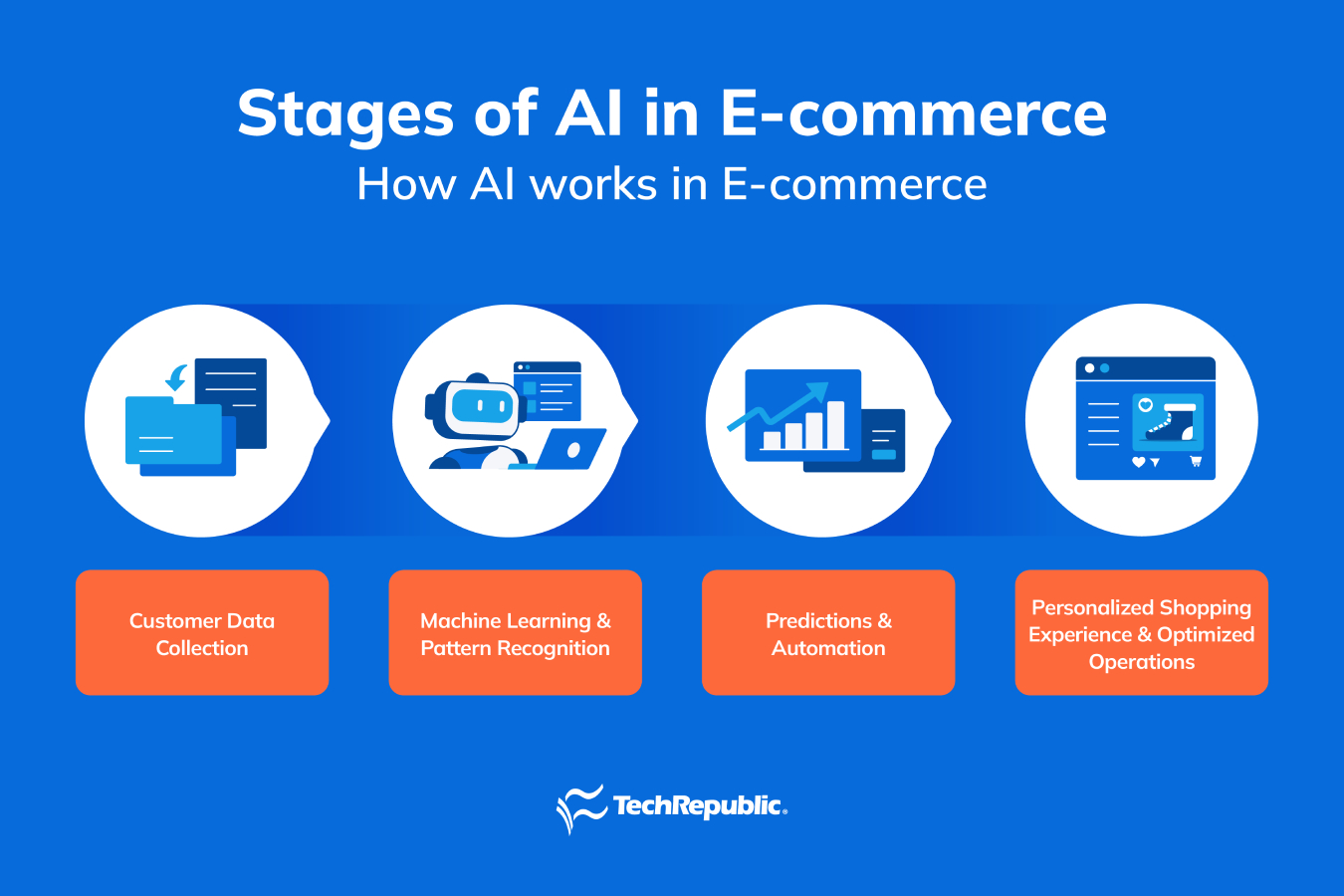
#Short Answer
Explains how AI works in e-commerce, covering data, models, workflows, practical examples, and adoption challenges.
#Infobox
AI in E-Commerce refers to the integration of artificial intelligence technologies—such as machine learning, natural language processing, and computer vision—into online retail platforms to enhance customer experiences, optimize operations, and drive sales through automation and data-driven insights.
AI in E-Commerce Field E-Commerce Focus Customer experience, sales optimization, inventory management Key Technologies Machine Learning, NLP, Computer Vision, Chatbots, Recommendation Systems Primary Applications Personalization, fraud detection, dynamic pricing, supply chain automation Adoption Rate ~60% of e-commerce businesses (2025)
#Overview
Artificial intelligence (AI) has become a transformative force in e-commerce, enabling businesses to automate processes, personalize customer interactions, and make data-driven decisions. By leveraging AI, online retailers can analyze vast amounts of data in real time, predict consumer behavior, and optimize every stage of the shopping journey—from product discovery to post-purchase support. The integration of AI in e-commerce spans multiple domains, including personalized recommendations, chatbots and virtual assistants, dynamic pricing, fraud detection, and supply chain management.
As consumer expectations evolve, AI-driven solutions help businesses stay competitive by delivering hyper-personalized experiences, reducing operational costs, and improving conversion rates. The global AI in e-commerce market is projected to grow significantly, driven by advancements in generative AI, computer vision, and predictive analytics.
#History / Background
#Early Developments (1990s–2000s)
The foundations of AI in e-commerce were laid in the 1990s with the rise of early online marketplaces like Amazon and eBay. Early AI applications included basic recommendation engines and fraud detection systems, which relied on rule-based algorithms to filter spam and suspicious transactions. During this period, businesses began experimenting with collaborative filtering—a technique that analyzes user behavior to suggest products based on similarities with other users.
#Rise of Machine Learning (2010s)
The 2010s marked a significant shift with the adoption of machine learning (ML) and deep learning in e-commerce. Companies like Amazon, Netflix, and Alibaba pioneered personalized recommendation systems that utilized neural networks to predict customer preferences with greater accuracy. The introduction of chatbots and virtual assistants (e.g., IBM Watson, Google Assistant) also gained traction, enabling 24/7 customer support.
Additionally, computer vision started playing a role in visual search (e.g., Pinterest Lens, Google Lens), allowing users to search for products using images rather than text. This decade also saw the emergence of dynamic pricing algorithms, which adjust prices in real time based on demand, competition, and user behavior.
#Modern Era (2020s–Present)
The 2020s have witnessed an explosion of AI advancements in e-commerce, driven by generative AI, large language models (LLMs), and autonomous systems. Key trends include:
- Hyper-Personalization: AI tailors product recommendations, email marketing, and website content to individual users using real-time data analysis.
- Voice Commerce: The integration of voice assistants (e.g., Alexa, Siri) into shopping platforms enables hands-free purchasing.
- AI-Powered Inventory Management: Predictive analytics help retailers optimize stock levels, reducing overstocking and stockouts.
- Augmented Reality (AR) & Virtual Try-Ons: AI-driven AR tools allow customers to visualize products (e.g., furniture, clothing) in their environment before buying.
- Autonomous Fulfillment: Robots and AI-driven logistics systems (e.g., Amazon’s Kiva robots) streamline warehouse operations and last-mile delivery.
The COVID-19 pandemic accelerated AI adoption in e-commerce, as businesses sought to automate processes and enhance digital customer experiences. Today, AI is no longer a luxury but a necessity for e-commerce competitiveness.
#How It Works
#Core AI Technologies in E-Commerce
AI in e-commerce relies on several foundational technologies, each serving distinct functions:
1. Machine Learning & Predictive Analytics
Machine learning algorithms analyze historical and real-time data to identify patterns and make predictions. Common applications include:
- Customer Segmentation: Grouping users based on behavior, demographics, or purchase history to tailor marketing strategies.
- Demand Forecasting: Predicting product demand to optimize inventory and supply chain operations.
- Churn Prediction: Identifying customers at risk of leaving to implement retention strategies.
2. Natural Language Processing (NLP)
NLP enables computers to understand, interpret, and generate human language. In e-commerce, it powers:
- Chatbots & Virtual Assistants: Handling customer queries, processing returns, and assisting with purchases (e.g., Sephora’s chatbot for beauty advice).
- Sentiment Analysis: Analyzing customer reviews and social media to gauge brand perception and improve products.
- Voice Search Optimization: Enhancing search results for voice-based queries (e.g., "Alexa, order more laundry detergent").
3. Computer Vision
Computer vision allows AI to interpret and analyze visual data, enabling:
- Visual Search: Users upload images to find similar products (e.g., ASOS’s "See My Fit" feature).
- Object Detection: Identifying products in images for automated tagging and categorization.
- Augmented Reality (AR) Try-Ons: Overlaying virtual products onto real-world environments (e.g., IKEA’s AR app for furniture placement).
4. Recommendation Systems
AI-driven recommendation engines suggest products based on user behavior, leveraging:
- Collaborative Filtering: Recommending items based on similar users' preferences (e.g., "Customers who bought X also bought Y").
- Content-Based Filtering: Suggesting products aligned with a user’s past interactions (e.g., recommending running shoes to a customer who frequently buys athletic wear).
- Hybrid Models: Combining multiple techniques for more accurate predictions (e.g., Netflix’s recommendation system).
5. Dynamic Pricing & Revenue Management
AI algorithms adjust prices in real time based on factors such as:
- Demand Elasticity: Increasing prices during high-demand periods (e.g., Black Friday).
- Competitor Pricing: Matching or undercutting rivals’ prices dynamically.
- User Behavior: Offering personalized discounts to high-value customers.
Companies like Uber and Amazon use dynamic pricing to maximize revenue and competitiveness.
6. Fraud Detection & Cybersecurity
AI enhances security by detecting fraudulent activities through:
- Anomaly Detection: Identifying unusual transaction patterns (e.g., sudden large purchases from a new location).
- Biometric Authentication: Using facial recognition or fingerprint scans for secure logins.
- Behavioral Biometrics: Analyzing typing speed and mouse movements to detect bots or hackers.
#Important Facts
- Personalization Boosts Sales: AI-driven product recommendations can increase conversion rates by up to 30% and average order value by 10–15%.
- Chatbots Improve Efficiency: Businesses using AI chatbots report a 30% reduction in customer service costs.
- Visual Search Growth: Over 60% of consumers prefer visual search over text-based search for product discovery.
- Dynamic Pricing Impact: Companies using AI for dynamic pricing see a 5–25% increase in revenue.
- Fraud Prevention Savings: AI fraud detection systems save e-commerce businesses an estimated $10 billion annually in chargebacks and losses.
- AR Adoption Rising: The AR market in retail is projected to reach $12.6 billion by 2025, driven by AI-powered try-on features.
- Supply Chain Optimization: AI reduces inventory costs by 10–40% and improves delivery times by optimizing logistics routes.
#Timeline
Year Milestone 1994 Amazon launches as an online bookstore, later pioneering recommendation systems. 1998 PayPal introduces AI-driven fraud detection to combat online payment scams. 2006 Netflix launches its $1 million recommendation algorithm competition (Netflix Prize). 2011 IBM Watson debuts, later integrating with e-commerce platforms for customer service. 2014 Amazon introduces Alexa, enabling voice-based shopping. 2016 Alibaba’s "FashionAI" uses computer vision for smart retail experiences. 2018 IKEA launches AR app for virtual furniture placement. 2020 COVID-19 pandemic accelerates AI adoption in e-commerce, with a 40% increase in chatbot usage. 2022 Generative AI tools (e.g., DALL·E, Midjourney) enable AI-generated product images and descriptions. 2023 Amazon unveils "Just Walk Out" cashier-less stores, powered by AI and computer vision. 2024 AI-driven "social commerce" platforms (e.g., TikTok Shop) integrate recommendation engines with live streaming. 2025 Over 60% of e-commerce businesses use AI for personalization, fraud detection, or inventory management.
#Related Terms
#FAQ
What does AI In E-Commerce: How It Works cover?
Explains how AI works in e-commerce, covering data, models, workflows, practical examples, and adoption challenges.
Why is AI In E-Commerce: How It Works important?
It helps readers understand key concepts, compare practical use cases, and evaluate how Business & Finance decisions affect outcomes, risks, and implementation choices.
What should readers verify before applying this topic?
Readers should compare the benefits, limitations, data requirements, and related themes such as Ecommerce, Work, Financial Technology before using the ideas in real projects.
#References
- AI In E-Commerce: How It Works terminology and background research
- AI In E-Commerce: How It Works use cases, implementation examples, and limitations
- Business & Finance best practices, standards, and risk guidance
- Ecommerce case studies, benchmarks, and current industry analysis

.png)
Comments
No comments yet. Start the discussion with a useful note.