

#Short Answer
Artificial Intelligence (AI) investments have surged in recent years, driven by breakthroughs in machine learning, natural language processing, and computer vision. The global AI market is projected to reach $1.8 trillion by 2030, with investments flowing into startups, research institutions, and established tech companies. Investors are particularly focused on generative AI, autonomous systems, and AI-driven automation, which are expected to redefine industries ranging from healthcare to finance.
#Infobox
#Overview
Artificial Intelligence (AI) investments have surged in recent years, driven by breakthroughs in machine learning, natural language processing, and computer vision. The global AI market is projected to reach $1.8 trillion by 2030, with investments flowing into startups, research institutions, and established tech companies. Investors are particularly focused on generative AI, autonomous systems, and AI-driven automation, which are expected to redefine industries ranging from healthcare to finance.
The investment ecosystem includes venture capital (VC) firms specializing in AI, corporate venture arms of tech giants, sovereign wealth funds, and high-net-worth individuals. Seed and early-stage funding dominate the landscape, with later-stage investments increasingly dominated by corporate investors and private equity firms. The rapid pace of AI advancements has led to compressed funding cycles, with some startups achieving unicorn status within months of founding.
#History / Background
#Early Developments
AI research dates back to the 1950s, but significant investment only began in the 1980s with the rise of expert systems and neural networks. Early AI investments were largely confined to academic institutions and government-funded projects, such as DARPA’s initiatives in the United States. The commercial potential of AI remained limited until the 2010s, when advancements in deep learning and the availability of large datasets enabled practical applications.
#The Rise of Venture Capital
The first major wave of AI-focused venture capital emerged in the mid-2010s, coinciding with breakthroughs in deep learning and the success of companies like Google DeepMind and NVIDIA. Firms such as Andreessen Horowitz and Sequoia Capital began dedicating specific funds to AI startups, recognizing the technology’s potential to disrupt multiple industries. The launch of generative AI models like GPT in 2018 further accelerated investment interest.
#The 2020s AI Boom
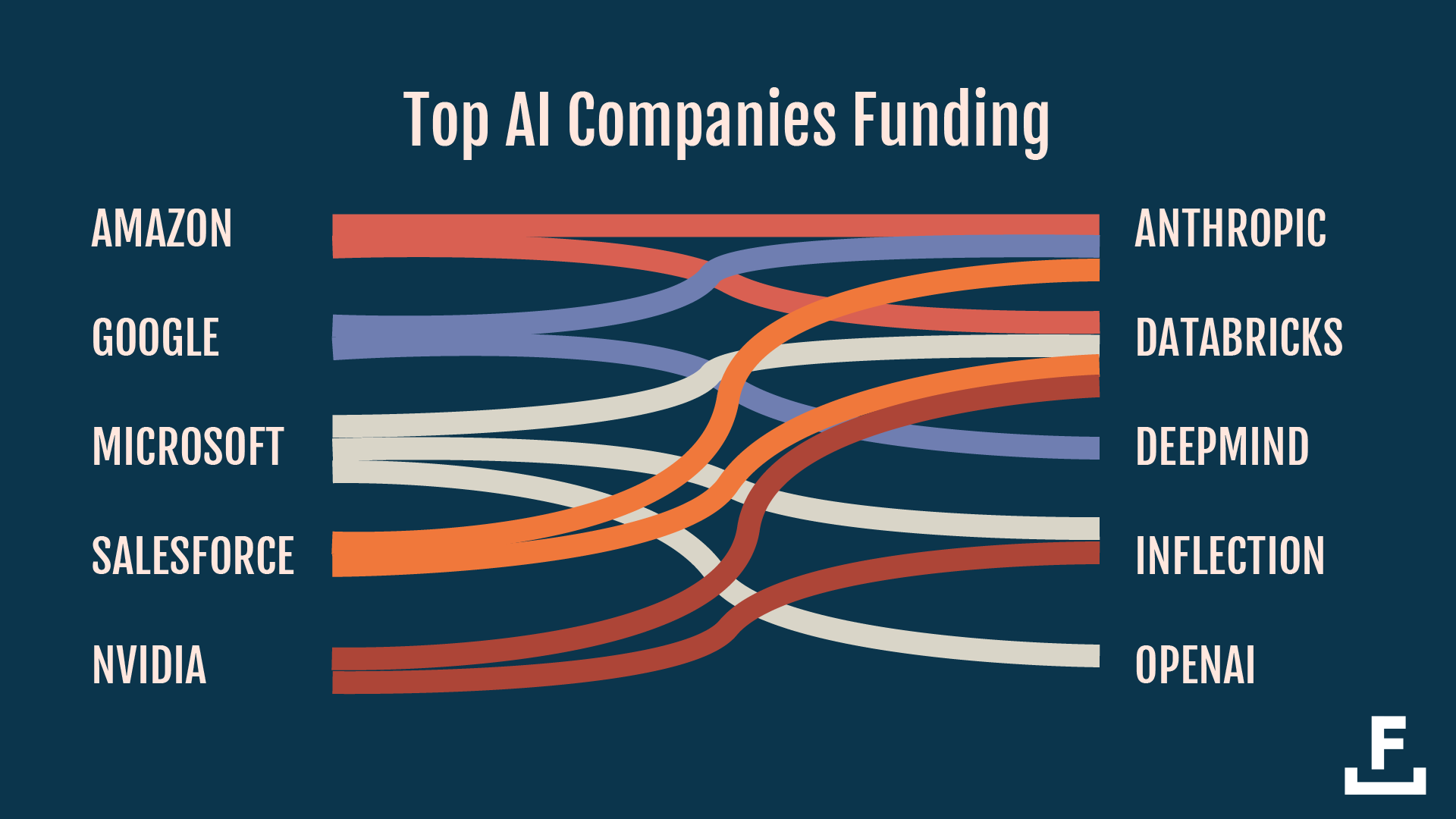
The 2020s have witnessed an unprecedented surge in AI investments, fueled by the commercialization of large language models (LLMs) and the entry of tech giants into the AI space. Companies like OpenAI, Anthropic, and Mistral AI have raised billions in funding, with valuations often exceeding traditional metrics due to their disruptive potential. Corporate investors, including Microsoft, Google, and Amazon, have played a pivotal role by providing both capital and strategic partnerships to AI startups.
#How It Works
#Investment Stages
AI investments typically follow a structured funding pipeline:
- Seed Funding: Early-stage capital (usually $500,000–$2 million) for proof-of-concept development, often sourced from angel investors or pre-seed VC funds.
- Series A: Larger rounds ($5–$20 million) to scale product development and market entry, led by specialized AI venture firms.
- Series B and Beyond: Expansion capital ($20–$100 million+) to accelerate growth, with participation from corporate investors and private equity.
- Late-Stage/Growth: Large investments ($100 million+) for scaling operations, often involving strategic partnerships with tech giants.
#Investor Types
The AI investment ecosystem comprises several key investor categories:
- Venture Capital Firms: Specialized funds like Lightspeed Venture Partners and Balderton Capital focus exclusively on AI startups.
- Corporate Investors: Tech giants such as Microsoft, Google, and Amazon invest directly in AI companies to integrate cutting-edge technologies into their platforms.
- Private Equity: Firms like Thoma Bravo acquire mature AI companies to optimize operations and scale.
- Sovereign Wealth Funds: Government-backed funds, such as Singapore’s Temasek Holdings, invest in AI to bolster national technological competitiveness.
- Angel Investors: High-net-worth individuals with expertise in AI often provide early-stage funding and mentorship.
#Valuation Metrics
AI startups are often valued based on metrics beyond traditional revenue models:
- Model Performance: Benchmark scores on AI tasks (e.g., language understanding, image generation).
- Talent Acquisition: Hiring of top researchers from institutions like MIT or Stanford.
- Strategic Partnerships: Collaborations with cloud providers (AWS, Azure) or enterprise software companies.
- User Growth: Adoption rates of AI-powered products or services.
#Important Facts
- The global AI startup ecosystem has raised over $200 billion in funding since 2010.
- The United States accounts for 70% of global AI investments, followed by China (15%) and Europe (10%).
- Generative AI startups: received over $10 billion in funding in 2023 alone.
- The median AI startup valuation has increased by 300% since 2020.
- Corporate investors: now account for 40% of late-stage AI funding.
- The average time from seed to Series A funding in AI has decreased from 24 months to 12 months.
- AI chip startups: like NVIDIA’s competitors have attracted $5 billion in funding in 2023.
#Timeline
- AlexNet wins ImageNet competit
AlexNet wins ImageNet competition, sparking renewed interest in deep learning.
- Google acquires DeepMind for
Google acquires DeepMind for $500 million, signaling corporate interest in AI.
- OpenAI is founded as
OpenAI is founded as a non-profit AI research lab.
- GPT-1 is released by
GPT-1 is released by OpenAI, demonstrating the potential of large language models.
- AI startup funding reaches
AI startup funding reaches $30 billion globally.
- Microsoft invests $1 billion
Microsoft invests $1 billion in OpenAI, followed by a $10 billion commitment in 2023.
- Stable Diffusion and DALL·E
Stable Diffusion and DALL·E 2 popularize generative AI, leading to a surge in startup funding.
- Global AI funding exceeds
Global AI funding exceeds $50 billion, with generative AI startups receiving $15 billion.
- Mistral AI raises $1.1
Mistral AI raises $1.1 billion at a $2 billion valuation, highlighting Europe’s growing AI ecosystem.
#Related Terms
#FAQ
What does AI Investments: Who’s Funding What? cover?
AI investments: who’s funding what covers practical examples, benefits, limitations, and important considerations for readers.
Why is AI Investments: Who’s Funding What? important?
It helps readers understand key concepts, compare practical use cases, and evaluate how Business & Finance decisions affect outcomes, risks, and implementation choices.
What should readers verify before applying this topic?
Readers should compare the benefits, limitations, data requirements, and related themes such as Investment, Funding, Financial Technology before using the ideas in real projects.
#References
- AI Investments: Who’s Funding What? terminology and background research
- AI Investments: Who’s Funding What? use cases, implementation examples, and limitations
- Business & Finance best practices, standards, and risk guidance
- Investment case studies, benchmarks, and current industry analysis
.png)



Comments
No comments yet. Start the discussion with a useful note.