

#Short Answer
Explains how AI works in banking, covering data, models, workflows, practical examples, and adoption challenges.
#Infobox
Artificial intelligence in banking refers to the application of AI technologies to enhance financial services, improve decision-making, and automate processes.
Artificial intelligence in banking Field Banking Focus Customer service, fraud detection, risk assessment, process automation Key Technologies Machine learning, natural language processing, robotic process automation, predictive analytics Major Applications Chatbots, credit scoring, algorithmic trading, personalized banking Adoption Rate High (growing rapidly since 2015) Regulatory Challenges Data privacy, algorithmic bias, compliance with financial regulations
#Overview
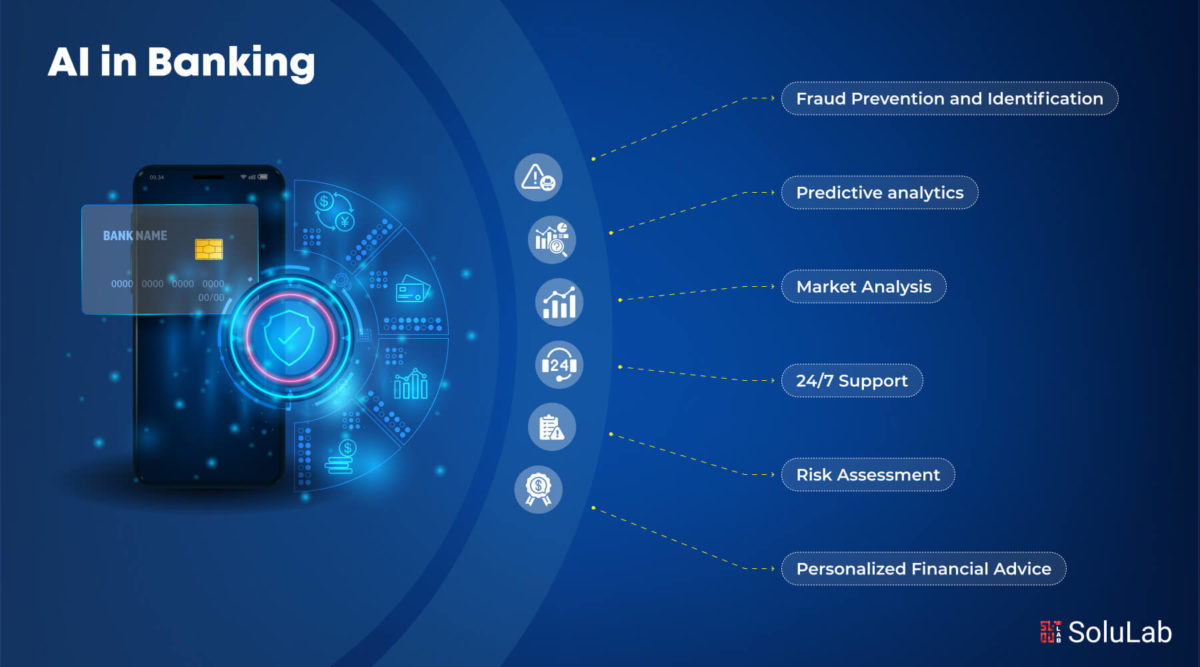
Artificial intelligence (AI) in banking encompasses the integration of AI technologies—such as machine learning, natural language processing (NLP), and robotic process automation (RPA)—into financial institutions to streamline operations, enhance customer experiences, and mitigate risks. AI systems analyze vast datasets in real time, enabling banks to make data-driven decisions, detect fraudulent activities, and offer personalized financial products. The adoption of AI in banking has accelerated due to advancements in computing power, the proliferation of big data, and increasing consumer demand for seamless digital banking experiences.
AI-driven banking solutions span multiple domains, including customer service automation through chatbots, credit risk assessment using predictive models, algorithmic trading for portfolio management, and anti-money laundering (AML) compliance monitoring. By leveraging AI, banks can reduce operational costs, improve accuracy in decision-making, and deliver 24/7 customer support without human intervention. However, the implementation of AI also introduces challenges such as data privacy concerns, regulatory compliance, and the need for explainable AI to ensure transparency in automated decisions.
#History / Background
The roots of AI in banking trace back to the 1980s and 1990s, when early expert systems were used for credit scoring and fraud detection. One of the first notable applications was the development of FICO scores in 1989, which utilized statistical models to assess creditworthiness. During the 1990s, banks began experimenting with neural networks for risk management and customer segmentation.
The early 2000s saw a surge in AI adoption with the rise of data mining techniques and the availability of larger datasets. Financial institutions started using AI for algorithmic trading, where machine learning algorithms analyzed market trends to execute trades automatically. The 2010s marked a turning point with the advent of deep learning and the integration of NLP in customer service, exemplified by the deployment of AI-powered chatbots by major banks such as Bank of America and JPMorgan Chase.
In 2018, the European Union's General Data Protection Regulation (GDPR) introduced stricter data privacy rules, prompting banks to adopt more transparent and ethical AI practices. The COVID-19 pandemic further accelerated digital transformation, as remote banking and contactless services became essential. Today, AI in banking is a multi-billion-dollar industry, with institutions investing heavily in AI research and development to stay competitive.
#How It Works
#Machine Learning and Predictive Modeling
Machine learning (ML) algorithms are the backbone of AI in banking. Supervised learning models, such as logistic regression and random forests, are commonly used for credit scoring and loan approvals. These models analyze historical data—including transaction history, income levels, and credit reports—to predict the likelihood of default. Unsupervised learning techniques, such as clustering, help banks segment customers based on spending patterns, enabling targeted marketing campaigns.
Deep learning, a subset of ML, powers more complex applications like fraud detection. Convolutional neural networks (CNNs) and recurrent neural networks (RNNs) analyze transactional data in real time to identify anomalies that may indicate fraudulent activity. For example, an AI system might flag a transaction as suspicious if it deviates significantly from a customer's typical spending behavior.
#Natural Language Processing
NLP enables banks to process and understand human language, facilitating applications such as chatbots and sentiment analysis. AI-powered chatbots, like Erica (used by Bank of America), interact with customers via text or voice to answer queries, provide financial advice, and assist with transactions. Sentiment analysis tools monitor social media and customer reviews to gauge public perception of a bank's services, helping institutions address concerns proactively.
NLP is also used in document processing, where AI systems extract key information from loan applications, contracts, and compliance reports, reducing manual data entry errors and speeding up workflows.
#Robotic Process Automation
RPA involves the use of software robots to automate repetitive, rule-based tasks such as data entry, account reconciliation, and report generation. In banking, RPA reduces operational costs and minimizes human errors. For instance, RPA can automatically process loan applications by extracting data from submitted forms, verifying information against databases, and updating customer records—all without human intervention. Banks like HSBC and Deutsche Bank have deployed RPA to handle millions of transactions daily, significantly improving efficiency.
#Computer Vision
Computer vision technology is employed in banking for tasks such as check processing and identity verification. Optical character recognition (OCR) systems scan and extract data from physical checks, while facial recognition and fingerprint scanning enhance security in mobile banking apps. For example, Apple Pay and Google Pay use biometric authentication powered by computer vision to authorize transactions securely.
#Important Facts
- Efficiency Gains: AI can process transactions up to 90% faster than traditional methods, reducing operational costs by up to 30%.
- Fraud Reduction: AI-powered fraud detection systems can identify and prevent fraudulent transactions with over 95% accuracy.
- Customer Personalization: Banks using AI report a 20-30% increase in customer engagement due to personalized product recommendations.
- Regulatory Compliance: AI helps banks comply with regulations like AML and KYC by automating monitoring and reporting.
- Job Displacement vs. Creation: While AI automates routine tasks, it also creates new roles in AI development, data science, and cybersecurity.
- Global Adoption: Over 80% of banks have implemented some form of AI, with the Asia-Pacific region leading in adoption rates.
- Explainable AI: Regulatory bodies increasingly require banks to use explainable AI models to ensure transparency in automated decisions.
#Timeline
Year Event 1989 Introduction of the FICO credit scoring model. 1990s Early use of neural networks for risk assessment in banking. 2000 First AI-driven algorithmic trading systems deployed by hedge funds. 2006 Banks begin using data mining for customer segmentation. 2011 IBM's Watson AI system debuts, later applied to financial advisory services. 2016 Bank of America launches Erica, one of the first AI-powered banking assistants. 2018 GDPR comes into effect, influencing AI ethics and data privacy in banking. 2020 COVID-19 pandemic accelerates digital banking and AI adoption. 2022 JPMorgan Chase deploys AI for real-time fraud detection across global transactions. 2023 Over 60% of banks worldwide use AI for at least one core function.
#Related Terms
#FAQ
What does AI In Banking: How It Works cover?
Explains how AI works in banking, covering data, models, workflows, practical examples, and adoption challenges.
Why is AI In Banking: How It Works important?
It helps readers understand key concepts, compare practical use cases, and evaluate how Business & Finance decisions affect outcomes, risks, and implementation choices.
What should readers verify before applying this topic?
Readers should compare the benefits, limitations, data requirements, and related themes such as Banking, Work, Financial Technology before using the ideas in real projects.
#References
- AI In Banking: How It Works terminology and background research
- AI In Banking: How It Works use cases, implementation examples, and limitations
- Business & Finance best practices, standards, and risk guidance
- Banking case studies, benchmarks, and current industry analysis
Comments
No comments yet. Start the discussion with a useful note.