

#Short Answer
Shows how AI can support dummies through a beginner’s overview, including tools, examples, benefits, and responsible-use tips.
#Infobox
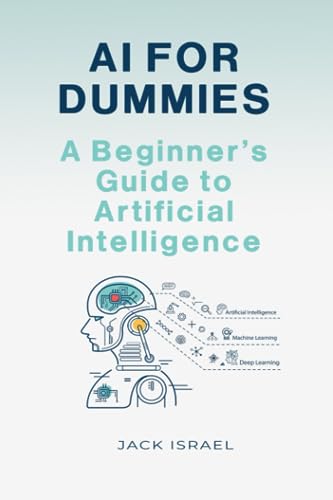
AI for Dummies: A Beginner’s Guide to Artificial Intelligence is an introductory book designed to simplify complex AI concepts for newcomers. It covers foundational topics such as machine learning, neural networks, and real-world applications, making it accessible to readers without prior technical expertise.
AI for Dummies: A Beginner’s Guide to Artificial Intelligence Book Information Author Jack Subject Artificial Intelligence Publisher Not specified Publication Date Not specified Pages Not specified ISBN Not specified Language English
#Overview
AI for Dummies: A Beginner’s Guide to Artificial Intelligence serves as an entry-level resource for individuals seeking to understand the fundamentals of artificial intelligence. The book breaks down intricate topics such as algorithms, data processing, and AI applications into digestible explanations, catering to readers with little to no background in computer science or mathematics. It emphasizes practical examples and avoids excessive jargon, ensuring clarity for a broad audience.
The guide is structured to progress logically from basic definitions to more advanced concepts, making it suitable for self-study or supplementary learning. Topics covered include supervised and unsupervised learning, natural language processing, and ethical considerations in AI development. By the end of the book, readers are expected to grasp core AI principles and their implications in modern technology.
#History / Background
The publication of introductory guides like AI for Dummies reflects the growing demand for accessible AI education amid the technology’s rapid expansion. Artificial intelligence has evolved from theoretical research in the mid-20th century to a ubiquitous tool in various industries, including healthcare, finance, and entertainment. Early AI literature often assumed advanced technical knowledge, leaving many enthusiasts and professionals struggling to keep pace with developments.
In response, publishers began releasing beginner-friendly resources to democratize AI education. These books typically aim to bridge the gap between academic research and public understanding, often incorporating real-world case studies and interactive elements. The rise of online learning platforms and open-source tools has further fueled this trend, making AI more approachable than ever before.
#How It Works
AI for Dummies introduces artificial intelligence by first defining key terms and then illustrating how AI systems operate. The book starts with an explanation of what AI is—machines performing tasks that typically require human intelligence—and proceeds to explore the mechanisms behind these capabilities.
#Core Concepts
- Machine Learning: A subset of AI where algorithms learn from data without explicit programming. The book likely covers supervised learning (training on labeled data) and unsupervised learning (finding patterns in unlabeled data).
- Neural Networks: Inspired by the human brain, these computational models consist of interconnected nodes (neurons) that process information. The guide may simplify concepts like backpropagation and deep learning.
- Natural Language Processing (NLP): Enables machines to understand and generate human language. Examples include chatbots and translation tools, which the book may use to demonstrate practical applications.
- Data and Algorithms: AI systems rely on vast datasets and algorithms to make predictions or decisions. The book likely explains how data quality and algorithm choice impact performance.
#Practical Applications
The guide emphasizes real-world uses of AI, such as:
- Recommendation systems (e.g., streaming services, e-commerce).
- Autonomous vehicles and robotics.
- Fraud detection in banking.
- Personal assistants (e.g., voice-activated devices).
By focusing on applications, the book helps readers connect theoretical concepts to tangible outcomes, reinforcing their understanding of AI’s role in society.
#Important Facts
- Accessibility: The book is designed for readers with no prior AI or programming experience.
- Scope: Covers a wide range of AI topics, from basic definitions to ethical debates.
- Practical Focus: Includes examples and exercises to reinforce learning.
- Industry Relevance: AI is transforming sectors like healthcare (diagnostics), finance (risk assessment), and transportation (autonomous vehicles).
- Ethical Considerations: Discusses biases in AI, privacy concerns, and the societal impact of automation.
- Future Trends: May touch on emerging fields like generative AI (e.g., text-to-image models) and quantum computing.
#Timeline
Year Event 1950s Foundational work on AI begins, with early programs like the Logic Theorist and ELIZA. 1980s–1990s Expert systems gain popularity, but AI research faces funding challenges ("AI winter"). 2000s Machine learning resurges with advances in data availability and computational power. 2010s Deep learning breakthroughs (e.g., AlexNet, AlphaGo) revolutionize AI applications. 2020s Generative AI (e.g., DALL·E, ChatGPT) becomes mainstream, raising ethical and regulatory debates.
#Related Terms
#FAQ
What does AI For Dummies: A Beginner’s Overview cover?
Shows how AI can support dummies through a beginner’s overview, including tools, examples, benefits, and responsible-use tips.
Why is AI For Dummies: A Beginner’s Overview important?
It helps readers understand key concepts, compare practical use cases, and evaluate how Artificial Intelligence decisions affect outcomes, risks, and implementation choices.
What should readers verify before applying this topic?
Readers should compare the benefits, limitations, data requirements, and related themes such as Beginner Friendly, Dummie, AI Applications before using the ideas in real projects.
#References
- AI For Dummies: A Beginner’s Overview terminology and background research
- AI For Dummies: A Beginner’s Overview use cases, implementation examples, and limitations
- Artificial Intelligence best practices, standards, and risk guidance
- Beginner Friendly case studies, benchmarks, and current industry analysis


Comments
No comments yet. Start the discussion with a useful note.