

#Short Answer
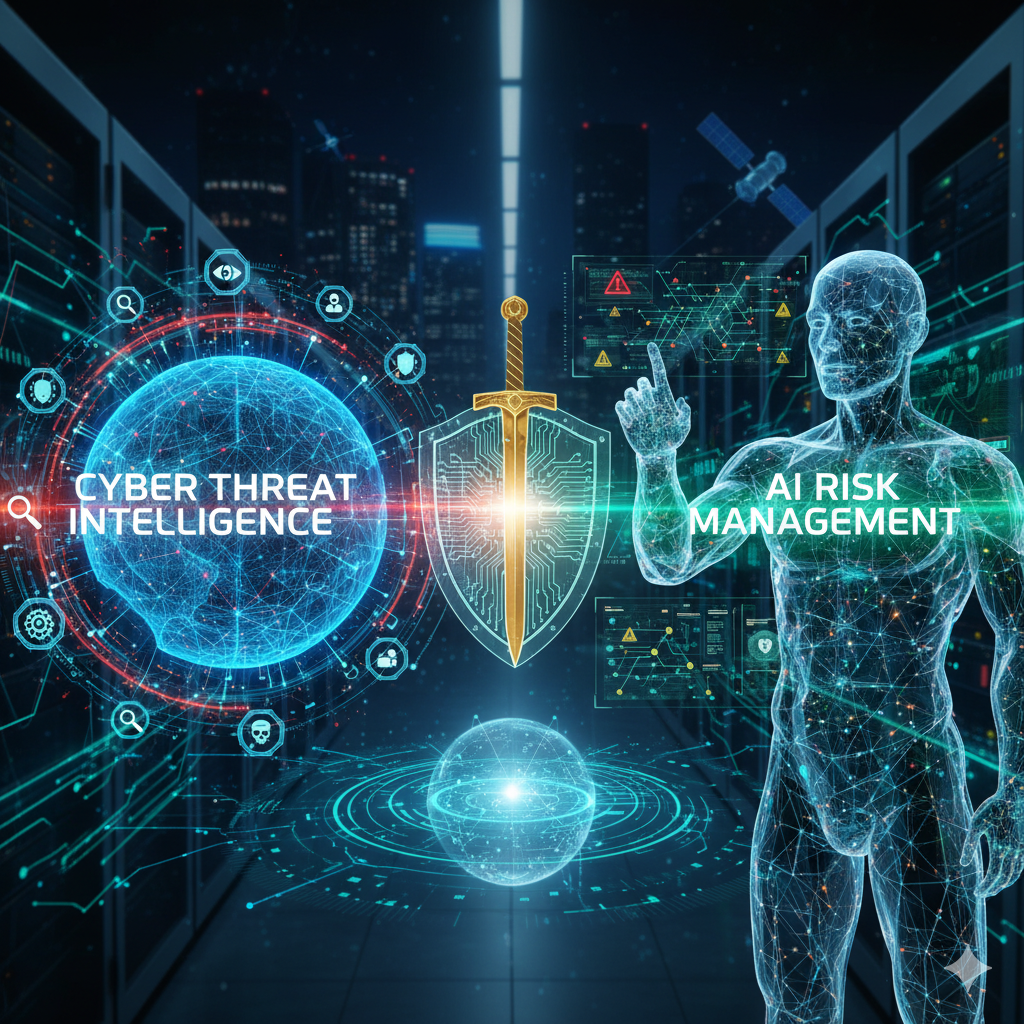
Explores how artificial intelligence shapes risk and managing threats, covering practical use cases, benefits, limitations, and risks.
#Infobox
Artificial Intelligence and Risk Management Field Artificial intelligence, Risk management Key Figures Nick Bostrom, Stuart Russell, Andrew Ng, Yoshua Bengio Applications Cybersecurity, Financial Services, Healthcare, Autonomous Systems Notable Organizations OpenAI, DeepMind, NIST, IEEE First Introduced 2010s (formalized risk frameworks) Related Fields Machine learning, Cyber threat intelligence, AI ethics
#Overview
Artificial Intelligence (AI) has transformed industries by enabling automation, predictive analytics, and intelligent decision-making. However, its integration introduces significant risks, including security vulnerabilities, ethical dilemmas, and operational failures. AI risk management is the structured process of identifying potential threats, evaluating their impact, and implementing controls to minimize harm. This field intersects with cybersecurity, regulatory compliance, and AI governance to ensure responsible deployment.
Key areas of focus include adversarial AI, where malicious actors exploit AI systems, data privacy risks from large-scale data collection, and algorithmic bias, which can lead to discriminatory outcomes. Effective risk management frameworks, such as the NIST AI Risk Management Framework, provide guidelines for organizations to assess and mitigate these risks systematically.
#History / Background
The concept of managing risks in AI emerged alongside early advancements in machine learning and autonomous systems. In the 2010s, as AI applications expanded into critical domains like healthcare and finance, concerns about safety and reliability grew. The 2016 AlphaGo match highlighted AI's potential but also raised questions about unpredictability in complex systems.
Formal risk management frameworks began to take shape in the late 2010s, with organizations like the IEEE and European Commission publishing guidelines for ethical AI. The GDPR (2018) introduced legal requirements for data protection, indirectly influencing AI risk practices. By 2020, governments and corporations started adopting dedicated AI risk management strategies, recognizing the need for proactive measures.
#How It Works
#Risk Identification
Risk identification involves cataloging potential threats to AI systems. Common risks include:
- Adversarial Attacks: Manipulation of AI inputs (e.g., data poisoning) to deceive models.
- Model Drift: Degradation of AI performance over time due to changing data patterns.
- Bias and Fairness: Systemic errors in AI outputs that disadvantage certain groups.
- Explainability Gaps: Lack of transparency in AI decision-making processes.
- Regulatory Non-Compliance: Failure to adhere to laws like GDPR or sector-specific regulations.
Techniques such as threat modeling, stress testing, and red teaming are used to uncover vulnerabilities.
#Risk Assessment
Once identified, risks are evaluated based on their likelihood and impact. Quantitative methods (e.g., risk matrices) and qualitative assessments (e.g., expert judgment) help prioritize threats. Tools like failure mode and effects analysis (FMEA) are employed to quantify potential harm.
For example, an AI-driven loan approval system might assess the risk of bias by analyzing demographic disparities in approval rates. High-risk scenarios trigger further investigation or mitigation strategies.
#Risk Mitigation
Mitigation strategies vary by risk type:
- Technical Controls: Robust encryption, adversarial training, and model monitoring.
- Governance Frameworks: Policies for AI development, such as the EU AI Act.
- Ethical Guidelines: Principles like fairness, accountability, and transparency (FAT).
- Continuous Monitoring: Real-time detection of anomalies via AI-driven security tools.
Collaboration between AI developers, ethicists, and regulators is essential to balance innovation with safety.
#Important Facts
- Adversarial AI: In 2018, researchers demonstrated that minor perturbations to images could trick AI vision systems into misclassifying objects with 99% confidence.
- AI in Cybersecurity: Over 60% of organizations use AI for threat detection, but 30% report increased vulnerability to AI-powered attacks (source: Gartner, 2023).
- Regulatory Landscape: The EU AI Act (2024) classifies AI systems into risk tiers, imposing stricter requirements for high-risk applications.
- Bias in Hiring AI: A 2018 study found that AI recruitment tools favored male candidates due to biased training data (source: MIT Technology Review).
- AI Incident Database: The Partnership on AI maintains a repository of AI-related failures to inform best practices.
#Timeline
Year Event 2012 AlexNet wins ImageNet competition, sparking interest in deep learning risks. 2016 AlphaGo defeats Lee Sedol, raising concerns about AI unpredictability. 2018 GDPR enforces data protection laws, influencing AI risk practices. 2020 NIST publishes the first AI Risk Management Framework draft. 2021 White House releases the Blueprint for an AI Bill of Rights. 2023 EU reaches political agreement on the EU AI Act. 2024 NIST finalizes the AI Risk Management Framework (AI RMF 1.0).
#Related Terms
#FAQ
What does AI And Risk: Managing Threats cover?
Explores how artificial intelligence shapes risk and managing threats, covering practical use cases, benefits, limitations, and risks.
Why is AI And Risk: Managing Threats important?
It helps readers understand key concepts, compare practical use cases, and evaluate how Healthcare AI decisions affect outcomes, risks, and implementation choices.
What should readers verify before applying this topic?
Readers should compare the benefits, limitations, data requirements, and related themes such as Risk, Managing, Threat before using the ideas in real projects.
#References
- AI And Risk: Managing Threats terminology and background research
- AI And Risk: Managing Threats use cases, implementation examples, and limitations
- Healthcare AI best practices, standards, and risk guidance
- Risk case studies, benchmarks, and current industry analysis


Comments
No comments yet. Start the discussion with a useful note.