

#Short Answer
Examines key questions about AI and job displacement, including current uses, likely impacts, benefits, limitations, and risks.
#Infobox
Artificial Intelligence and Job Displacement Field Artificial intelligence Focus Impact on employment and workforce dynamics Notable Effects Job displacement, creation, and transformation across industries Key Industries Affected Manufacturing, customer service, healthcare, finance, transportation Estimated Displacement Rate (2025) ~15-20% of routine-based roles Estimated Job Creation Rate (2025) ~10-12% in AI-driven sectors
Artificial Intelligence and job displacement refers to the automation of tasks traditionally performed by humans, leading to shifts in employment across industries. This phenomenon has accelerated in the 2020s, reshaping workforce dynamics and creating both challenges and opportunities.
#Overview
Artificial Intelligence (AI) and job displacement describe the process where AI systems, including machine learning, robotics, and natural language processing, automate tasks previously handled by human workers. This transformation is driven by advancements in computing power, data availability, and algorithmic efficiency. While AI enhances productivity and enables new industries, it also disrupts traditional employment patterns, particularly in roles involving repetitive, predictable, or data-driven tasks.
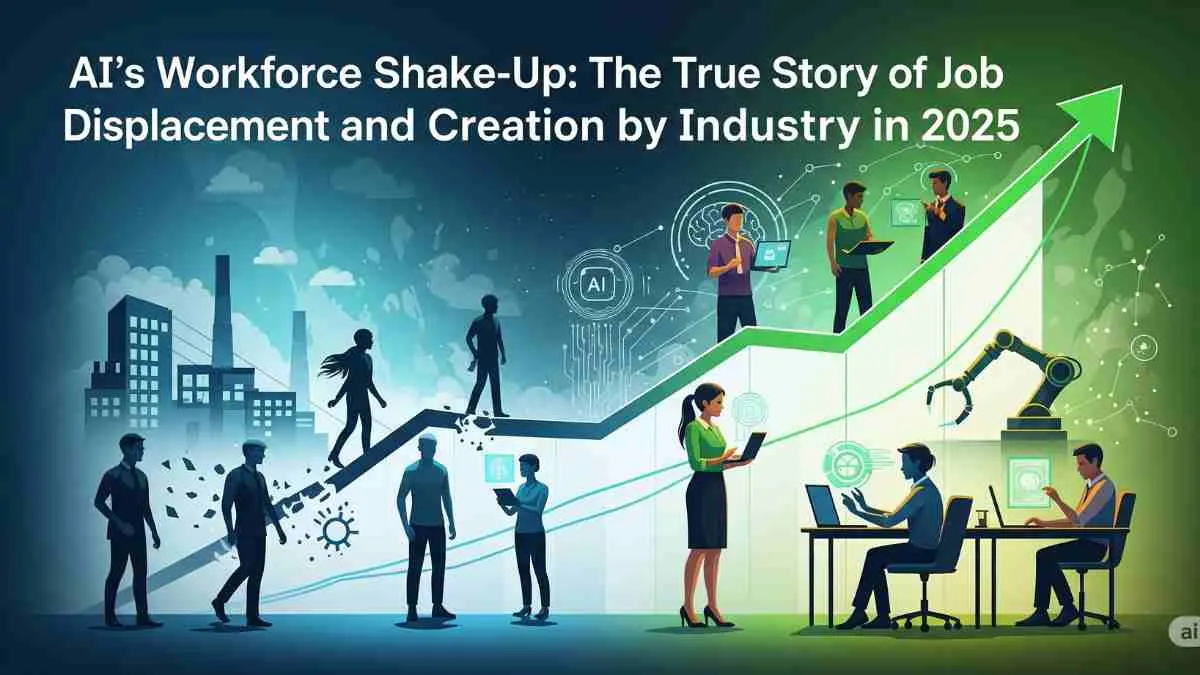
By 2025, AI-driven automation is expected to displace approximately 15-20% of routine-based jobs globally, while simultaneously creating 10-12% new roles in AI-related fields such as data science, AI ethics, and system maintenance. The net impact varies by sector, with manufacturing and administrative roles facing higher displacement risks, while healthcare, education, and creative industries see more gradual transformation.
#History / Background
#Early Automation
The concept of machines replacing human labor dates back to the Industrial Revolution, when mechanized looms and steam engines reduced the need for manual weaving and factory work. However, the digital revolution of the late 20th century marked a turning point, with computers automating clerical and data processing tasks. Early AI systems in the 1980s and 1990s, such as expert systems, began to perform decision-making roles in niche industries like finance and healthcare.
#Rise of AI and Machine Learning
The 2010s witnessed a surge in AI capabilities, fueled by breakthroughs in deep learning and neural networks. Companies like Google, Amazon, and Tesla integrated AI into core operations, automating tasks such as image recognition, speech processing, and autonomous navigation. The proliferation of big data and cloud computing further accelerated AI adoption, enabling systems to learn from vast datasets and improve over time.
By 2020, AI-driven tools like chatbots, robotic process automation (RPA), and predictive analytics became commonplace in customer service, supply chain management, and financial forecasting. The COVID-19 pandemic (2020–2022) accelerated digital transformation, pushing businesses to adopt AI solutions to maintain operations during lockdowns and remote work scenarios.
#2020s: Accelerated Displacement and Transformation
In the early 2020s, AI systems began to encroach on higher-skilled roles, including legal research, medical diagnostics, and software development. Companies like IBM and Microsoft introduced AI-powered tools that could draft contracts, analyze medical scans, and generate code. Governments and labor organizations started issuing reports on the potential societal impacts, with estimates suggesting that up to 30% of jobs could be automated by 2030.
By 2025, the integration of generative AI—capable of creating text, images, and even music—further blurred the lines between human and machine output. Industries like journalism, marketing, and graphic design saw significant shifts as AI tools became capable of producing publishable content. Meanwhile, sectors like renewable energy and AI ethics emerged as new growth areas, offering opportunities for workforce adaptation.
#How It Works
#Automation Technologies
AI-driven job displacement operates through several key technologies:
- Robotic Process Automation (RPA): Software robots mimic human interactions with digital systems to perform repetitive tasks such as data entry, invoice processing, and customer inquiries.
- Machine Learning (ML): Algorithms analyze patterns in data to make predictions or decisions, such as credit scoring, fraud detection, or personalized recommendations.
- Natural Language Processing (NLP): Systems like chatbots and virtual assistants understand and generate human language, automating customer service, content creation, and translation.
- Computer Vision: AI analyzes visual data from cameras or images, enabling applications like autonomous vehicles, quality control in manufacturing, and medical imaging.
- Generative AI: Models like large language models (LLMs) and diffusion-based image generators create new content, reducing the need for human writers, designers, and developers.
#Industry-Specific Impacts
The extent of AI-driven displacement varies by industry:
- Manufacturing: Robots and AI-driven assembly lines reduce the need for manual labor, particularly in automotive and electronics production.
- Customer Service: Chatbots and virtual assistants handle routine inquiries, decreasing the demand for human agents in call centers.
- Healthcare: AI assists in diagnostics, drug discovery, and patient monitoring, but also creates new roles in AI system oversight and data management.
- Finance: Algorithmic trading, fraud detection, and automated advisory services (robo-advisors) reduce the need for traditional financial analysts and brokers.
- Transportation: Autonomous vehicles threaten jobs in trucking, taxi services, and delivery, while increasing demand for AI engineers and safety regulators.
- Creative Industries: Generative AI tools like DALL-E and Midjourney produce artwork, music, and written content, impacting graphic designers, musicians, and journalists.
#Important Facts
- Displacement vs. Transformation: While some jobs are eliminated, many roles are transformed rather than fully replaced. For example, radiologists may shift from interpreting scans to overseeing AI-assisted diagnostics.
- Skill Gaps: The demand for AI-related skills (e.g., machine learning, data analysis, AI ethics) is growing faster than the supply, creating a talent shortage in tech-driven sectors.
- Geographical Variations: Developed economies with advanced AI adoption (e.g., United States, Japan, Germany) face higher displacement rates, while developing nations may see slower but long-term impacts as AI diffuses globally.
- Policy Responses: Governments are implementing measures such as universal basic income (UBI) pilots, reskilling programs, and AI regulation to mitigate displacement effects.
- Economic Productivity: Studies suggest that AI-driven automation could boost global productivity by 1.5–3% annually, though benefits may not be evenly distributed across industries or regions.
- Ethical Concerns: Issues like algorithmic bias, job market inequality, and the psychological impact of automation on workers have prompted calls for ethical AI frameworks and corporate accountability.
#Timeline
Year Event 1950s Early AI research begins with the Turing Test and symbolic AI systems. 1980s Expert systems are deployed in industries like finance and healthcare. 2000s Machine learning gains traction with applications in recommendation systems (e.g., Netflix, Amazon). 2011 IBM's Watson wins Jeopardy!, demonstrating advanced natural language processing. 2016 AlphaGo defeats a world champion Go player, showcasing deep learning's potential. 2020 COVID-19 pandemic accelerates AI adoption in remote work, telemedicine, and supply chain automation. 2022 Generative AI tools like DALL-E and Stable Diffusion become publicly accessible, disrupting creative industries. 2023 Major tech companies announce AI-driven workforce reductions, with projections of 10–15% job displacement in administrative roles. 2024 Governments in the EU and U.S. introduce AI regulation bills to address ethical and labor concerns. 2025 AI-driven automation reaches 15–20% displacement in routine-based sectors, with new roles emerging in AI ethics, training, and maintenance.
#Related Terms
#FAQ
What does AI And Job Displacement: What To Expect cover?
Examines key questions about AI and job displacement, including current uses, likely impacts, benefits, limitations, and risks.
Why is AI And Job Displacement: What To Expect important?
It helps readers understand key concepts, compare practical use cases, and evaluate how Artificial Intelligence decisions affect outcomes, risks, and implementation choices.
What should readers verify before applying this topic?
Readers should compare the benefits, limitations, data requirements, and related themes such as Job, Displacement, Expect before using the ideas in real projects.
#References
- AI And Job Displacement: What To Expect terminology and background research
- AI And Job Displacement: What To Expect use cases, implementation examples, and limitations
- Artificial Intelligence best practices, standards, and risk guidance
- Job case studies, benchmarks, and current industry analysis



Comments
No comments yet. Start the discussion with a useful note.