

#Short Answer
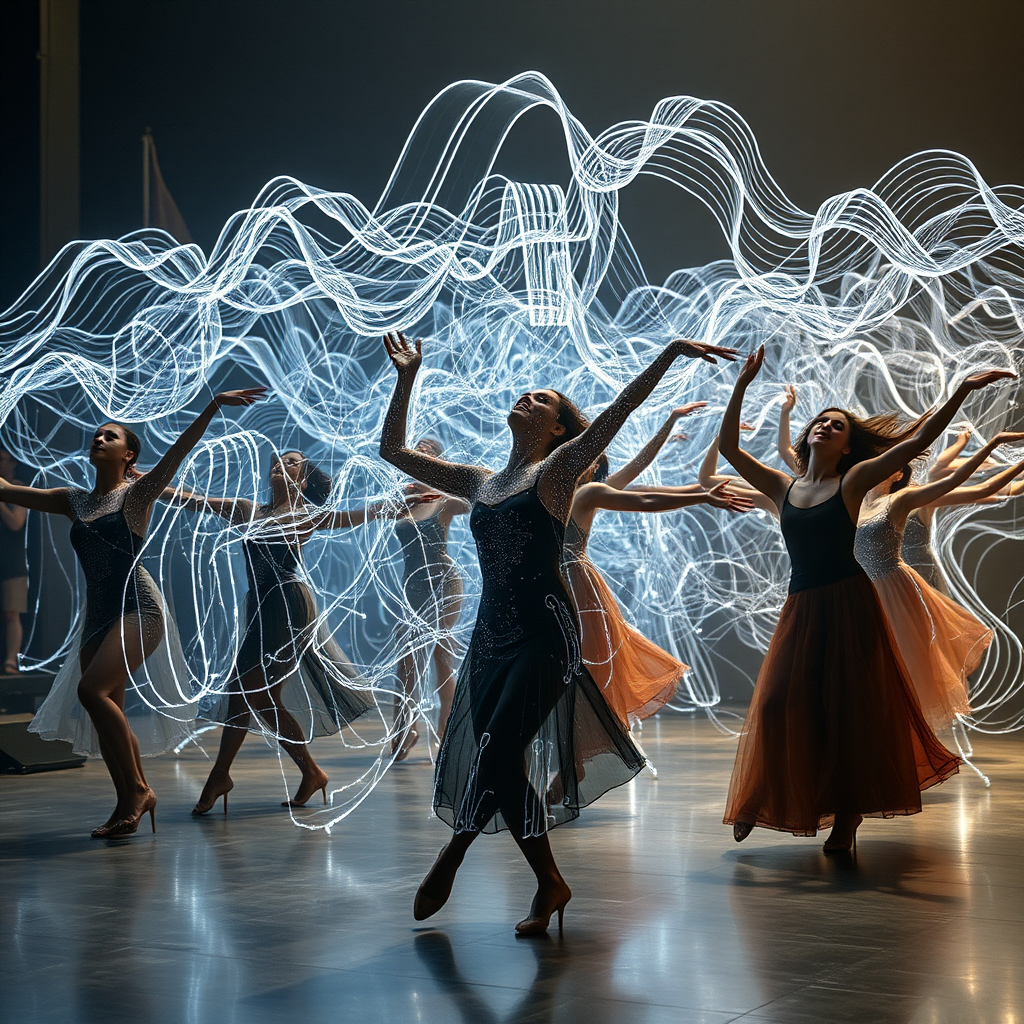
Artificial intelligence (AI) in dance refers to the use of machine learning, generative models, and motion capture technologies to create, analyze, and enhance choreographic works. AI systems can generate original dance sequences, assist human choreographers, and enable real-time interaction between dancers and digital environments. These technologies bridge the gap between traditional dance practices and computational creativity, offering new avenues for artistic expression and performance.
#Infobox
#Overview
AI in dance is an interdisciplinary field that combines computer science, dance studies, and cognitive science. It leverages algorithms to analyze, generate, and interpret human movement, enabling both autonomous choreography and collaborative creation between humans and machines. The integration of AI into dance has expanded the creative possibilities for choreographers, allowing for the exploration of complex movement patterns, real-time improvisation, and the fusion of digital and physical performance spaces.
Key applications include:
- Generative Choreography: AI models trained on large datasets of dance movements can produce original sequences based on learned patterns.
- Motion Capture and Analysis: AI enhances the precision of motion capture systems, enabling detailed analysis of dance techniques and biomechanics.
- Interactive Performances: AI-driven systems can respond to dancers' movements in real time, creating dynamic and adaptive performances.
- Virtual Dance Partners: AI can simulate virtual dancers or avatars that interact with human performers, expanding the scope of stage productions.
#History / Background
The intersection of AI and dance dates back to the late 20th century, with early experiments in computational choreography emerging alongside advancements in computer graphics and robotics. One of the pioneering projects was Life Forms (1989), developed by Merce Cunningham and Life Forms Technologies. This software allowed choreographers to manipulate 3D stick-figure representations of dancers to design movement sequences, marking a significant step toward digital choreography.
In the 1990s and 2000s, researchers began exploring AI-driven motion synthesis. Projects like ChoreoGraph (2004) by Bill T. Jones and DanceForms (formerly Life Forms) enabled choreographers to experiment with virtual dancers and refine their compositions digitally. The rise of machine learning in the 2010s further accelerated progress, with deep learning models capable of generating realistic and stylistically coherent dance sequences.
Contemporary developments include the use of reinforcement learning for adaptive choreography and the integration of AI in immersive environments such as virtual reality (VR) and augmented reality (AR) performances. Companies and research institutions worldwide are now exploring AI's potential to redefine dance as both an art form and a technological discipline.
#How It Works
#Data Collection and Training
AI models in dance rely on large datasets of annotated movement data. These datasets may include:
- Motion capture recordings of professional dancers.
- Annotated dance sequences from various styles (ballet, contemporary, hip-hop, etc.).
- Biomechanical data capturing joint angles, muscle activation, and skeletal movement.
Machine learning algorithms, particularly recurrent neural networks (RNNs) and generative adversarial networks (GANs), are trained on this data to learn the underlying patterns of human movement. For example, a GAN can generate new dance sequences by interpolating between existing movements, while an RNN can predict the next likely pose in a sequence based on prior frames.
#Generative Models
Generative AI models, such as variational autoencoders (VAEs) and diffusion models, are used to create original choreography. These models can:
- Generate sequences that mimic the style of a specific dancer or choreographer.
- Blend movements from different dance styles to produce hybrid choreography.
- Optimize sequences for specific constraints, such as musical tempo or spatial limitations on stage.
For instance, a model trained on ballet data might generate a contemporary ballet sequence by combining classical positions with modern fluidity.
#Real-Time Interaction
AI systems can interact with dancers in real time using sensors, cameras, or motion capture suits. These systems employ:
- Computer Vision: Cameras track dancers' movements, feeding data into AI models that respond with projected visuals, music, or virtual dancers.
- Haptic Feedback: Wearable devices provide tactile responses based on AI-generated choreographic cues.
- Reinforcement Learning: AI agents learn to adapt their movements based on feedback from human dancers, optimizing for aesthetic or technical goals.
An example is a performance where an AI-driven virtual dancer mirrors and improvises alongside a human performer, creating a dialogue between the physical and digital realms.
#Motion Capture and Analysis
AI enhances motion capture by automating the labeling and interpretation of movement data. Techniques include:
- Pose Estimation: AI models identify key points on a dancer's body (e.g., joints, limbs) in video or depth-sensor data.
- Style Transfer: AI can apply the stylistic nuances of one dancer to another, enabling comparative analysis or creative reinterpretation.
- Injury Prevention: AI systems analyze movement patterns to detect potential risks of strain or injury, providing feedback to dancers and choreographers.
#Important Facts
- First AI-Choreographed Piece: Biped (1999), choreographed by Merce Cunningham using the Life Forms software, is considered one of the earliest works where AI played a direct role in choreography.
- Generative AI in Dance: Models like Dance Diffusion and ChoreoNet can generate novel dance sequences from text prompts or musical inputs.
- AI as a Collaborator: Choreographers like Wayne McGregor have used AI to explore new movement vocabularies, treating the technology as a creative partner rather than a tool.
- Ethical Considerations: The use of AI in dance raises questions about authorship, originality, and the role of human creativity in an increasingly automated art form.
- Accessibility: AI-powered tools are making dance education and choreography more accessible, allowing non-professionals to experiment with movement design.
#Related Terms
#FAQ
What does AI And Dance: Choreographing Movements cover?
Explores how artificial intelligence shapes dance and choreographing movements, covering practical use cases, benefits, limitations, and risks.
Why is AI And Dance: Choreographing Movements important?
It helps readers understand key concepts, compare practical use cases, and evaluate how Artificial Intelligence decisions affect outcomes, risks, and implementation choices.
What should readers verify before applying this topic?
Readers should compare the benefits, limitations, data requirements, and related themes such as Dance, Choreographing, Movement before using the ideas in real projects.
#References
- AI And Dance: Choreographing Movements terminology and background research
- AI And Dance: Choreographing Movements use cases, implementation examples, and limitations
- Artificial Intelligence best practices, standards, and risk guidance
- Dance case studies, benchmarks, and current industry analysis



Comments
No comments yet. Start the discussion with a useful note.