

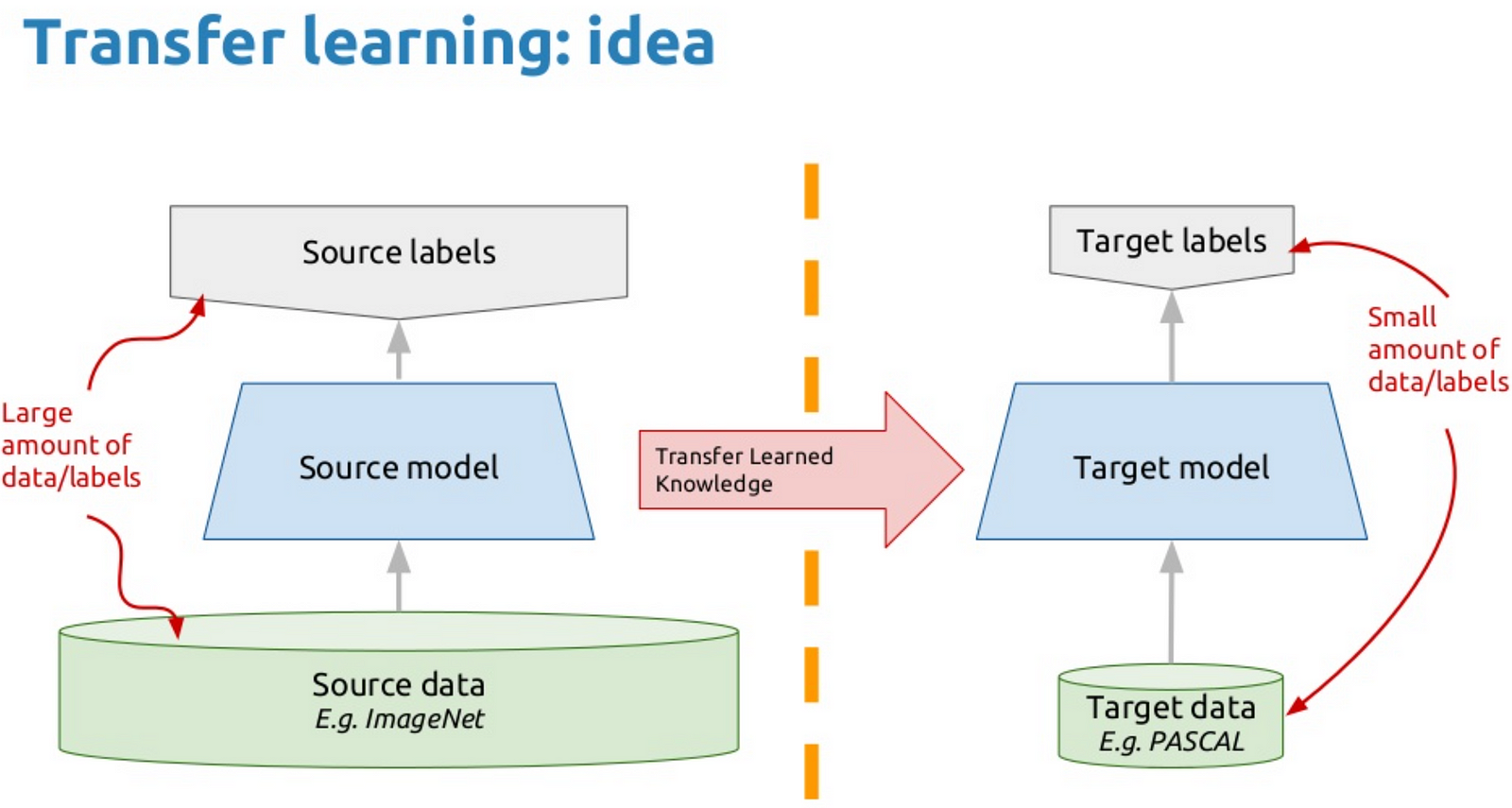
#Short Answer
Explains What Is Transfer Learning, including the core definition, how it works, practical examples, and limitations.
#Infobox
#Important Facts
- Reduced Data Requirements: Transfer learning significantly reduces the need for large labeled datasets, making it feasible to train models in domains where data is scarce.
- Computational Efficiency: By leveraging pre-trained models, transfer learning reduces the computational cost and time required for training, as the model starts with a strong initialization.
- Performance Improvement: Models trained via transfer learning often outperform those trained from scratch, especially when the target task has limited data.
- Negative Transfer: Not all transfer learning attempts are successful. If the source and target tasks are too dissimilar, the pre-trained model may perform worse than a randomly initialized model. This phenomenon is known as negative transfer.
- Domain Adaptation: Transfer learning can be used to adapt models to new domains (e.g., from natural images to medical images) by fine-tuning on domain-specific data.
- Multi-task Learning: Some transfer learning approaches involve training a single model on multiple related tasks simultaneously, improving generalization across tasks.
- Ethical Considerations: Pre-trained models may inherit biases present in their training data, which can propagate to downstream tasks. Careful evaluation and mitigation strategies are essential.
#Timeline
- Foundational ideas
Core concepts and early methods shape What Is Transfer Learning?.
- Practical use
Tools, examples, and real-world deployments make the topic easier to evaluate.
- Responsible implementation
Current work focuses on reliability, governance, performance, and measurable impact.
#Related Terms
#FAQ
What does What Is Transfer Learning? cover?
Explains What Is Transfer Learning, including the core definition, how it works, practical examples, and limitations.
Why is What Is Transfer Learning? important?
It helps readers understand key concepts, compare practical use cases, and evaluate how Artificial Intelligence decisions affect outcomes, risks, and implementation choices.
What should readers verify before applying this topic?
Readers should compare benefits, limitations, data requirements, and related themes such as Transfer, Learning, AI before using the ideas in real projects.
#References
- What Is Transfer Learning? terminology and background research
- What Is Transfer Learning? use cases, implementation examples, and limitations
- Artificial Intelligence best practices, standards, and risk guidance
- Transfer case studies, benchmarks, and current industry analysis



Comments
No comments yet. Start the discussion with a useful note.