

#Short Answer
Explains What Is the Turing Test, including the core definition, how it works, practical examples, and limitations.
#Infobox
#Overview
The Turing Test is a foundational concept in the field of artificial intelligence (AI) and cognitive science. It serves as a benchmark for evaluating the sophistication of AI systems, particularly in their ability to engage in human-like conversation. The test is named after Alan Turing, a British mathematician and computer scientist, who introduced the idea in his 1950 paper "Computing Machinery and Intelligence." At its core, the Turing Test examines whether a machine can demonstrate human-like intelligence through natural language interaction. Unlike traditional AI benchmarks that focus on specific tasks (e.g., chess-playing or image recognition), the Turing Test emphasizes general intelligence—the ability to understand, reason, and respond in a manner indistinguishable from a human. The test is often framed as an imitation game, where a human evaluator engages in a text-based conversation with both a human and a machine. If the evaluator cannot reliably determine which participant is the machine, the machine is considered to have passed the test. This criterion underscores the test's emphasis on human-like behavior rather than raw computational power or specialized problem-solving.
#History / Background
#Origins in Alan Turing's Work The Turing Test was first introduced in Turing's 1950 paper "Computing Machinery and Intelligence," published in the journal Mind. Turing posed the question: "Can machines think?"—a question he deemed too vague for meaningful discussion. Instead, he proposed a more practical test, now known as the Turing Test, to shift the focus from abstract definitions of intelligence to observable behavior. Turing's inspiration came from the imitation game, a parlor game where a player attempts to determine the gender of two hidden participants based solely on their written responses. Turing adapted this concept to assess machine intelligence, replacing gender with human versus machine.
#Early Reactions and Criticisms Turing's proposal sparked significant debate. Some critics argued that the test was too anthropocentric, focusing on human-like behavior rather than true intelligence. Others contended that the test was overly simplistic, as it did not account for the full spectrum of human cognition. In the decades following its introduction, the Turing Test became a cornerstone of AI research. Early AI systems, such as ELIZA (1966) and PARRY (1972), were designed to simulate human conversation and were evaluated using variations of the Turing Test. However, these systems often relied on scripted responses or keyword matching, revealing their limitations in true understanding.
#Modern Interpretations As AI advanced, the Turing Test evolved beyond its original formulation. Modern interpretations emphasize contextual understanding, emotional intelligence, and adaptability—traits that were not fully addressed in Turing's original proposal. The test has also been adapted for multimodal interactions, including voice and visual cues, though the text-based version remains the most widely recognized.
#How It Works
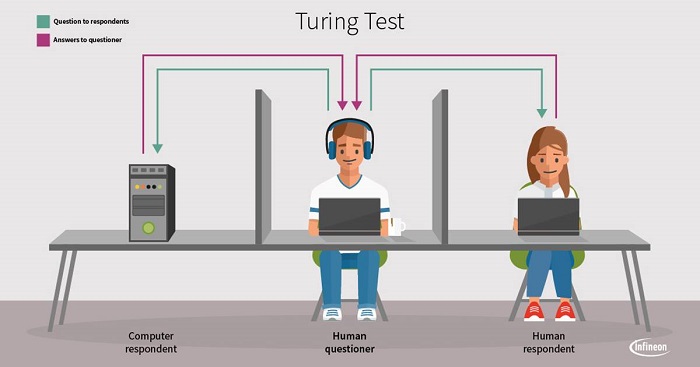
#The Imitation Game The Turing Test is conducted as an imitation game, involving three participants:
- A human evaluator (the judge).
- A human respondent (the control).
- A machine respondent (the test subject). The evaluator engages in a text-based conversation with both the human and the machine, without knowing which is which. The conversations are typically conducted via a chat interface, ensuring that the evaluator cannot rely on visual or auditory cues.
#Passing the Test For the machine to pass the Turing Test, the evaluator must be unable to reliably distinguish between the machine's responses and those of the human. This does not require the machine to be perfect—only that its errors and successes are statistically indistinguishable from a human's.
#Variations of the Test Several variations of the Turing Test have been proposed to address its limitations:
- Total Turing Test (TTT): Introduced by Daniel Dennett, this version includes additional sensory inputs (e.g., vision and mobility) to evaluate a machine's ability to interact with its environment.
- Reverse Turing Test: In this variation, the machine evaluates whether a human is truly human, often used in CAPTCHA systems to distinguish humans from bots.
- Lovelace Test: Proposed by Selmer Bringsjord, this test assesses a machine's ability to create original, creative work, addressing the Turing Test's focus on imitation rather than innovation.
#Challenges in Implementation Despite its simplicity in concept, the Turing Test presents several challenges:
- Subjectivity: Human evaluators may have varying standards for what constitutes "human-like" behavior.
- Deception: Machines may employ strategies to mimic human errors or inconsistencies, complicating the evaluation.
- Scalability: Conducting large-scale Turing Tests is resource-intensive, requiring multiple human evaluators and diverse participants.
#Important Facts
- Alan Turing's Legacy: The Turing Test is named after Alan Mathison Turing, a pioneering figure in computer science and cryptanalysis. Turing's work laid the foundation for modern computing and AI.
- ELIZA and Early AI: The first AI program to pass a simplified version of the Turing Test was ELIZA (1966), developed by Joseph Weizenbaum. ELIZA simulated a Rogerian psychotherapist, using pattern matching to generate responses.
- PARRY and Schizophrenia Simulation: PARRY (1972), created by Kenneth Colby, was designed to simulate a paranoid schizophrenic. It passed a modified Turing Test, fooling psychiatrists in some cases.
- Loebner Prize: Established in 1990, the Loebner Prize is an annual competition that awards prizes to the most human-like AI systems based on the Turing Test. No system has yet passed the test definitively.
- Criticism of the Test: Philosophers like John Searle argue that the Turing Test does not measure true intelligence, as it focuses on behavior rather than understanding (e.g., the Chinese Room Argument).
- Modern AI and the Turing Test: Advanced AI models, such as Google's LaMDA and OpenAI's GPT-4, have demonstrated impressive conversational abilities, sparking renewed debate about the test's relevance in the era of large language models.
- Ethical Considerations: The Turing Test raises questions about machine consciousness, personhood, and the ethical implications of creating AI that mimics humans.
#Timeline
- Foundational ideas
Core concepts and early methods shape What Is the Turing Test?.
- Practical use
Tools, examples, and real-world deployments make the topic easier to evaluate.
- Responsible implementation
Current work focuses on reliability, governance, performance, and measurable impact.
#Related Terms
#FAQ
What does What Is the Turing Test? cover?
Explains What Is the Turing Test, including the core definition, how it works, practical examples, and limitations.
Why is What Is the Turing Test? important?
It helps readers understand key concepts, compare practical use cases, and evaluate how Artificial Intelligence decisions affect outcomes, risks, and implementation choices.
What should readers verify before applying this topic?
Readers should compare benefits, limitations, data requirements, and related themes such as Turing, Test, AI before using the ideas in real projects.
#References
- What Is the Turing Test? terminology and background research
- What Is the Turing Test? use cases, implementation examples, and limitations
- Artificial Intelligence best practices, standards, and risk guidance
- Turing case studies, benchmarks, and current industry analysis



Comments
No comments yet. Start the discussion with a useful note.