

#Short Answer
Explains What Is Overfitting in AI, including the core definition, how it works, practical examples, and limitations.
#Infobox
#Overview
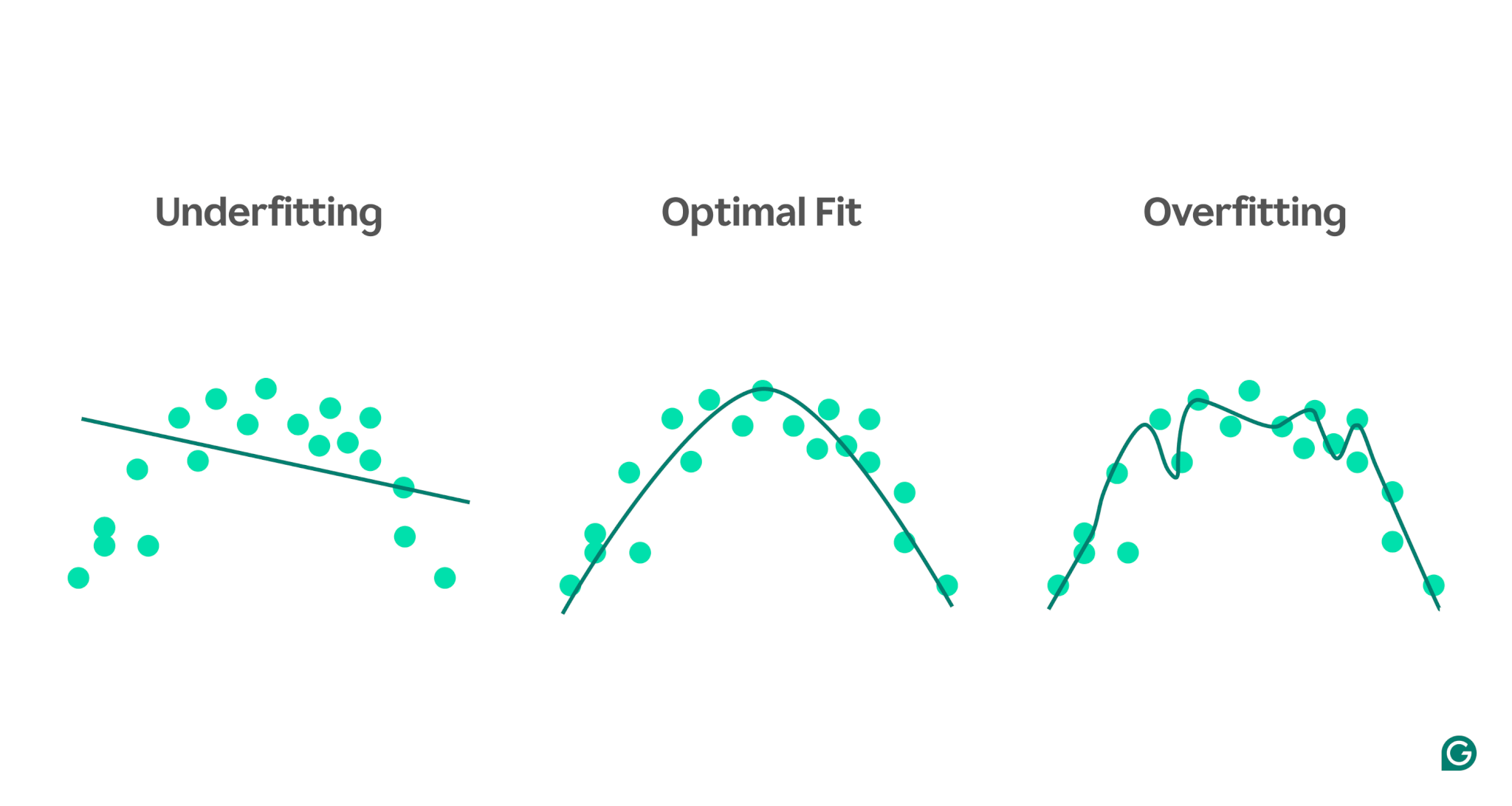
Overfitting is a fundamental challenge in the development of AI and machine learning systems. It arises when a model, such as a neural network, decision tree, or regression algorithm, becomes overly tailored to the specific examples in its training dataset. While the model may achieve near-perfect performance on the training data, its predictive power diminishes when applied to new, unseen data. This phenomenon undermines the core objective of machine learning: to create models that generalize well beyond the data they were trained on. The issue is particularly prevalent in complex models with a large number of parameters, such as deep neural networks. These models have the capacity to memorize training examples, including irrelevant details, rather than learning the true underlying distribution of the data. Overfitting is closely related to the bias-variance tradeoff, where a model with high variance (sensitive to small fluctuations in the training set) is prone to overfitting, while a model with high bias (oversimplified) may underfit the data.
#History / Background
The concept of overfitting has roots in classical statistics and has been a persistent issue since the early days of predictive modeling. In the 19th and early 20th centuries, statisticians observed that models with too many parameters could fit noise in the data rather than the signal. However, the term "overfitting" gained prominence with the rise of machine learning in the late 20th century. One of the earliest documented cases of overfitting occurred in the 1960s and 1970s with the development of polynomial regression models. Researchers noticed that increasing the degree of the polynomial improved training accuracy but led to erratic behavior on test data. This led to the introduction of regularization techniques, such as ridge regression (Tikhonov regularization) and lasso regression, which penalize large coefficients to prevent overfitting. The advent of neural networks in the 1980s and 1990s further highlighted the problem, as deep architectures with many layers and parameters became increasingly susceptible to memorizing training data. The resurgence of interest in deep learning in the 2010s brought renewed attention to overfitting, prompting the development of advanced techniques like dropout, batch normalization, and data augmentation to mitigate the issue.
#How It Works
#Mechanism of Overfitting Overfitting occurs through a process where a model learns not only the true patterns in the data but also the random noise and idiosyncrasies specific to the training set. This can be visualized by considering a high-degree polynomial regression model fitted to a small dataset. While the model may pass through every training point, its curve may oscillate wildly between points, capturing noise rather than the underlying trend.
#Mathematical Perspective From a mathematical standpoint, overfitting can be understood in terms of the bias-variance decomposition of the expected prediction error: \[ \textError = \textBias^2 + \textVariance + \textIrreducible Error \]
- Bias refers to the error introduced by approximating a real-world problem (which may be complex) with a simplified model. High bias leads to underfitting.
- Variance measures how much the model's predictions fluctuate when trained on different subsets of the data. High variance leads to overfitting. A model that is too complex (e.g., a deep neural network with millions of parameters) will have low bias but high variance, fitting the training data closely but failing to generalize.
#Visualization Overfitting can be visualized using learning curves, which plot training and validation error as a function of the number of training examples or model complexity. In an overfit model: - Training error continues to decrease as the model memorizes the data. - Validation error initially decreases but then starts to increase as the model begins to fit noise.
#Important Facts
- Complexity vs. Generalization: More complex models are not inherently better. While they can fit training data more closely, they risk overfitting unless properly regularized.
- Data Quantity: Overfitting is more likely when the training dataset is small relative to the model's capacity. Larger datasets help the model learn general patterns rather than memorizing noise.
- Noise Sensitivity: Models trained on noisy data are more prone to overfitting, as they may learn to predict the noise rather than the signal.
- Evaluation Metrics: Accuracy on training data is not a reliable indicator of model performance. Validation or test set performance is a better measure of generalization.
- Regularization: Techniques like L1 (lasso) and L2 (ridge) regularization add a penalty term to the loss function, discouraging overly complex models.
- Cross-Validation: Methods like k-fold cross-validation help assess how well a model generalizes by testing it on multiple subsets of the data.
- Early Stopping: In iterative training (e.g., gradient descent), monitoring validation error and stopping training when it starts to increase can prevent overfitting.
- Ensemble Methods: Techniques like bagging (e.g., Random Forests) and boosting combine multiple models to reduce variance and improve generalization.
#Timeline
- Foundational ideas
Core concepts and early methods shape What Is Overfitting in AI?.
- Practical use
Tools, examples, and real-world deployments make the topic easier to evaluate.
- Responsible implementation
Current work focuses on reliability, governance, performance, and measurable impact.
#Related Terms
#FAQ
What does What Is Overfitting in AI? cover?
Explains What Is Overfitting in AI, including the core definition, how it works, practical examples, and limitations.
Why is What Is Overfitting in AI? important?
It helps readers understand key concepts, compare practical use cases, and evaluate how Machine Learning decisions affect outcomes, risks, and implementation choices.
What should readers verify before applying this topic?
Readers should compare benefits, limitations, data requirements, and related themes such as Overfitting, AI, Implementation before using the ideas in real projects.
#References
- What Is Overfitting in AI? terminology and background research
- What Is Overfitting in AI? use cases, implementation examples, and limitations
- Machine Learning best practices, standards, and risk guidance
- Overfitting case studies, benchmarks, and current industry analysis



Comments
No comments yet. Start the discussion with a useful note.