

#Short Answer
Explains What Is Hyperparameter Tuning, including the core definition, how it works, practical examples, and limitations.
#Infobox
#Overview
Hyperparameter tuning is a critical step in the machine learning pipeline that involves adjusting the external configuration of a model to enhance its predictive accuracy, efficiency, and generalization capabilities. Unlike model parameters, which are learned during training (e.g., weights in a neural network), hyperparameters are set prior to training and govern the learning process itself. Examples include learning rates, batch sizes, tree depths, and regularization strengths. The primary goal of hyperparameter tuning is to find the optimal combination of these settings that minimizes prediction error on unseen data while avoiding overfitting. This process is often computationally intensive, as it requires evaluating multiple configurations across different datasets and model architectures.
#History / Background
The concept of hyperparameter tuning emerged alongside the development of machine learning algorithms in the late 20th century. Early methods relied on manual experimentation, where practitioners adjusted hyperparameters based on intuition or trial-and-error. This approach was time-consuming and lacked systematic rigor. The formalization of hyperparameter optimization began in the 1990s with the introduction of grid search and random search techniques. Grid search exhaustively evaluates predefined combinations of hyperparameters, while random search samples configurations randomly from a specified range. These methods laid the foundation for automated tuning but were limited by scalability and computational inefficiency. In the 2000s, Bayesian optimization emerged as a more efficient alternative, using probabilistic models to guide the search toward promising hyperparameter regions. Tools like Hyperopt and Optuna later popularized this approach, integrating machine learning into the tuning process itself. The rise of deep learning in the 2010s further accelerated the need for advanced tuning methods, as neural networks required careful configuration of layers, activation functions, and optimization algorithms. Today, hyperparameter tuning is an integral part of the machine learning workflow, supported by frameworks like scikit-learn, TensorFlow, and PyTorch.
#How It Works
#Core Principles Hyperparameter tuning operates on the principle of exploration vs. exploitation. The process involves:
- Defining a Search Space: Specifying the range or distribution of possible hyperparameter values.
- Evaluating Configurations: Training and validating the model with each configuration.
- Selecting the Best Model: Choosing the configuration that yields the highest performance on a validation set.
#Common Methods
- Grid Search - Exhaustively tests all possible combinations within a predefined grid.
- Pros: Simple, guarantees finding the global optimum within the grid.
- Cons: Computationally expensive, scales poorly with high-dimensional spaces.
- Random Search - Samples hyperparameters randomly from a distribution.
- Pros: More efficient than grid search, often finds good configurations faster.
- Cons: May miss optimal regions if sampling is not well-distributed.
- Bayesian Optimization - Uses probabilistic models (e.g., Gaussian processes) to predict the performance of hyperparameter configurations.
- Pros: Balances exploration and exploitation, highly efficient for expensive evaluations.
- Cons: Requires more computational overhead for model training.
- Evolutionary Algorithms - Mimics natural selection by iteratively improving hyperparameter sets through mutation and crossover.
- Pros: Can escape local optima, suitable for complex search spaces.
- Cons: Slower convergence, requires careful tuning of algorithm parameters.
- Gradient-Based Optimization - Applies gradient descent to optimize hyperparameters directly.
- Pros: Fast for differentiable hyperparameters (e.g., learning rates).
- Cons: Limited to specific model types and hyperparameters.
#Practical Workflow
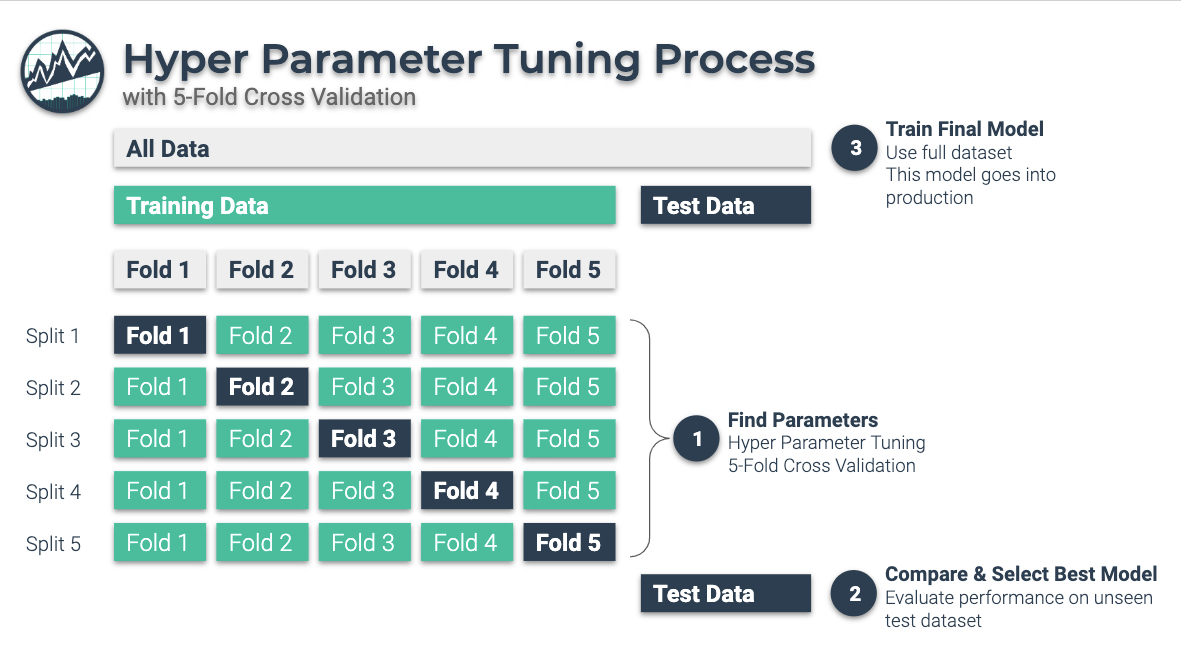
- Split Data: Divide the dataset into training, validation, and test sets.
- Define Metrics: Select evaluation metrics (e.g., accuracy, F1-score, RMSE).
- Configure Search Space: Specify hyperparameter ranges (e.g.,
learning_rate: [0.001, 0.01, 0.1]). - Run Optimization: Execute the chosen tuning method.
- Validate Results: Assess the best configuration on the test set to ensure generalization.
#Important Facts
- Computational Cost: Hyperparameter tuning can consume significant computational resources, often requiring distributed computing or cloud-based solutions.
- Overfitting Risk: Tuning on the test set can lead to overfitting; validation sets or cross-validation are essential.
- Automated Tools: Frameworks like Optuna, Hyperopt, and Ray Tune automate the tuning process, reducing manual effort.
- Transfer Learning: Techniques like warm-starting in Bayesian optimization reuse past tuning results to speed up new searches.
- Multi-Objective Tuning: Some methods optimize for multiple objectives (e.g., accuracy and model complexity) simultaneously.
- Reproducibility: Logging tuning experiments (e.g., using MLflow or Weights & Biases) ensures reproducibility and traceability.
#Timeline
- Foundational ideas
Core concepts and early methods shape What Is Hyperparameter Tuning?.
- Practical use
Tools, examples, and real-world deployments make the topic easier to evaluate.
- Responsible implementation
Current work focuses on reliability, governance, performance, and measurable impact.
#Related Terms
#FAQ
What does What Is Hyperparameter Tuning? cover?
Explains What Is Hyperparameter Tuning, including the core definition, how it works, practical examples, and limitations.
Why is What Is Hyperparameter Tuning? important?
It helps readers understand key concepts, compare practical use cases, and evaluate how Artificial Intelligence decisions affect outcomes, risks, and implementation choices.
What should readers verify before applying this topic?
Readers should compare benefits, limitations, data requirements, and related themes such as Hyperparameter, Tuning, AI before using the ideas in real projects.
#References
- What Is Hyperparameter Tuning? terminology and background research
- What Is Hyperparameter Tuning? use cases, implementation examples, and limitations
- Artificial Intelligence best practices, standards, and risk guidance
- Hyperparameter case studies, benchmarks, and current industry analysis




Comments
No comments yet. Start the discussion with a useful note.