

#Short Answer
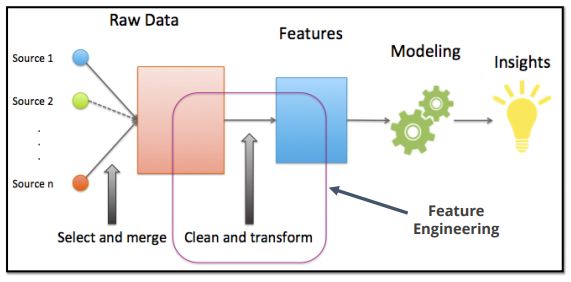
Explains What Is Feature Engineering, including the core definition, how it works, practical examples, and limitations.
#Infobox
#How It Works
Feature Selection Feature selection involves identifying the most relevant features from a dataset to improve model performance and reduce computational complexity. Techniques include:
- Filter Methods: Statistical tests (e.g., chi-square, ANOVA) to rank features based on their relevance.
- Wrapper Methods: Algorithms like recursive feature elimination (RFE) that evaluate feature subsets using model performance.
- Embedded Methods: Feature selection integrated into the model training process (e.g., Lasso regression).
Feature Transformation Transforming features to better suit the model’s requirements is essential. Common techniques include:
- Normalization: Scaling features to a common range (e.g., Min-Max scaling, Z-score standardization).
- Encoding: Converting categorical data into numerical format (e.g., one-hot encoding, label encoding).
- Discretization: Converting continuous variables into discrete bins (e.g., binning age into age groups).
Feature Extraction Feature extraction involves creating new features from existing ones to capture hidden patterns. Techniques include:
- Dimensionality Reduction: Reducing the number of features while preserving variance (e.g., PCA, t-SNE).
- Aggregation: Combining multiple features into a single feature (e.g., summing daily sales into monthly sales).
- Polynomial Features: Creating interaction terms or higher-order terms to capture non-linear relationships.
Handling Missing Data Missing data can distort feature engineering. Strategies include:
- Imputation: Filling missing values with mean, median, or mode.
- Deletion: Removing rows or columns with excessive missing values.
- Advanced Techniques: Using algorithms like k-nearest neighbors (KNN) imputation.
Feature Scaling Scaling ensures that features contribute equally to the model. Common methods include:
- Min-Max Scaling: Rescaling features to a range of [0, 1].
- Standard Scaling: Transforming features to have a mean of 0 and a standard deviation of 1.
- Robust Scaling: Using median and interquartile range to handle outliers.
#Important Facts
- Impact on Model Performance: Well-engineered features can improve model accuracy by up to 30% compared to raw data.
- Domain Knowledge: Domain expertise is often crucial in identifying meaningful features.
- Automation vs. Manual Effort: While automated tools (e.g., AutoML) can assist, manual feature engineering often yields better results.
- Feature Importance: Techniques like SHAP (SHapley Additive exPlanations) can help interpret feature contributions.
- High-Dimensional Data: Feature engineering is essential in high-dimensional datasets to avoid the "curse of dimensionality."
- Time-Series Data: Feature engineering for time-series data often involves lag features, rolling statistics, and window functions.
- Text Data: For NLP tasks, feature engineering includes techniques like TF-IDF, word embeddings, and n-grams.
#Timeline
- Foundational ideas
Core concepts and early methods shape What Is Feature Engineering?.
- Practical use
Tools, examples, and real-world deployments make the topic easier to evaluate.
- Responsible implementation
Current work focuses on reliability, governance, performance, and measurable impact.
#Related Terms
#FAQ
What does What Is Feature Engineering? cover?
Explains What Is Feature Engineering, including the core definition, how it works, practical examples, and limitations.
Why is What Is Feature Engineering? important?
It helps readers understand key concepts, compare practical use cases, and evaluate how Artificial Intelligence decisions affect outcomes, risks, and implementation choices.
What should readers verify before applying this topic?
Readers should compare benefits, limitations, data requirements, and related themes such as Feature, Engineering, AI before using the ideas in real projects.
#References
- What Is Feature Engineering? terminology and background research
- What Is Feature Engineering? use cases, implementation examples, and limitations
- Artificial Intelligence best practices, standards, and risk guidance
- Feature case studies, benchmarks, and current industry analysis




Comments
No comments yet. Start the discussion with a useful note.