

#Short Answer
Traces timeline of artificial intelligence, highlighting major milestones, context, examples, and future implications.
#Infobox
#Overview
Artificial Intelligence (AI) encompasses a broad range of technologies designed to enable machines to perform tasks typically requiring human intelligence. These include reasoning, learning, perception, problem-solving, and decision-making. The Timeline of Artificial Intelligence highlights the evolution of AI from theoretical concepts to practical applications, marking significant breakthroughs that have shaped modern technology. AI systems are broadly categorized into:
- Narrow AI (Weak AI): Designed for specific tasks (e.g., voice assistants, recommendation systems).
- General AI (Strong AI): Hypothetical systems with human-like cognitive abilities (not yet achieved).
- Superintelligent AI: Theoretical systems surpassing human intelligence (highly debated). The field has seen exponential growth, driven by advancements in computing power, data availability, and algorithmic innovations.
#History / Background
#Early Foundations (Pre-1950s)
The concept of artificial intelligence predates modern computing. Key precursors include:
- Ancient Myths: Stories of artificial beings (e.g., Greek myths of automatons, Jewish golem).
- Mechanical Calculators: Devices like the Antikythera mechanism (c. 100 BCE) and Blaise Pascal’s Pascaline (1642) laid groundwork for computational logic.
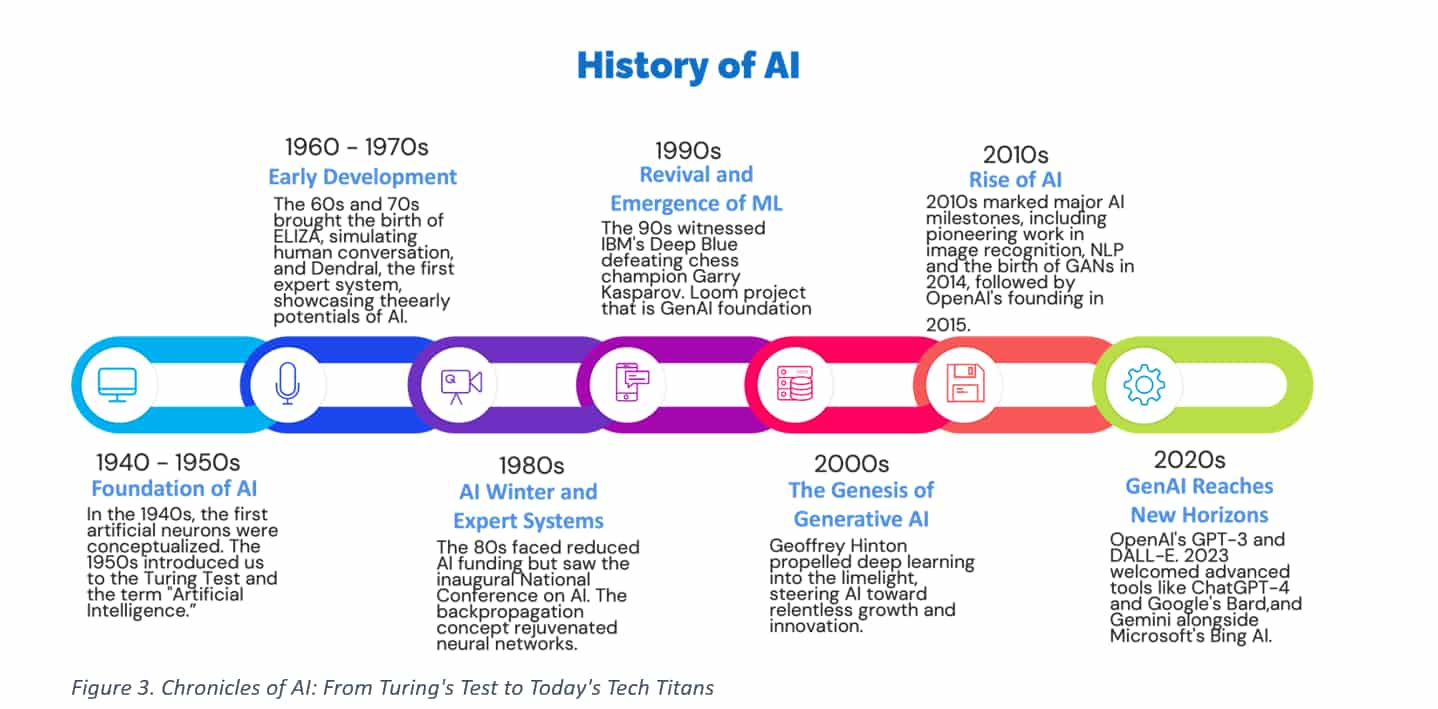
- Alan Turing’s Contributions: Turing’s 1936 paper on computable numbers introduced the concept of a universal machine, later formalized as the Turing Machine. His 1950 paper, "Computing Machinery and Intelligence," proposed the Turing Test to assess machine intelligence.
#The Birth of AI (1950s–1960s)
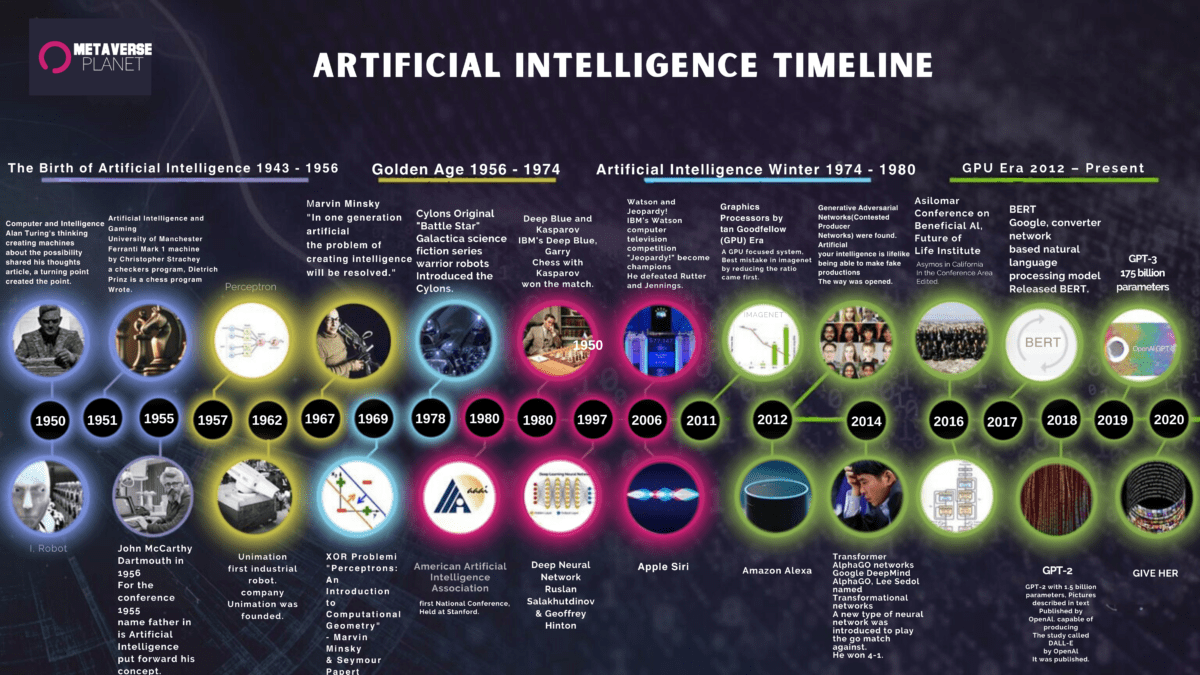
The term "Artificial Intelligence" was coined in 1956 at the Dartmouth Conference, organized by John McCarthy, Marvin Minsky, Nathaniel Rochester, and Claude Shannon. This event marked the official birth of AI as a field.
- 1951: Ferranti Mark 1 became the first commercially available general-purpose computer, enabling early AI experiments.
- 1956: Logic Theorist, developed by Allen Newell and Herbert Simon, solved mathematical theorems, demonstrating symbolic reasoning.
- 1958: John McCarthy created LISP, a programming language pivotal for AI research.
- 1966: ELIZA, an early natural language processing (NLP) program by Joseph Weizenbaum, simulated human conversation.
#The Golden Years (1960s–1970s)
This period saw optimism and rapid progress, fueled by government funding (e.g., DARPA in the U.S.).
- 1965: Joseph Weizenbaum’s ELIZA demonstrated rudimentary chatbot capabilities.
- 1966: Shakey the Robot, developed at Stanford Research Institute, integrated perception and planning.
- 1969: Stanford Cart, an early autonomous vehicle, navigated obstacles using AI.
- 1972: MYCIN, an expert system for medical diagnosis, achieved near-human accuracy. However, AI Winter (1974–1980) emerged due to: - Overpromising and underdelivering (e.g., machine translation failures). - Limited computational power and data storage. - Criticism from researchers like Hubert Dreyfus, who argued AI lacked human-like understanding.
#Revival and Expert Systems (1980s–1990s)
The field rebounded with the rise of expert systems and increased computing power.
- 1981: Japan’s Fifth Generation Computer Systems project aimed to create AI-powered computers (ultimately unsuccessful).
- 1986: Backpropagation algorithm revitalized neural networks by enabling efficient training.
- 1997: IBM’s Deep Blue defeated world chess champion Garry Kasparov, marking a milestone in AI’s ability to master complex games.
#The Modern Era (2000s–Present)
Advancements in machine learning (ML), deep learning, and big data propelled AI into mainstream applications.
- 2006: Geoffrey Hinton’s work on deep belief networks reignited interest in neural networks.
- 2011: IBM Watson won Jeopardy!, showcasing AI’s natural language processing capabilities.
- 2012: AlexNet, a deep convolutional neural network, revolutionized computer vision by winning the ImageNet competition.
- 2016: AlphaGo (Google DeepMind) defeated Lee Sedol, a top Go player, using reinforcement learning.
- 2020s: Explosion of generative AI, including models like DALL·E, Stable Diffusion, and ChatGPT, democratized AI creativity.
#How It Works
AI systems operate through a combination of algorithms, data, and computational power. The core methodologies include:
#
- Machine Learning (ML) ML enables systems to learn from data without explicit programming. Subfields include:
- Supervised Learning: Models are trained on labeled data (e.g., spam detection).
- Unsupervised Learning: Models identify patterns in unlabeled data (e.g., customer segmentation).
- Reinforcement Learning: Agents learn by interacting with an environment (e.g., AlphaGo).
#
- Deep Learning A subset of ML, deep learning uses neural networks with multiple layers (hence "deep") to model complex patterns. Key architectures:
- Convolutional Neural Networks (CNNs): Excels in image/video recognition.
- Recurrent Neural Networks (RNNs): Processes sequential data (e.g., time-series analysis).
- Transformers: Powers modern NLP (e.g., BERT, GPT models).
#
- Natural Language Processing (NLP) NLP enables machines to understand, interpret, and generate human language. Techniques include:
- Tokenization: Breaking text into words/phrases.
- Sentiment Analysis: Determining emotional tone in text.
- Machine Translation: Tools like Google Translate use sequence-to-sequence models.
#
- Computer Vision AI systems analyze and interpret visual data using:
- Object Detection: Identifying objects in images (e.g., self-driving cars).
- Image Segmentation: Partitioning images into meaningful regions.
- Facial Recognition: Used in security and authentication.
#
- Robotics AI integrates with robotics to enable:
- Autonomous Navigation: Drones, self-driving cars.
- Manipulation: Robotic arms in manufacturing.
- Human-Robot Interaction: Assistive robots (e.g., Boston Dynamics’ Spot).
#
- Explainable AI (XAI) Addresses the "black box" problem by making AI decisions interpretable (e.g., LIME, SHAP).
#Important Facts
- AI’s Impact on Jobs: The World Economic Forum estimates that AI will displace 85 million jobs by 2025 but create 97 million new ones.
- AI in Healthcare: AI models like IBM Watson for Oncology assist in cancer diagnosis and treatment planning.
- AI Ethics: Concerns include bias in algorithms, privacy violations, and autonomous weapons.
- AI’s Energy Consumption: Training large models (e.g., GPT-3) consumes significant computational resources, raising sustainability questions.
- AI in Art: Generative AI tools like MidJourney and DALL·E are transforming creative industries.
- AI in Finance: Used for fraud detection, algorithmic trading, and credit scoring.
#Timeline
- Foundational ideas
Core concepts and early methods shape Timeline of Artificial Intelligence.
- Practical use
Tools, examples, and real-world deployments make the topic easier to evaluate.
- Responsible implementation
Current work focuses on reliability, governance, performance, and measurable impact.
#Related Terms
#FAQ
What does Timeline of Artificial Intelligence cover?
Traces timeline of artificial intelligence, highlighting major milestones, context, examples, and future implications.
Why is Timeline of Artificial Intelligence important?
It helps readers understand key concepts, compare practical use cases, and evaluate how AI Trends decisions affect outcomes, risks, and implementation choices.
What should readers verify before applying this topic?
Readers should compare benefits, limitations, data requirements, and related themes such as Timeline, Artificial, Intelligence before using the ideas in real projects.
#References
- Timeline of Artificial Intelligence terminology and background research
- Timeline of Artificial Intelligence use cases, implementation examples, and limitations
- AI Trends best practices, standards, and risk guidance
- Timeline case studies, benchmarks, and current industry analysis

Comments
No comments yet. Start the discussion with a useful note.