

#Short Answer
Traces timeline of ai in gaming, highlighting major milestones, context, examples, and future implications.
#Infobox
#Overview
Artificial intelligence (AI) has been a cornerstone of video game development since the medium’s inception, evolving from simple rule-based systems to sophisticated algorithms capable of simulating human-like behavior, generating vast procedural worlds, and adapting to player actions. The integration of AI in gaming has not only shaped gameplay mechanics but also redefined player experiences, enabling dynamic narratives, intelligent non-player characters (NPCs), and adaptive difficulty systems. This timeline explores the major milestones, technological breakthroughs, and cultural impacts of AI in gaming, highlighting how the field has mirrored broader advancements in computer science and machine learning.
#History / Background
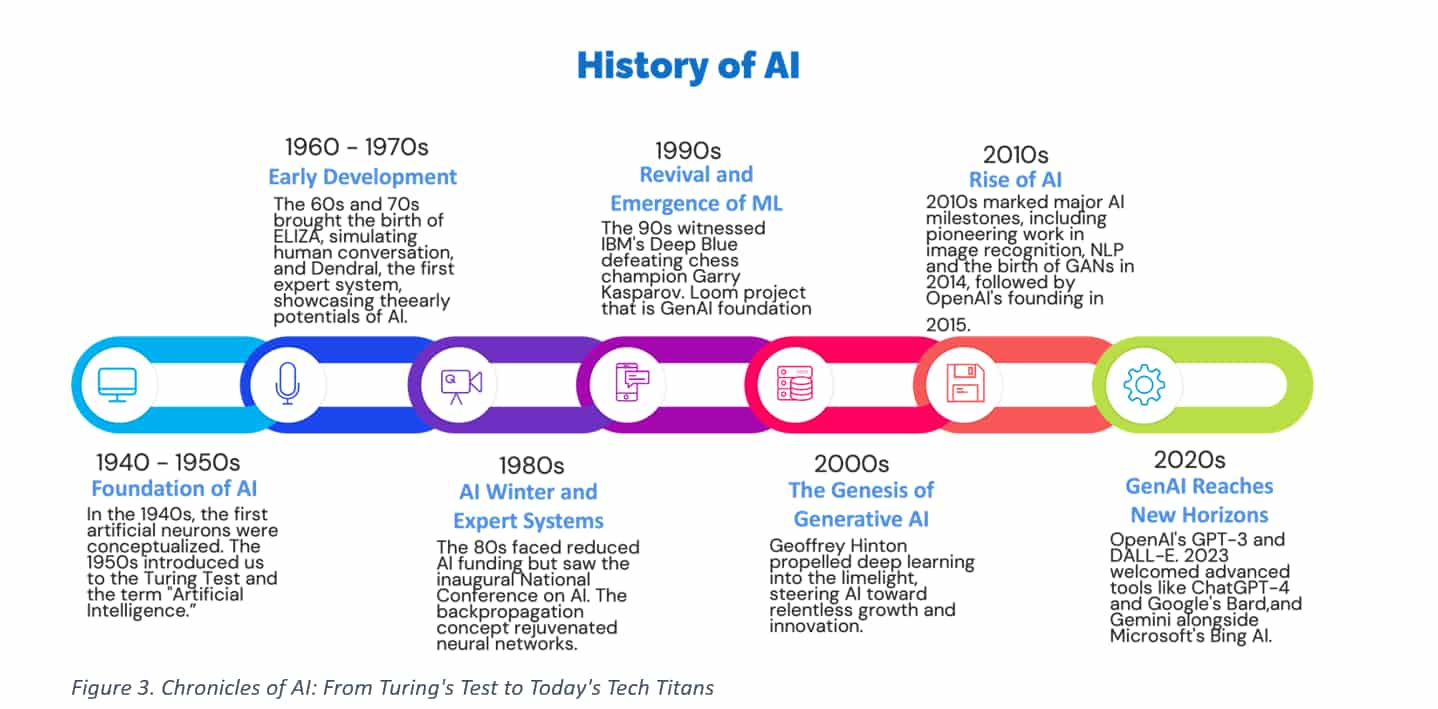
The history of AI in gaming is intertwined with the evolution of computing itself. Early games relied on deterministic algorithms to simulate opponent behavior, while later innovations leveraged probabilistic models and machine learning to create more nuanced interactions. The field can be segmented into distinct eras, each marked by technological breakthroughs and paradigm shifts in game design.
#Early Foundations (1950s–1970s)
The origins of AI in gaming trace back to the 1950s, when academic researchers began experimenting with computer-based simulations. One of the earliest examples was Nim, a mathematical game where an AI could outperform human players by calculating optimal moves. However, it wasn’t until the 1970s that AI began making its way into commercial video games. Pong (1972), one of the first arcade games, featured a simple AI opponent that followed a predictable pattern, laying the groundwork for competitive gameplay.
#The Arcade Era (1980s)
The 1980s saw the rise of arcade games that incorporated AI to create more engaging experiences. Pac-Man (1980) introduced ghost AI that followed distinct behavioral patterns, using finite state machines to simulate pursuit and evasion. Games like Space Invaders (1978) and Galaga (1981) used simple decision trees to control enemy movements, while Rogue (1980) pioneered procedural generation, using algorithms to create randomized dungeons. This era established AI as a tool for enhancing replayability and challenge.
#The Strategy and Simulation Boom (1990s)
The 1990s marked a significant leap in AI complexity, driven by the rise of real-time strategy (RTS) games and simulation titles. Civilization (1991) introduced AI opponents with multi-layered decision-making, balancing economic growth, military expansion, and diplomatic relations. The Sims (2000) revolutionized AI by implementing "autonomous agents" that pursued goals based on personality traits and environmental stimuli. Meanwhile, Half-Life (1998) featured AI-driven NPCs with advanced pathfinding and squad tactics, setting new standards for immersion.
#The Machine Learning Revolution (2000s–2010s)
The 2000s and 2010s witnessed the integration of machine learning (ML) and neural networks into gaming AI. Black & White (2001) used a learning system where the player’s actions influenced the AI’s morality, while F.E.A.R. (2005) employed goal-oriented action planning (GOAP) to create dynamic, unpredictable enemy behaviors. The introduction of AlphaGo (2016) by DeepMind demonstrated the potential of reinforcement learning (RL) in complex decision-making, inspiring game developers to explore similar techniques for NPC behavior.
#Modern Era
(2020s–Present)
Today, AI in gaming is defined by generative models, large language models (LLMs), and real-time adaptive systems. Games like No Man’s Sky (2016) use procedural generation powered by AI to create vast, unique universes. The Last of Us Part II (2020) features AI-driven NPCs with advanced pathfinding and emotional responses. Meanwhile, AI tools like NVIDIA’s ACE (Avatar Cloud Engine) enable real-time facial animation and voice synthesis, blurring the line between virtual and real performances.
#How It Works
AI in gaming operates through a combination of algorithms, data structures, and computational techniques tailored to simulate intelligence within interactive environments. The core methodologies can be categorized into several key approaches:
#Rule-Based Systems The simplest form of game AI relies on rule-based systems, where NPCs follow predefined scripts or decision trees. For example, in Pac-Man, the ghosts adhere to specific rules (e.g., Blinky chases the player directly, while Pinky targets a position ahead of the player). While effective for predictable behaviors, rule-based systems lack adaptability and can feel repetitive over time.
#Pathfinding Algorithms Pathfinding is essential for NPC navigation in 3D environments. The A (A-Star) algorithm*, introduced in the 1960s, remains a gold standard for finding optimal paths in grid-based or graph-based spaces. Games like Halo (2001) and The Elder Scrolls V: Skyrim (2011) use A* or its variants to enable NPCs to traverse complex terrain while avoiding obstacles.
#Finite State Machines (FSMs)
FSMs model NPC behavior as a set of states (e.g., "patrol," "attack," "flee") with transitions triggered by events. This approach is widely used in action games, such as Doom (1993), where enemies switch between aggressive and defensive states based on player proximity. FSMs are computationally efficient but can become rigid if not carefully designed.
#Behavior Trees A more flexible alternative to FSMs, behavior trees organize AI decisions hierarchically, allowing for modular and reusable logic. Each node represents a decision (e.g., "Can I see the player?"), with child nodes handling sub-decisions. Games like Left 4 Dead (2008) use behavior trees to create dynamic, emergent gameplay scenarios where NPCs coordinate intelligently.
#Machine Learning and Neural Networks Modern AI in gaming increasingly leverages machine learning, particularly reinforcement learning (RL) and deep learning. RL enables NPCs to learn optimal strategies through trial and error, as demonstrated in AlphaStar (2019), where DeepMind’s AI mastered StarCraft II at a professional level. Generative adversarial networks (GANs) are used for procedural content creation, while transformer-based models (e.g., LLMs) power advanced dialogue systems in games like Starfield (2023).
#Procedural Content Generation (PCG)
PCG uses AI to algorithmically create game content, including levels, quests, and assets. Techniques range from grammar-based generation (e.g., Dwarf Fortress) to neural networks (e.g., No Man’s Sky). PCG reduces development time and enables infinite replayability but requires careful balancing to ensure playability.
#Adaptive Difficulty AI-driven dynamic difficulty adjustment (DDA) tailors gameplay to the player’s skill level. Games like Left 4 Dead’s "AI Director" analyze player performance to spawn enemies, items, and events in real time, maintaining tension without explicit difficulty settings. This approach enhances immersion by creating a personalized experience.
#Important Facts
- First AI Opponent: The Nimrod computer (1951) played Nim against human players, marking one of the earliest instances of AI in gaming.
- Pac-Man’s Ghost AI: The ghosts in Pac-Man use a combination of deterministic rules and pseudo-randomness to create the illusion of intelligence.
- The Sims’ Autonomous Agents: The Sims (2000) introduced AI agents with "wants" and "fears," simulating human-like behaviors based on personality traits.
- AlphaGo’s Milestone: In 2016, DeepMind’s AlphaGo defeated Lee Sedol, a 9-dan professional Go player, showcasing the potential of RL in complex games.
- Procedural Worlds: No Man’s Sky (2016) generates over 18 quintillion planets using procedural algorithms, each with unique ecosystems and resources.
- AI in Esports: AI bots like OpenAI Five (2018) have competed against human teams in Dota 2, demonstrating the capabilities of RL in multiplayer environments.
- Voice and Facial Animation: NVIDIA’s ACE (2023) uses AI to generate real-time facial animations and voices for NPCs, reducing the need for motion capture.
- Ethical Concerns: The use of AI in gaming raises questions about job displacement (e.g., voice actors, animators) and the potential for biased NPC behaviors.
#Timeline
- Foundational ideas
Core concepts and early methods shape Timeline of AI in Gaming.
- Practical use
Tools, examples, and real-world deployments make the topic easier to evaluate.
- Responsible implementation
Current work focuses on reliability, governance, performance, and measurable impact.
#Related Terms
#FAQ
What does Timeline of AI in Gaming cover?
Traces timeline of ai in gaming, highlighting major milestones, context, examples, and future implications.
Why is Timeline of AI in Gaming important?
It helps readers understand key concepts, compare practical use cases, and evaluate how AI Trends decisions affect outcomes, risks, and implementation choices.
What should readers verify before applying this topic?
Readers should compare benefits, limitations, data requirements, and related themes such as Timeline, AI, Gaming before using the ideas in real projects.
#References
- Timeline of AI in Gaming terminology and background research
- Timeline of AI in Gaming use cases, implementation examples, and limitations
- AI Trends best practices, standards, and risk guidance
- Timeline case studies, benchmarks, and current industry analysis


Comments
No comments yet. Start the discussion with a useful note.