

#Short Answer
Covers the science behind ai in healthcare, including core concepts, practical examples, benefits, limitations, and risks in AI in Healthcare.
#Infobox
#Overview
Artificial Intelligence (AI) is transforming healthcare by enabling data-driven decision-making, automating repetitive tasks, and uncovering insights from complex medical datasets. Unlike traditional software, AI systems improve over time through exposure to more data, making them particularly valuable in fields like radiology, pathology, and genomics. The integration of AI in healthcare spans clinical, administrative, and research domains, with applications ranging from early disease detection to robotic-assisted surgeries. AI’s role in healthcare is categorized into three primary functions:
- Assistive AI: Augments human capabilities (e.g., image analysis in radiology).
- Autonomous AI: Operates independently (e.g., robotic surgery systems).
- Predictive AI: Forecasts patient outcomes or disease progression (e.g., sepsis prediction models). The global AI in healthcare market was valued at $10.4 billion in 2021 and is projected to grow at a CAGR of 47.6% through 2030, driven by advancements in computing power, big data analytics, and cloud infrastructure.
#History / Background
#Early Foundations (1950s–1970s)
The concept of AI in medicine dates back to the 1950s, with early experiments in symbolic AI and rule-based systems. One of the first notable applications was MYCIN (1970s), a Stanford-developed expert system designed to diagnose bacterial infections and recommend antibiotics. MYCIN demonstrated the potential of AI to assist clinicians, though its adoption was limited by computational constraints and lack of integration with real-world medical workflows.
#The AI Winter and Revival (1980s–1990s)
During the "AI winter" of the 1980s, funding and research in AI declined due to overhyped expectations and technical limitations. However, niche applications persisted, such as expert systems in oncology (e.g., ONCOCIN) and neurology. The 1990s saw the emergence of machine learning techniques, including neural networks, which laid the groundwork for modern AI applications.
#The Big Data Era (2000s–2010s)
The proliferation of electronic health records (EHRs) and digital imaging in the 2000s provided the raw material for AI systems. Key milestones included:
- 2012: Google’s DeepMind (later acquired by Alphabet) began developing AI for medical imaging.
- 2015: IBM Watson Health partnered with Memorial Sloan Kettering Cancer Center to train AI on oncology data.
- 2016: The FDA approved the first AI-powered medical device (IDx-DR) for diabetic retinopathy screening.
#The Deep Learning Revolution (2010s–Present)
The advent of deep learning—particularly convolutional neural networks (CNNs) for image analysis and recurrent neural networks (RNNs) for sequential data—accelerated AI’s impact on healthcare. Breakthroughs included:
- 2017: Google’s DeepMind AI outperformed radiologists in detecting breast cancer from mammograms.
- 2018: Zebra Medical Vision received FDA clearance for AI-driven X-ray analysis.
- 2020: AI-driven drug discovery (e.g., BenevolentAI) played a role in identifying potential COVID-19 treatments.
- 2023: FDA approved over 200 AI/ML-enabled medical devices, including tools for stroke detection and cardiac monitoring.
#How It Works
#Core Technologies
AI in healthcare relies on several foundational technologies:
- Machine Learning (ML)
- Supervised Learning: Trained on labeled data (e.g., images labeled as "tumor" or "healthy") to classify new data.
- Unsupervised Learning: Identifies patterns in unlabeled data (e.g., clustering patients by genetic similarities).
- Reinforcement Learning: Optimizes decision-making through trial-and-error (e.g., robotic surgery path planning).
- Deep Learning
- Convolutional Neural Networks (CNNs): Specialized for image analysis (e.g., detecting tumors in MRI scans).
- Recurrent Neural Networks (RNNs): Processes sequential data (e.g., predicting patient deterioration from EHR time-series data).
- Transformer Models: Used in natural language processing (NLP) for extracting insights from clinical notes (e.g., BERT for healthcare).
- Natural Language Processing (NLP) - Extracts structured data from unstructured text (e.g., converting physician notes into structured diagnostic codes). - Powers chatbots (e.g., Ada Health) for symptom assessment.
- Computer Vision - Analyzes medical images (X-rays, CT scans, histopathology slides) with precision rivaling human experts. - Applications include diabetic retinopathy detection, lung nodule identification, and surgical tool tracking.
#Data Sources AI systems in healthcare ingest diverse data types:
- Structured Data: EHRs, lab results, genomic sequences.
- Unstructured Data: Physician notes, pathology reports, medical journals.
- Medical Imaging: X-rays, MRIs, ultrasounds, PET scans.
- Wearable Data: Continuous glucose monitors, ECG wearables.
- Omics Data: Genomics, proteomics, metabolomics.
#Workflow Integration AI tools typically follow this workflow:
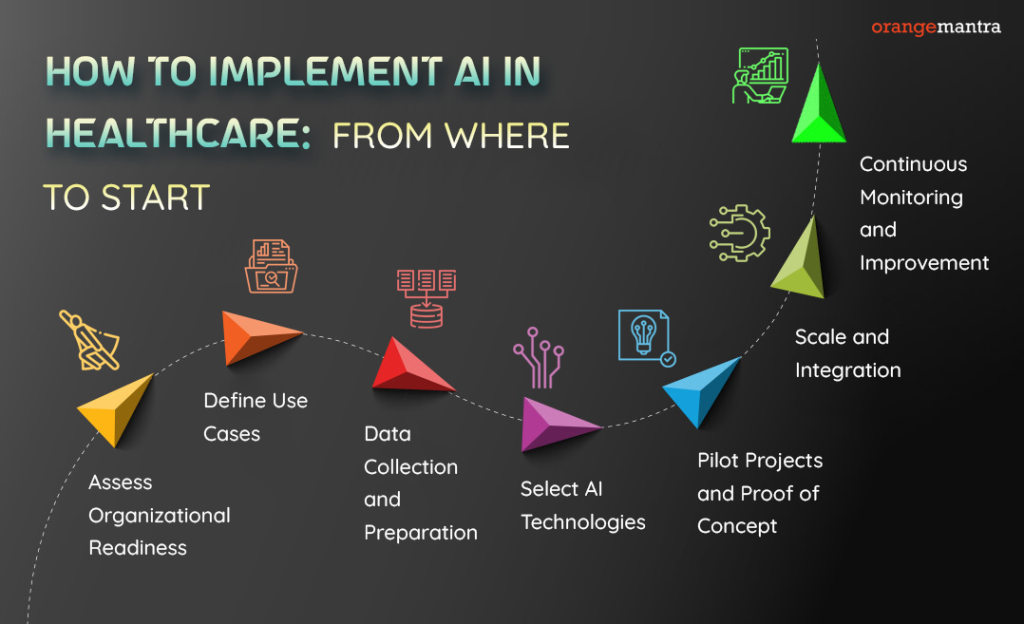
- Data Collection: Aggregating data from multiple sources (hospitals, wearables, research databases).
- Preprocessing: Cleaning, normalizing, and augmenting data to reduce noise.
- Model Training: Using labeled data to train algorithms (e.g., a CNN to recognize pneumonia in chest X-rays).
- Validation: Testing models on independent datasets to ensure generalizability.
- Deployment: Integrating AI into clinical workflows (e.g., as a plugin in radiology software).
- Monitoring: Continuously updating models with new data to maintain accuracy.
#Challenges in Implementation
- Data Quality: Incomplete or biased datasets can lead to inaccurate predictions.
- Interpretability: "Black-box" models (e.g., deep neural networks) are difficult to explain to clinicians.
- Regulatory Hurdles: AI tools must meet stringent standards (e.g., FDA’s SaMD framework).
- Ethical Concerns: Issues like algorithmic bias (e.g., underrepresentation of certain demographics in training data) and patient privacy (HIPAA compliance).
#Important Facts
- Accuracy Comparisons: - AI models have matched or exceeded human performance in tasks like diabetic retinopathy detection (Google DeepMind, 2016) and skin cancer classification (Stanford, 2017). - In radiology, AI tools like Aidoc and Lunit INSIGHT can flag abnormalities in CT scans with 90%+ sensitivity.
- Cost Savings: - AI-driven prior authorization automation can reduce administrative costs by up to 30% (McKinsey, 2022). - Predictive models for hospital readmissions can save $15 billion annually in the U.S. (IBM Watson Health).
- Drug Discovery: - AI has reduced the time for drug discovery from 10+ years to 2–5 years (e.g., BenevolentAI’s AI-discovered baricitinib for COVID-19).
- Generative AI (e.g., AlphaFold) predicts protein structures, accelerating vaccine development.
- Global Adoption:
- China leads in AI healthcare patents, followed by the U.S. and EU.
- India and Brazil are emerging markets for AI-driven telemedicine and diagnostics.
- Regulatory Landscape: - The FDA has approved over 200 AI/ML medical devices as of 2023, with 510(k) exemptions for low-risk tools. - The EU’s AI Act (2024) classifies AI in healthcare as "high-risk," mandating strict oversight.
#Timeline
- Foundational ideas
Core concepts and early methods shape The Science Behind AI in Healthcare.
- Practical use
Tools, examples, and real-world deployments make the topic easier to evaluate.
- Responsible implementation
Current work focuses on reliability, governance, performance, and measurable impact.
#Related Terms
#FAQ
What does The Science Behind AI in Healthcare cover?
Covers the science behind ai in healthcare, including core concepts, practical examples, benefits, limitations, and risks in AI in Healthcare.
Why is The Science Behind AI in Healthcare important?
It helps readers understand key concepts, compare practical use cases, and evaluate how AI in Healthcare decisions affect outcomes, risks, and implementation choices.
What should readers verify before applying this topic?
Readers should compare benefits, limitations, data requirements, and related themes such as Science, Behind, AI before using the ideas in real projects.
#References
- The Science Behind AI in Healthcare terminology and background research
- The Science Behind AI in Healthcare use cases, implementation examples, and limitations
- AI in Healthcare best practices, standards, and risk guidance
- Science case studies, benchmarks, and current industry analysis


Comments
No comments yet. Start the discussion with a useful note.