

#Short Answer
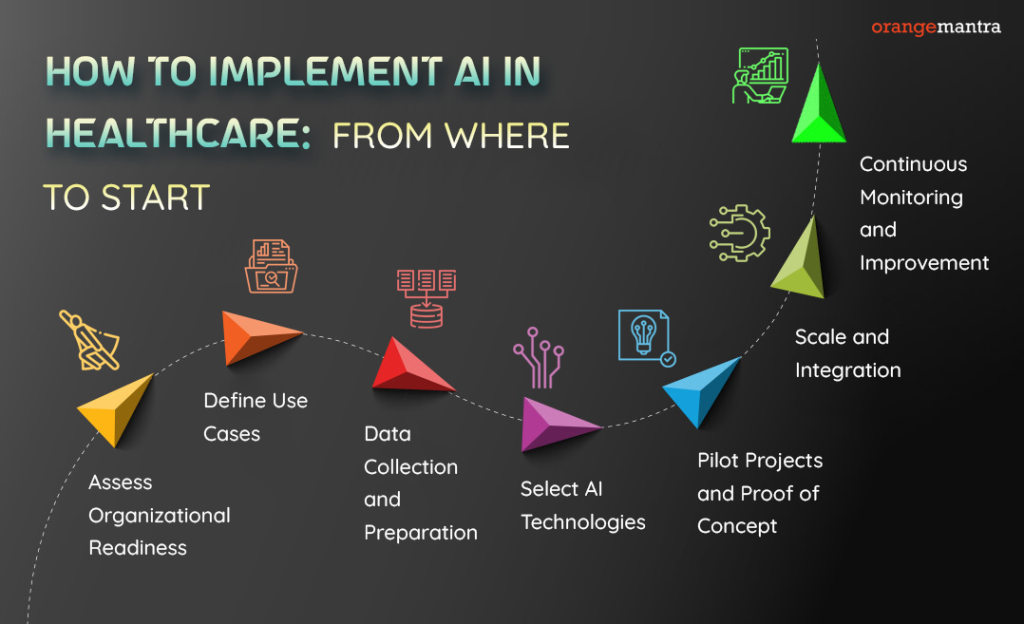
Explains how to get started with ai in healthcare, including the main process, tools, examples, risks, and practical implementation steps.
#Infobox
#Overview
Artificial Intelligence (AI) is transforming healthcare by enabling faster, more accurate diagnostics, personalized treatment plans, and streamlined administrative processes. AI systems analyze vast amounts of medical data—including electronic health records (EHRs), imaging scans, and genomic data—to identify patterns, predict outcomes, and assist clinicians in decision-making. From detecting early-stage cancers to optimizing hospital workflows, AI is becoming an indispensable tool in modern medicine. The integration of AI in healthcare is driven by the exponential growth of medical data, advancements in computing power, and the need for cost-effective solutions in an aging global population. While AI cannot replace human expertise, it serves as a powerful augmentation tool, enhancing the capabilities of healthcare professionals and improving patient outcomes.
#History / Background
#Early Foundations (1950s–1980s)
The concept of AI in healthcare dates back to the 1950s, with early experiments in rule-based systems for medical diagnosis. One of the first notable applications was MYCIN, developed in the 1970s at Stanford University. MYCIN was an expert system designed to diagnose bacterial infections and recommend antibiotics, showcasing the potential of AI in clinical decision support. During this period, AI research in healthcare was largely theoretical, constrained by limited computational power and data availability. However, the foundational work laid the groundwork for future advancements.
#The Rise of Machine Learning (1990s–2010s)
The 1990s and 2000s saw the emergence of machine learning (ML) techniques, which enabled AI systems to learn from data rather than rely solely on predefined rules. Projects like IBM Watson (launched in 2011) demonstrated how AI could process and analyze large volumes of medical literature to assist in cancer treatment recommendations. Advancements in natural language processing (NLP) allowed AI to extract insights from unstructured clinical notes, while computer vision began to play a role in medical imaging analysis, particularly in radiology.
#The Deep Learning Revolution (2010s–Present)
The breakthrough in deep learning—a subset of ML involving neural networks with multiple layers—revolutionized AI in healthcare. Deep learning models, particularly convolutional neural networks (CNNs), achieved human-level performance in tasks such as:
- Medical imaging analysis (e.g., detecting tumors in X-rays, MRIs, and CT scans).
- Pathology (e.g., identifying cancerous cells in biopsy slides).
- Drug discovery (e.g., predicting molecular interactions for new pharmaceuticals). The FDA’s approval of AI-based medical devices (e.g., IDx-DR for diabetic retinopathy screening) marked a significant milestone, legitimizing AI’s role in clinical practice. Today, AI is being deployed across various healthcare domains, from predictive analytics for patient deterioration to virtual health assistants for remote monitoring.
#How It Works
#Core AI Technologies in Healthcare
- Machine Learning (ML)
- Supervised Learning: Trained on labeled data (e.g., historical patient records with known outcomes) to predict future events (e.g., readmission risks, disease progression).
- Unsupervised Learning: Identifies patterns in unlabeled data (e.g., clustering patients with similar symptoms for personalized treatment).
- Reinforcement Learning: Optimizes treatment strategies by learning from trial-and-error interactions (e.g., dynamic dosing in chronic disease management).
- Natural Language Processing (NLP) - Extracts structured data from unstructured clinical notes, research papers, and patient feedback. - Enables chatbots and virtual assistants (e.g., symptom checkers, appointment schedulers). - Powers voice recognition for medical transcription.
- Computer Vision - Analyzes medical images (X-rays, MRIs, ultrasounds) to detect abnormalities (e.g., tumors, fractures). - Used in radiology, pathology, and ophthalmology for high-precision diagnostics.
- Robotics & Automation
- Surgical robots (e.g., da Vinci system) assist in minimally invasive procedures.
- Automated lab systems process samples and generate reports.
- AI-driven prosthetics adapt to user movements in real time.
#Data Infrastructure AI in healthcare relies on high-quality, interoperable data. Key components include:
- Electronic Health Records (EHRs): Digital records of patient histories, lab results, and medications.
- Medical Imaging Databases: Stores scans (DICOM format) for analysis.
- Genomic Data: DNA sequences for personalized medicine.
- IoT Devices: Wearables (e.g., glucose monitors, ECG patches) that generate real-time health data.
#AI Workflow in Healthcare
- Data Collection: Gathering structured and unstructured data from multiple sources.
- Data Preprocessing: Cleaning, normalizing, and annotating data for training.
- Model Training: Developing AI algorithms using ML techniques.
- Validation & Testing: Assessing model accuracy, sensitivity, and specificity in clinical trials.
- Deployment: Integrating AI tools into clinical workflows (e.g., EHR plugins, imaging software).
- Monitoring & Feedback: Continuously updating models based on new data and outcomes.
#Important Facts
- AI in Diagnostics - AI models can detect breast cancer in mammograms with 94% accuracy, comparable to radiologists.
- Google’s DeepMind developed an AI that predicts acute kidney injury 48 hours before symptoms appear.
- Drug Discovery - AI accelerates drug development by simulating molecular interactions and predicting drug efficacy.
- BenevolentAI used AI to identify a potential treatment for amyotrophic lateral sclerosis (ALS) in just 18 months (vs. 5+ years traditionally).
- Operational Efficiency - AI-powered chatbots reduce hospital call center workload by 30–50%.
- Predictive analytics can cut emergency room wait times by 20% by optimizing staff allocation.
- Challenges
- Bias in AI: Models trained on non-diverse datasets may perform poorly for underrepresented groups.
- Regulatory Hurdles: AI medical devices require FDA clearance, which can take years.
- Data Privacy: Compliance with HIPAA/GDPR is critical to avoid breaches.
- Economic Impact - The global AI in healthcare market is projected to reach $45.2 billion by 2026 (CAGR of 44.9%). - AI adoption could save the U.S. healthcare system $150 billion annually by 2026.
#Timeline
- Foundational ideas
Core concepts and early methods shape How to Get Started with AI in Healthcare.
- Practical use
Tools, examples, and real-world deployments make the topic easier to evaluate.
- Responsible implementation
Current work focuses on reliability, governance, performance, and measurable impact.
#Related Terms
#FAQ
What does How to Get Started with AI in Healthcare cover?
Explains how to get started with ai in healthcare, including the main process, tools, examples, risks, and practical implementation steps.
Why is How to Get Started with AI in Healthcare important?
It helps readers understand key concepts, compare practical use cases, and evaluate how AI in Healthcare decisions affect outcomes, risks, and implementation choices.
What should readers verify before applying this topic?
Readers should compare benefits, limitations, data requirements, and related themes such as Get, Started, AI before using the ideas in real projects.
#References
- How to Get Started with AI in Healthcare terminology and background research
- How to Get Started with AI in Healthcare use cases, implementation examples, and limitations
- AI in Healthcare best practices, standards, and risk guidance
- Get case studies, benchmarks, and current industry analysis


Comments
No comments yet. Start the discussion with a useful note.