

#Short Answer
Explores the future of neural networks, including emerging trends, practical impacts, risks, and important signals to watch.
#Infobox
#Overview
Neural networks, inspired by the biological neural systems of the human brain, have become the cornerstone of modern artificial intelligence (AI). Their ability to learn from vast datasets and generalize patterns has revolutionized fields such as computer vision, natural language processing (NLP), and robotics. As computational power and data availability continue to grow, the future of neural networks is poised to address longstanding limitations while unlocking unprecedented capabilities. The evolution of neural networks is characterized by a shift from traditional feedforward architectures to more complex and dynamic models. Innovations such as deep learning, transformers, and neuromorphic computing are redefining the boundaries of what AI systems can achieve. These advancements are not only enhancing performance but also addressing critical challenges like interpretability, energy efficiency, and ethical considerations.
#History / Background
#Early Foundations (1940s–1980s)
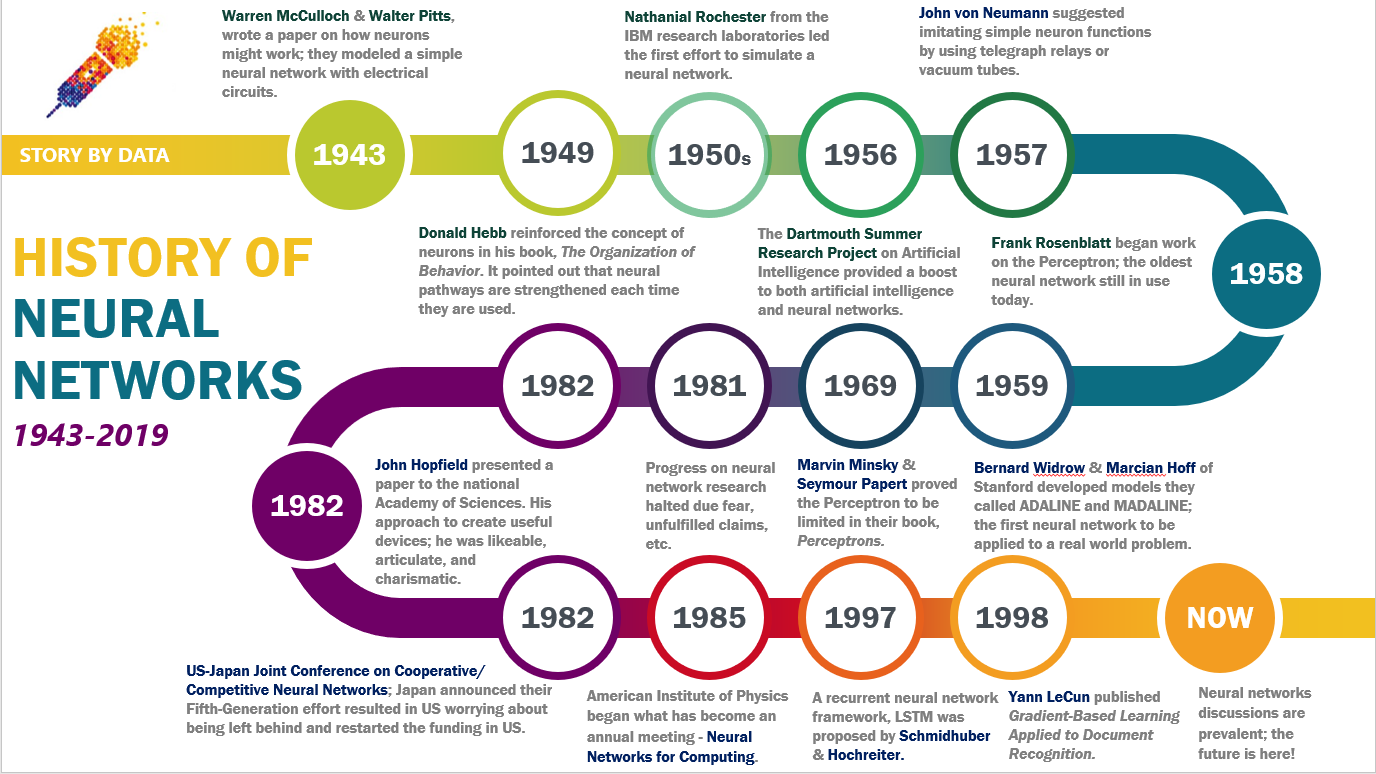
The concept of neural networks traces back to the 1940s with the work of Warren McCulloch and Walter Pitts, who proposed a mathematical model of artificial neurons. This foundational work laid the groundwork for perceptrons, introduced by Frank Rosenblatt in 1958, which were among the first trainable neural networks. However, limitations in computational power and the XOR problem (a limitation in single-layer perceptrons) led to a decline in interest during the 1970s.
#The Revival (1980s–2000s)
The resurgence of neural networks began in the 1980s with the introduction of backpropagation, a method for training multi-layer networks. Geoffrey Hinton, Yann LeCun, and others pioneered deep learning, demonstrating its potential in tasks like handwritten digit recognition. The development of convolutional neural networks (CNNs) by LeCun in the 1990s further advanced image processing capabilities.
#The Deep Learning Era (2010s–Present)
The 2010s marked a turning point with the advent of big data and graphical processing units (GPUs), enabling the training of large-scale neural networks. Key milestones include:
- AlexNet (2012): A CNN that achieved breakthrough performance in the ImageNet competition.
- AlphaGo (2016): A deep reinforcement learning system that defeated a world champion Go player.
- Transformers (2017): Introduced by Vaswani et al., these architectures revolutionized NLP with models like BERT and GPT.
#How It Works
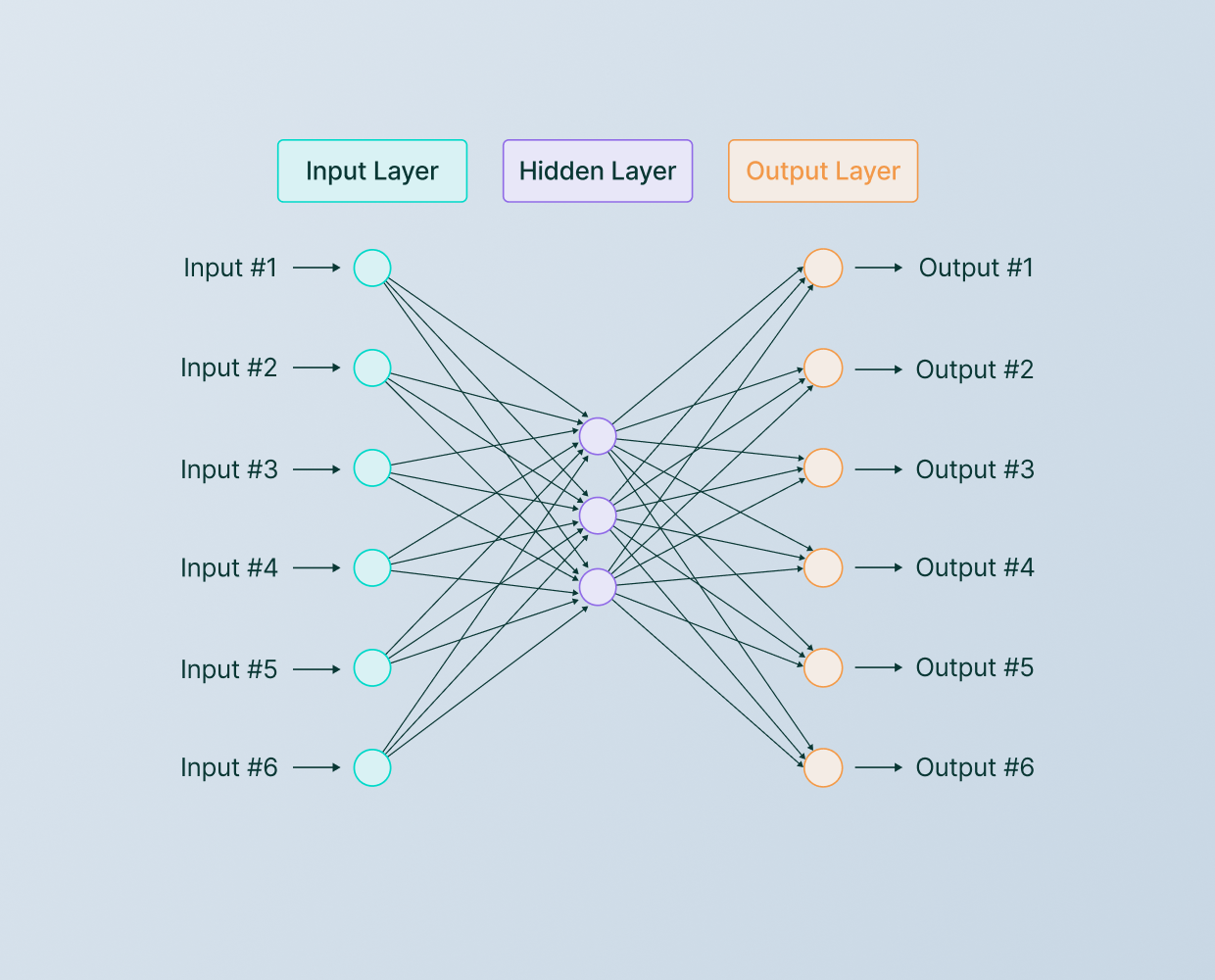
#Core Principles Neural networks consist of interconnected layers of artificial neurons (nodes), each performing simple computations. The three primary types of layers are:
- Input Layer: Receives raw data (e.g., pixels in an image or words in a sentence).
- Hidden Layers: Perform intermediate computations, extracting features through weighted connections.
- Output Layer: Produces the final prediction or classification.
#Key Mechanisms
- Forward Propagation: Data flows through the network, with each neuron applying an activation function (e.g., ReLU, sigmoid) to its inputs.
- Backpropagation: A training algorithm that adjusts weights based on the error gradient, minimizing the difference between predicted and actual outputs.
- Optimization: Techniques like stochastic gradient descent (SGD) and Adam are used to refine the model’s parameters.
#Advanced Architectures
- Convolutional Neural Networks (CNNs): Specialized for grid-like data (e.g., images), using convolutional layers to detect spatial hierarchies.
- Recurrent Neural Networks (RNNs): Designed for sequential data (e.g., time series), with loops that allow information to persist.
- Transformers: Replace RNNs with self-attention mechanisms, enabling parallel processing and superior performance in NLP tasks.
- Generative Adversarial Networks (GANs): Comprise two networks—a generator and a discriminator—competing to produce realistic data (e.g., images, text).
#Important Facts
- Scalability: Modern neural networks can contain billions of parameters (e.g., GPT-4 has over 1 trillion), requiring massive computational resources.
- Energy Consumption: Training large models consumes significant electricity; for example, training a single transformer model can emit as much CO₂ as five cars in their lifetimes.
- Data Dependency: Neural networks rely on vast, high-quality datasets. Biases in training data can lead to unfair or inaccurate predictions.
- Interpretability: "Black-box" nature of deep learning models makes it difficult to explain their decisions, a critical issue in healthcare and finance.
- Hardware Advancements: TPUs (Tensor Processing Units) and GPUs have accelerated training, while neuromorphic chips (e.g., Intel’s Loihi) mimic biological neurons for energy efficiency.
- Federated Learning: Enables training across decentralized devices (e.g., smartphones) without sharing raw data, addressing privacy concerns.
- Quantum Neural Networks: Emerging field combining quantum computing with neural networks to solve complex optimization problems.
#Timeline
- Foundational ideas
Core concepts and early methods shape The Future of Neural Networks.
- Practical use
Tools, examples, and real-world deployments make the topic easier to evaluate.
- Responsible implementation
Current work focuses on reliability, governance, performance, and measurable impact.
#Related Terms
#FAQ
What does The Future of Neural Networks cover?
Explores the future of neural networks, including emerging trends, practical impacts, risks, and important signals to watch.
Why is The Future of Neural Networks important?
It helps readers understand key concepts, compare practical use cases, and evaluate how Machine Learning decisions affect outcomes, risks, and implementation choices.
What should readers verify before applying this topic?
Readers should compare benefits, limitations, data requirements, and related themes such as Future, Neural, Networks before using the ideas in real projects.
#References
- The Future of Neural Networks terminology and background research
- The Future of Neural Networks use cases, implementation examples, and limitations
- Machine Learning best practices, standards, and risk guidance
- Future case studies, benchmarks, and current industry analysis
Comments
No comments yet. Start the discussion with a useful note.