

#Short Answer
Covers meaning of ai in gaming, including core concepts, practical examples, benefits, limitations, and risks in Artificial Intelligence.
#Infobox
#Overview
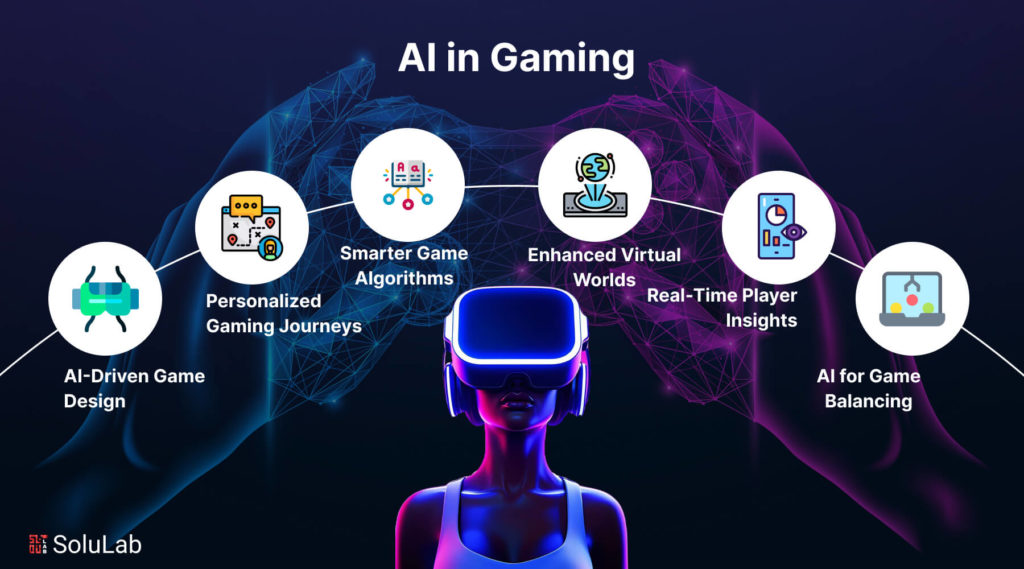
Artificial Intelligence (AI) has become a cornerstone of modern gaming, revolutionizing how games are designed, played, and experienced. Unlike traditional static games, AI-driven games leverage computational power to create responsive, unpredictable, and immersive environments. From non-player characters (NPCs) that exhibit human-like decision-making to procedurally generated worlds that evolve with player input, AI enhances both the depth and replayability of games. The role of AI extends beyond mere automation—it enables games to learn from player behavior, adjust difficulty dynamically, and even generate unique narratives. This adaptability fosters deeper engagement, as players encounter challenges tailored to their skill level and preferences. Moreover, AI-driven tools assist developers in streamlining production, from automated asset generation to intelligent bug detection, reducing development time while increasing creativity. As AI technology advances, its integration into gaming continues to push boundaries, blurring the line between virtual and real-world interactions. The future of gaming lies in AI’s ability to create truly personalized experiences, where every playthrough feels distinct and every decision carries weight.
#History / Background
#Early Foundations (1950s–1980s)
The concept of AI in gaming traces back to the mid-20th century, with early experiments in computer science laying the groundwork for intelligent systems. One of the first notable examples was Eliza (1966), an early natural language processing program that simulated conversation, though not directly tied to gaming. The 1970s saw the rise of text-based adventure games like Colossal Cave Adventure (1976), which used simple parsing to interpret player commands. The 1980s marked a turning point with arcade and console games incorporating basic AI. Pac-Man (1980) featured ghosts with distinct movement patterns, creating a dynamic challenge. Similarly, Pong (1972) and Space Invaders (1978) used simple rule-based AI to control enemy behavior. These early implementations were limited by hardware constraints but established the foundation for future advancements.
#The 1990s: Emergence of Advanced AI The 1990s brought significant progress with the advent of 3D graphics and more sophisticated AI algorithms. Games like Quake (1996) and Half-Life (1998) introduced pathfinding algorithms (e.g., A* search) to enable NPCs to navigate complex environments intelligently. Black & White (2001) took AI further by incorporating learning mechanics, where the player’s actions influenced the behavior of a virtual creature. This era also saw the rise of procedural content generation (PCG), where AI algorithms created game worlds dynamically. Elite (1984) and Diablo (1996) used PCG to generate vast, unique environments, reducing the need for manual design.
#The 2000s: AI Goes Mainstream The 2000s witnessed AI’s integration into mainstream gaming, driven by increased computational power and the popularity of open-world games. F.E.A.R. (2005) featured NPCs that coordinated attacks and took cover, mimicking tactical human behavior. The Sims (2000) introduced AI-driven life simulation, where virtual characters pursued goals autonomously. Machine learning also began to play a role, with games like Left 4 Dead (2008) using AI to adjust enemy spawns based on player performance, ensuring a balanced challenge. This period also saw the rise of adaptive difficulty systems, where games like Max Payne (2001) and Bayonetta (2009) dynamically altered enemy strength to match the player’s skill.
#The 2010s–Present: AI-Driven Innovation The last decade has seen AI become a defining feature of modern gaming, with deep learning and reinforcement learning enabling unprecedented realism. The Last of Us Part II (2020) used AI to create NPCs with complex decision-making, while Red Dead Redemption 2 (2018) employed advanced pathfinding and animation blending for lifelike characters. Procedural generation reached new heights with games like No Man’s Sky (2016), which uses AI to generate entire planets with unique ecosystems. AI also powers dynamic storytelling, as seen in Detroit: Become Human (2018), where characters make autonomous choices based on player interactions. Today, AI is not just a tool for developers but a core component of gameplay, with AI-driven NPCs, procedural quests, and adaptive soundtracks becoming standard in high-budget titles. The rise of generative AI (e.g., tools like NVIDIA’s GauGAN for asset creation) is further accelerating innovation, allowing for faster and more creative game development.
#How It Works
#Core AI Techniques in Gaming AI in gaming relies on a combination of algorithms, data structures, and computational models to simulate intelligence. The most common techniques include:
- Rule-Based Systems
The simplest form of AI, where NPCs follow predefined scripts or decision trees. For example, in Pac-Man, ghosts adhere to specific movement rules (e.g., chasing the player or patrolling). While limited, rule-based AI is still used in games requiring predictable behavior.
- Pathfinding Algorithms
NPCs need to navigate environments efficiently, which is achieved through algorithms like:
- *A (A-Star)**: A widely used pathfinding algorithm that calculates the shortest path between two points while avoiding obstacles.
- Dijkstra’s Algorithm: Similar to A*, but prioritizes nodes based on distance rather than heuristic estimates.
- Navigation Meshes: 3D representations of walkable surfaces that help NPCs move realistically in complex environments. Games like The Elder Scrolls V: Skyrim (2011) use these algorithms to ensure NPCs don’t clip through walls or get stuck.
- Finite State Machines (FSM)
FSMs model NPC behavior as a set of states (e.g., "patrol," "attack," "flee") with transitions based on conditions. For example, an enemy in Halo (2001) might switch from "patrol" to "attack" when detecting the player. FSMs are easy to implement but can become rigid in complex scenarios.
- Behavior Trees
A more flexible alternative to FSMs, behavior trees allow NPCs to make decisions based on hierarchical rules. Each node represents a decision (e.g., "Is the player visible?"), and branches determine subsequent actions. The Last of Us Part II uses behavior trees to create NPCs that react dynamically to combat situations.
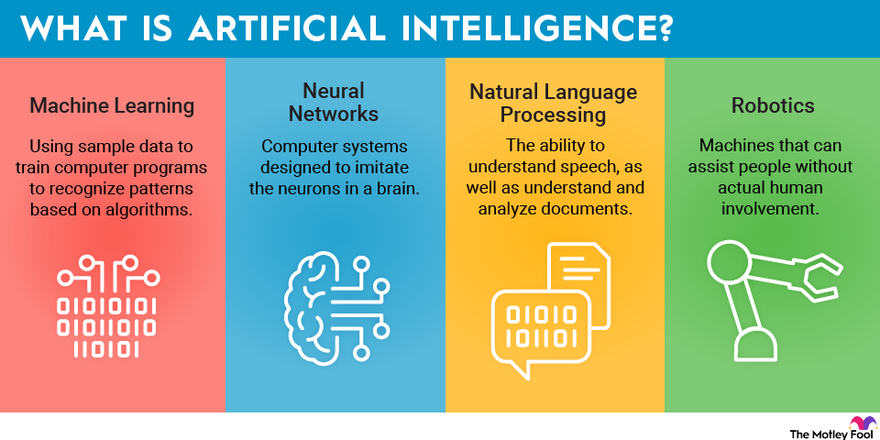
- Machine Learning (ML) and Neural Networks
ML enables NPCs to learn from player behavior and adapt over time. Techniques include:
- Supervised Learning: Training NPCs using labeled datasets (e.g., teaching an AI to recognize enemy patterns).
- Reinforcement Learning (RL): NPCs learn optimal strategies through trial and error, rewarding desired behaviors. AlphaStar (DeepMind’s AI for StarCraft II) uses RL to outperform human players.
- Neural Networks: Deep learning models simulate human-like decision-making. For example, NVIDIA’s GameGAN uses generative adversarial networks (GANs) to create game environments from scratch.
- Procedural Content Generation (PCG)
PCG uses algorithms to generate game content dynamically, including:
- World Generation: Minecraft (2011) uses Perlin noise to create infinite, unique landscapes.
- Quest Generation: Dwarf Fortress (2006) generates complex narratives based on character interactions.
- Asset Creation: AI tools like NVIDIA’s Canvas generate textures and sprites automatically.
- Natural Language Processing (NLP)
NLP enables NPCs to understand and respond to player speech. Games like Detroit: Become Human use NLP to interpret dialogue choices, while voice-controlled games (e.g., The Quarry, 2022) rely on speech recognition.
- Dynamic Difficulty Adjustment (DDA)
DDA systems analyze player performance and adjust game parameters in real-time. For example: - Left 4 Dead’s "AI Director" spawns enemies based on player stress levels. - Resident Evil 4 Remake (2023) scales enemy aggression to match player skill.
#Important Facts
- AI Enhances Realism - NPCs in Red Dead Redemption 2 use animation blending to transition between actions seamlessly, creating lifelike movement. - The Last of Us Part II employs facial animation AI to simulate realistic expressions and emotions.
- Procedural Generation Saves Development Time - No Man’s Sky’s universe was generated using AI, reducing the need for manual asset creation. - Roguelike games like Dead Cells (2018) use PCG to ensure endless replayability.
- AI Can Beat Human Players - AlphaGo (2016) defeated world champion Go player Lee Sedol, demonstrating AI’s strategic superiority. - AlphaStar achieved Grandmaster status in StarCraft II without human input.
- AI Drives Accessibility - Games like The Last of Us Part II include AI-assisted difficulty modes for players with disabilities. - AI-powered text-to-speech and voice recognition improve accessibility in narrative-driven games.
- AI is Used in Game Development
- NVIDIA’s Omniverse allows developers to simulate lighting, physics, and AI behaviors in real-time.
- Unity’s ML-Agents enables developers to train NPCs using reinforcement learning.
- Ethical Concerns Exist
- Deepfake NPCs: AI-generated voices and faces raise questions about consent and authenticity.
- Job Displacement: Automation in game development may reduce the need for certain roles (e.g., level designers).
- AI is Revolutionizing Esports - AI tools analyze player strategies to predict outcomes and optimize training. - Dota 2’s OpenAI Five demonstrated AI’s potential in competitive gaming.
#Timeline
- Foundational ideas
Core concepts and early methods shape Meaning of AI in Gaming.
- Practical use
Tools, examples, and real-world deployments make the topic easier to evaluate.
- Responsible implementation
Current work focuses on reliability, governance, performance, and measurable impact.
#Related Terms
#FAQ
What does Meaning of AI in Gaming cover?
Covers meaning of ai in gaming, including core concepts, practical examples, benefits, limitations, and risks in Artificial Intelligence.
Why is Meaning of AI in Gaming important?
It helps readers understand key concepts, compare practical use cases, and evaluate how Artificial Intelligence decisions affect outcomes, risks, and implementation choices.
What should readers verify before applying this topic?
Readers should compare benefits, limitations, data requirements, and related themes such as Meaning, AI, Gaming before using the ideas in real projects.
#References
- Meaning of AI in Gaming terminology and background research
- Meaning of AI in Gaming use cases, implementation examples, and limitations
- Artificial Intelligence best practices, standards, and risk guidance
- Meaning case studies, benchmarks, and current industry analysis

Comments
No comments yet. Start the discussion with a useful note.