


#Short Answer
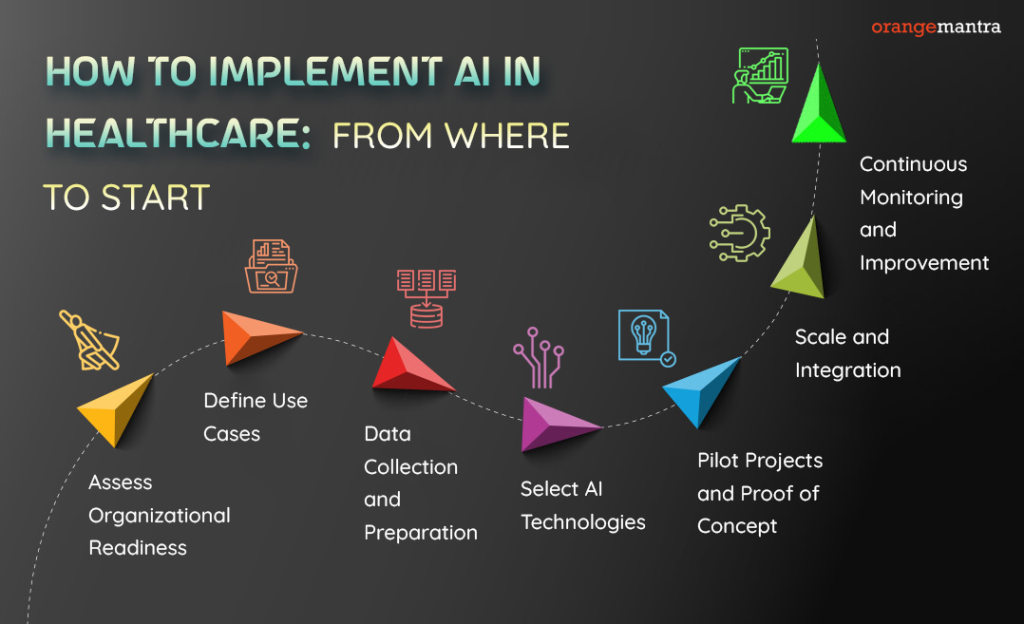
Explains how healthcare uses ai: case studies, including the main process, tools, examples, risks, and practical implementation steps.
#Infobox
#Overview
Artificial Intelligence (AI) has emerged as a transformative force in healthcare, reshaping how medical professionals diagnose, treat, and manage diseases. By leveraging vast amounts of clinical data, AI systems can identify patterns, predict outcomes, and automate routine tasks—enabling faster, more accurate, and cost-effective care. The integration of AI spans multiple domains, including diagnostics, treatment planning, drug development, and hospital management. AI in healthcare is not a monolithic concept but a collection of technologies applied across various medical specialties. These include machine learning models trained on medical images, natural language processing systems that extract insights from unstructured clinical notes, and predictive analytics tools that forecast patient deterioration. As AI capabilities grow—particularly with advancements in generative AI—its role in personalized medicine and preventive care continues to expand. The adoption of AI in healthcare is driven by the exponential growth of medical data, the need for precision medicine, and the pressure to reduce healthcare costs. While challenges such as data privacy, regulatory hurdles, and ethical concerns persist, the potential benefits are substantial, positioning AI as a cornerstone of next-generation healthcare delivery.
#History / Background
The concept of AI in medicine dates back to the 1970s, with early systems like MYCIN, developed at Stanford University, which used rule-based logic to diagnose bacterial infections and recommend antibiotics. MYCIN demonstrated the potential of AI to assist clinicians, though it was limited by computational power and data availability. The 1980s and 1990s saw the rise of expert systems and early machine learning applications in medical imaging, particularly in radiology. However, progress was slow due to technological constraints and skepticism from the medical community. The real turning point came in the 2010s with the advent of deep learning and the availability of large, labeled medical datasets. Breakthroughs such as Google’s DeepMind achieving superhuman performance in detecting diabetic retinopathy from retinal scans (2016) and IBM Watson for Oncology assisting in cancer treatment planning marked a new era. The proliferation of electronic health records (EHRs) and the digitization of medical imaging further fueled AI adoption. Today, AI is embedded in various healthcare workflows, from triaging patients in emergency departments to accelerating drug discovery. The COVID-19 pandemic accelerated AI deployment, particularly in vaccine development and predictive modeling of disease spread. Regulatory bodies like the FDA have begun approving AI-driven medical devices, signaling growing acceptance of AI as a clinical tool.
#How It Works
AI in healthcare operates through several core technologies and methodologies:
#
- Machine Learning (ML) and Deep Learning ML models, including neural networks, are trained on large datasets to recognize patterns. In medical imaging, convolutional neural networks (CNNs) analyze X-rays, MRIs, and CT scans to detect abnormalities such as tumors or fractures. For example, deep learning models can distinguish between malignant and benign lesions with accuracy comparable to or exceeding that of radiologists.
#
- Natural Language Processing (NLP) NLP enables AI systems to extract meaningful information from unstructured clinical text, such as physician notes or discharge summaries. Tools like IBM Watson use NLP to parse medical literature, summarize patient histories, and suggest treatment options based on published evidence.
#
- Predictive Analytics AI models analyze patient data—including lab results, vital signs, and historical records—to predict outcomes such as hospital readmissions, sepsis onset, or disease progression. These models help clinicians intervene early and optimize care pathways.
#
- Robotics and Automation AI-powered robotic systems assist in surgeries, such as the da Vinci Surgical System, which enhances precision and reduces recovery times. AI also automates administrative tasks like scheduling, billing, and coding, reducing administrative burden on healthcare staff.
#
- Generative AI Recent advancements in generative AI, such as large language models (LLMs), are being explored for creating synthetic medical data, drafting clinical documentation, and simulating patient scenarios for training purposes. These models can also generate personalized health insights based on patient queries.
#
- Computer Vision Beyond imaging, computer vision is used in pathology (e.g., analyzing tissue slides), dermatology (e.g., detecting skin cancer from photos), and even in public health surveillance (e.g., tracking disease outbreaks via social media or satellite imagery).
#Important Facts
- Accuracy: AI systems have demonstrated diagnostic accuracy in certain areas exceeding 90%, particularly in radiology and pathology.
- Speed: AI can analyze medical images in seconds, compared to minutes or hours for human experts.
- Cost Reduction: AI-driven automation in administrative tasks can save hospitals up to $18 billion annually in the U.S.
- Drug Discovery: AI has reduced the time and cost of drug development by up to 50%, enabling faster identification of potential drug candidates.
- Personalization: AI enables precision medicine by tailoring treatments based on individual genetic, lifestyle, and clinical data.
- Regulatory Approval: Over 200 AI-enabled medical devices have received FDA clearance as of 2024.
- Data Volume: A single patient’s EHR can contain thousands of data points, making AI essential for synthesizing and interpreting this information.
#Timeline
- Foundational ideas
Core concepts and early methods shape How Healthcare Uses AI: Case Studies.
- Practical use
Tools, examples, and real-world deployments make the topic easier to evaluate.
- Responsible implementation
Current work focuses on reliability, governance, performance, and measurable impact.
#Related Terms
#FAQ
What does How Healthcare Uses AI: Case Studies cover?
Explains how healthcare uses ai: case studies, including the main process, tools, examples, risks, and practical implementation steps.
Why is How Healthcare Uses AI: Case Studies important?
It helps readers understand key concepts, compare practical use cases, and evaluate how AI in Healthcare decisions affect outcomes, risks, and implementation choices.
What should readers verify before applying this topic?
Readers should compare benefits, limitations, data requirements, and related themes such as Healthcare, Uses, AI before using the ideas in real projects.
#References
- How Healthcare Uses AI: Case Studies terminology and background research
- How Healthcare Uses AI: Case Studies use cases, implementation examples, and limitations
- AI in Healthcare best practices, standards, and risk guidance
- Healthcare case studies, benchmarks, and current industry analysis


Comments
No comments yet. Start the discussion with a useful note.