

#Short Answer
Explains how do ai tools work?, including the main process, tools, examples, risks, and practical implementation steps.
#Infobox
#Overview
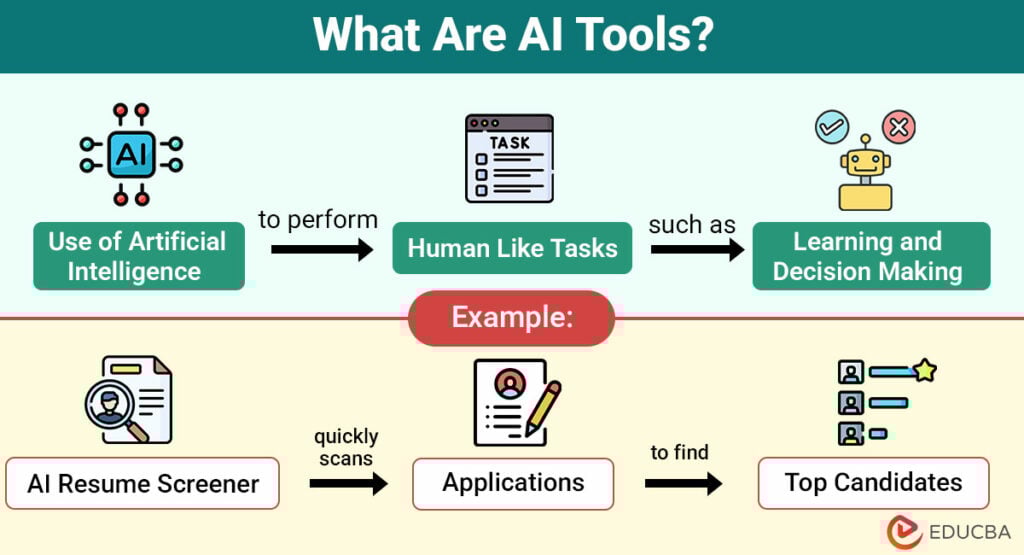
Artificial Intelligence (AI) tools represent a transformative class of software designed to emulate human-like cognitive abilities. These tools are built on advanced algorithms and computational models that enable machines to process vast amounts of data, identify trends, and make informed decisions with minimal human intervention. Unlike traditional software, which follows rigid, pre-defined instructions, AI tools adapt and improve over time through exposure to new data—a process known as machine learning. The scope of AI tools spans a wide range of applications, from virtual assistants that understand and respond to natural language queries to predictive analytics platforms that forecast market trends. In healthcare, AI tools assist in diagnosing diseases by analyzing medical images and patient records. In finance, they detect fraudulent transactions by monitoring unusual patterns. Retailers use AI to personalize shopping experiences, while manufacturers employ it to optimize supply chains and quality control. AI tools are not monolithic; they encompass various subfields, including machine learning (ML), deep learning, natural language processing (NLP), and computer vision. Each subfield contributes specialized capabilities that enable AI tools to perform specific functions, such as text generation, speech recognition, or object detection. The adoption of AI tools has accelerated due to advancements in computing power, the availability of large datasets, and breakthroughs in algorithmic design. As a result, AI tools have become integral to modern digital infrastructure, driving innovation and efficiency across sectors.
#History / Background
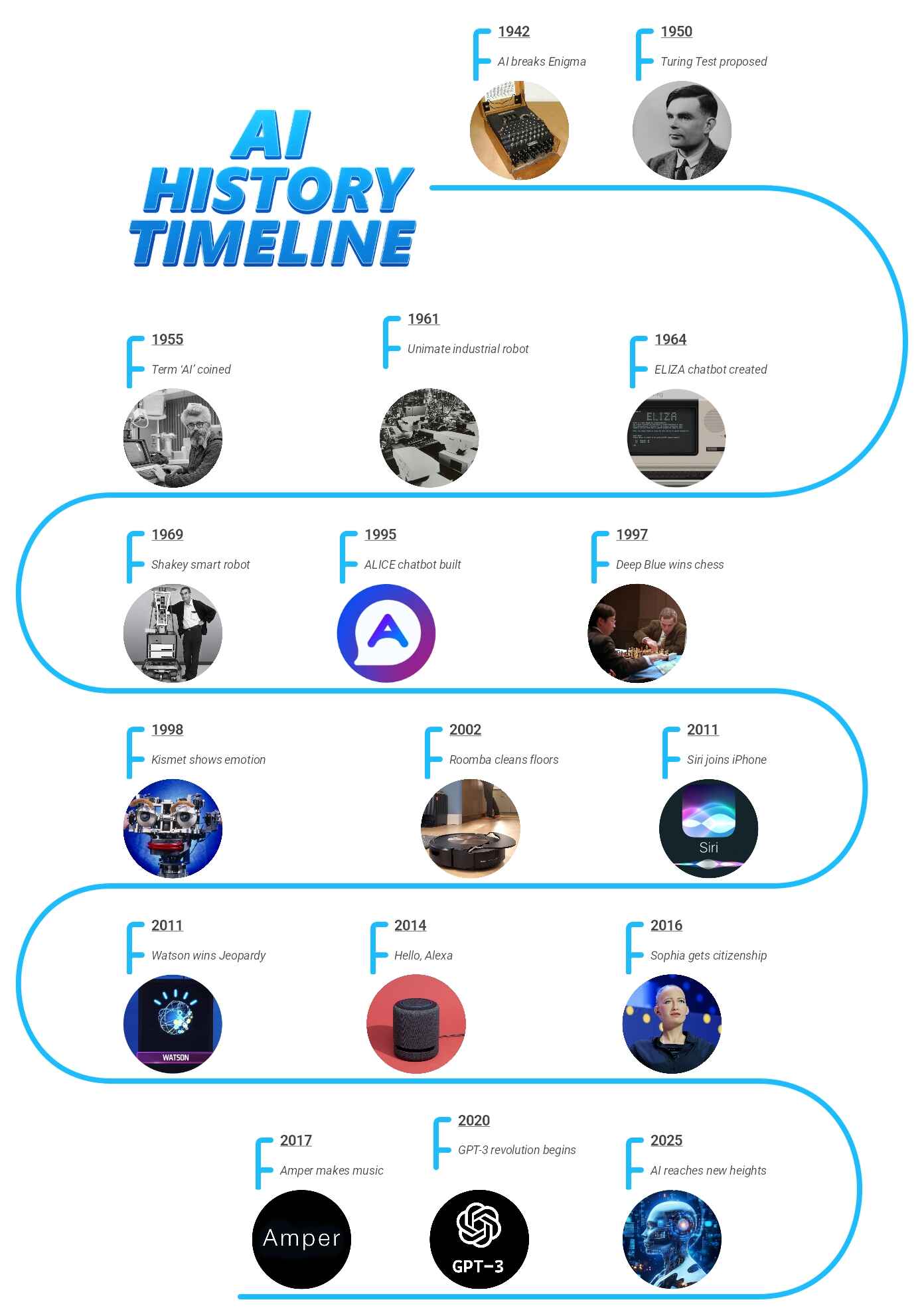
The evolution of AI tools is deeply intertwined with the broader history of artificial intelligence, which traces its origins to mid-20th century theoretical foundations and early computational experiments.
#Early Foundations (1940s–1950s)
The concept of AI was first articulated in 1950 by mathematician and computer scientist Alan Turing, who proposed the "Turing Test" as a criterion for machine intelligence. In 1956, the term "artificial intelligence" was coined at the Dartmouth Conference, marking the formal beginning of AI as a field of study. Early AI research focused on symbolic reasoning and rule-based systems, such as the Logic Theorist developed by Allen Newell and Herbert Simon, which could prove mathematical theorems.
#The Rise of Expert Systems (1960s–1980s)
During this period, AI tools evolved into expert systems, which encoded human expertise into rule-based programs. Notable examples include MYCIN, a medical diagnosis system, and DENDRAL, used for chemical analysis. These systems demonstrated the potential of AI to solve complex problems in specialized domains. However, they were limited by their reliance on hand-crafted rules and struggled with scalability.
#Machine Learning Revolution (1980s–2000s)
The advent of machine learning shifted the paradigm from rule-based systems to data-driven models. Algorithms such as decision trees, support vector machines (SVM), and neural networks enabled systems to learn from data rather than rely solely on predefined rules. The development of backpropagation in the 1980s facilitated training of multi-layer neural networks, laying the groundwork for modern deep learning.
#Deep Learning and Big Data (2010s–Present)
The breakthrough in deep learning—a subset of machine learning using multi-layered neural networks—drove a surge in AI tool capabilities. Key milestones include:
- 2012: AlexNet, a deep convolutional neural network, won the ImageNet competition, showcasing the power of deep learning in image recognition.
- 2016: Google’s AlphaGo defeated a world champion Go player, demonstrating AI’s ability to master complex, strategic games.
- 2020s: The proliferation of transformer models (e.g., BERT, GPT) revolutionized natural language processing, enabling tools like chatbots and language translators to achieve near-human performance. The availability of big data, cloud computing, and open-source AI frameworks (e.g., TensorFlow, PyTorch) democratized access to AI tools, enabling businesses and individuals to deploy sophisticated models without extensive in-house expertise.
#How It Works
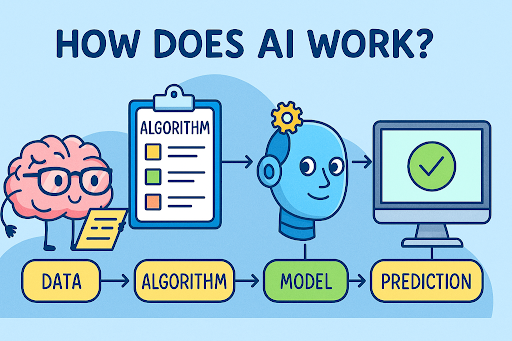
AI tools operate through a combination of data ingestion, model training, inference, and feedback loops. The process can be broken down into several core stages:
#1. Data Collection and Preprocessing AI tools rely on high-quality, diverse datasets. Data is collected from various sources, including sensors, databases, user interactions, and public repositories. Before training, the data undergoes preprocessing, which involves:
- Cleaning: Removing noise, duplicates, and inconsistencies.
- Normalization: Scaling data to a standard range to improve model performance.
- Feature Extraction: Identifying relevant variables (features) that influence the model’s output.
- Augmentation: Generating synthetic data to enhance training robustness (common in computer vision and NLP).
#2. Model Selection and Training The choice of model depends on the task:
- Supervised Learning: The model is trained on labeled data (input-output pairs). Examples include classification (e.g., spam detection) and regression (e.g., price prediction).
- Unsupervised Learning: The model identifies patterns in unlabeled data, such as clustering (e.g., customer segmentation) or anomaly detection.
- Reinforcement Learning: The model learns by interacting with an environment and receiving rewards for correct actions (e.g., robotics, game-playing AI). Training involves feeding the preprocessed data into the model and adjusting its internal parameters (e.g., weights in a neural network) to minimize error. This is typically done using optimization algorithms like gradient descent.
#3. Inference and Prediction Once trained, the model can make predictions or decisions on new, unseen data. For example: - A chatbot uses NLP models to interpret user input and generate responses. - A fraud detection tool analyzes transaction patterns to flag suspicious activity. - A recommendation system predicts user preferences based on past behavior.
#4. Feedback and Continuous Learning Many AI tools incorporate feedback mechanisms to improve over time. For instance:
- Active Learning: The system queries users for labels on uncertain predictions to refine its model.
- Online Learning: The model updates incrementally as new data arrives.
- Human-in-the-Loop: Human experts review and correct model outputs, especially in high-stakes applications like healthcare.
#Core Technologies
Behind AI Tools | Technology | Function | Example Use Cases | |------------------------------|-----------------------------------------------------------------------------|-----------------------------------------------| | Machine Learning (ML) | Learns patterns from data without explicit programming | Spam filtering, demand forecasting | | Deep Learning | Uses neural networks with multiple layers to model complex data relationships | Image recognition, speech synthesis | | Natural Language Processing (NLP) | Enables machines to understand, interpret, and generate human language | Chatbots, sentiment analysis, translation | | Computer Vision | Analyzes and interprets visual data from images or videos | Facial recognition, autonomous vehicles | | Reinforcement Learning | Learns optimal actions through trial and error in an environment | Robotics, game AI, resource management |
#Important Facts
- AI tools are not autonomous: They require human oversight for training, validation, and ethical considerations.
- Bias in AI: AI tools can perpetuate or amplify biases present in training data, leading to unfair outcomes (e.g., in hiring or lending algorithms).
- Explainability: Many AI models, especially deep learning, operate as "black boxes," making it difficult to understand their decision-making processes.
- Energy Consumption: Training large AI models (e.g., LLMs) consumes significant computational resources, raising environmental concerns.
- Regulation: Governments are increasingly implementing AI-specific regulations (e.g., EU AI Act) to address ethical, privacy, and safety concerns.
- Accessibility: Open-source AI tools (e.g., Hugging Face, TensorFlow) have lowered barriers to entry, enabling small businesses and researchers to innovate.
- Multimodal AI: Modern tools can process and integrate multiple data types (e.g., text, images, audio), enabling richer applications like virtual assistants.
#Timeline
- Foundational ideas
Core concepts and early methods shape How Do AI Tools Work?.
- Practical use
Tools, examples, and real-world deployments make the topic easier to evaluate.
- Responsible implementation
Current work focuses on reliability, governance, performance, and measurable impact.
#Related Terms
#FAQ
What does How Do AI Tools Work? cover?
Explains how do ai tools work?, including the main process, tools, examples, risks, and practical implementation steps.
Why is How Do AI Tools Work? important?
It helps readers understand key concepts, compare practical use cases, and evaluate how AI Tools decisions affect outcomes, risks, and implementation choices.
What should readers verify before applying this topic?
Readers should compare benefits, limitations, data requirements, and related themes such as Do, AI, Tools before using the ideas in real projects.
#References
- How Do AI Tools Work? terminology and background research
- How Do AI Tools Work? use cases, implementation examples, and limitations
- AI Tools best practices, standards, and risk guidance
- Do case studies, benchmarks, and current industry analysis

Comments
No comments yet. Start the discussion with a useful note.