

#Short Answer
Covers facts about ai in healthcare, including core concepts, practical examples, benefits, limitations, and risks in AI in Healthcare.
#Infobox
#Overview
Artificial Intelligence (AI) in healthcare represents a paradigm shift in how medical professionals diagnose, treat, and manage diseases. By leveraging advanced algorithms and computational power, AI systems can process and interpret complex medical data at speeds and scales unattainable by humans. This technology is not merely an auxiliary tool but a transformative force that enhances clinical decision-making, reduces human error, and personalizes patient care. AI applications in healthcare span a wide spectrum, including medical imaging analysis (e.g., detecting tumors in X-rays or MRIs), predictive analytics (e.g., forecasting patient deterioration or readmission risks), drug discovery (e.g., identifying potential drug compounds), and operational optimization (e.g., streamlining hospital workflows). The integration of AI with electronic health records (EHRs) enables real-time data analysis, improving efficiency and reducing administrative burdens. One of the most significant advantages of AI in healthcare is its ability to detect patterns in large datasets that may elude human observation. For instance, AI models trained on thousands of retinal images can identify early signs of diabetic retinopathy with accuracy comparable to or exceeding that of human experts. Similarly, AI-driven genomics tools can analyze DNA sequences to predict an individual’s susceptibility to certain diseases, paving the way for precision medicine. However, the adoption of AI in healthcare is not without challenges. Issues such as data privacy, algorithmic bias, and regulatory compliance must be addressed to ensure ethical and equitable deployment. Despite these hurdles, the global AI in healthcare market is projected to grow exponentially, driven by increasing investments, technological advancements, and the pressing need for cost-effective healthcare solutions.
#History / Background
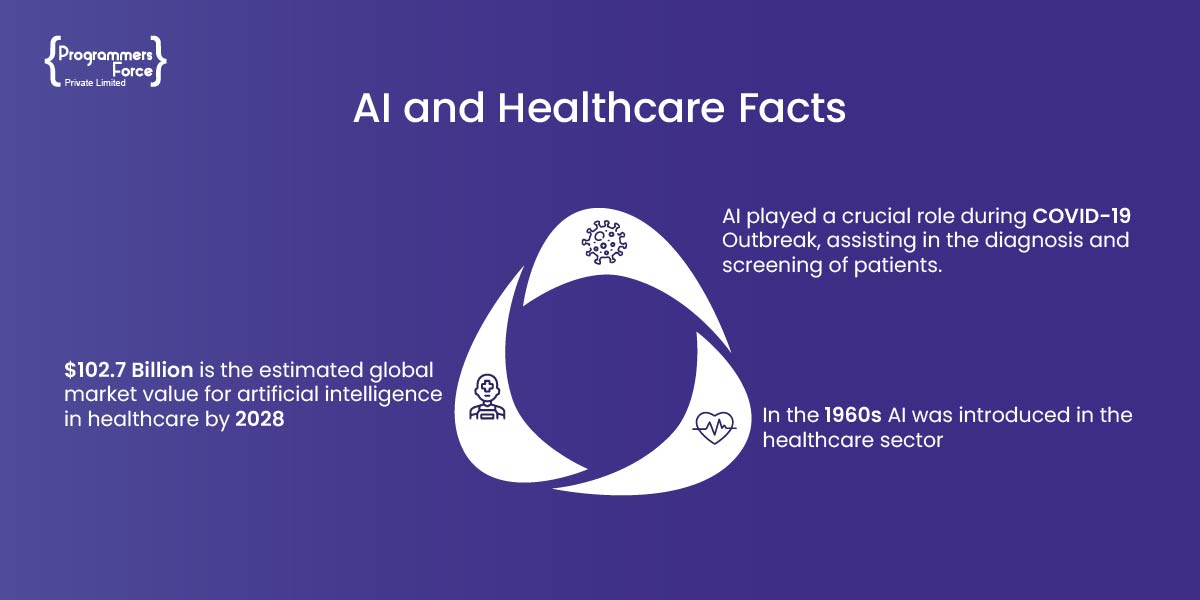
The integration of AI into healthcare is rooted in decades of research and technological evolution. The journey began in the 1950s and 1960s, when early AI pioneers like Alan Turing and John McCarthy explored the potential of machines to mimic human intelligence. However, it wasn’t until the 1970s that AI started making inroads into medical applications, with systems like MYCIN, developed at Stanford University, designed to assist in diagnosing bacterial infections. The 1980s and 1990s saw the emergence of expert systems, which used rule-based logic to provide clinical decision support. These systems, while limited in scope, laid the groundwork for more sophisticated AI applications. The 2000s marked a turning point with the advent of machine learning and big data analytics, enabling AI to process vast amounts of medical data more efficiently. A major milestone was achieved in 2012, when a deep learning model developed by Geoffrey Hinton and his team at the University of Toronto won the ImageNet competition, demonstrating the power of neural networks in image recognition. This breakthrough catalyzed the adoption of AI in medical imaging, particularly in radiology and pathology. In 2016, IBM Watson Health made headlines by partnering with healthcare institutions to develop AI-driven diagnostic tools. Around the same time, Google DeepMind began collaborating with the UK’s National Health Service (NHS) to apply AI to medical imaging and patient data analysis. The 2020s have witnessed an explosion of AI applications in healthcare, fueled by the COVID-19 pandemic, which accelerated the adoption of telemedicine, predictive analytics, and AI-driven drug discovery. Today, AI is increasingly integrated into electronic health records (EHRs), wearable devices, and remote monitoring systems, enabling proactive and personalized healthcare delivery.
#How It Works
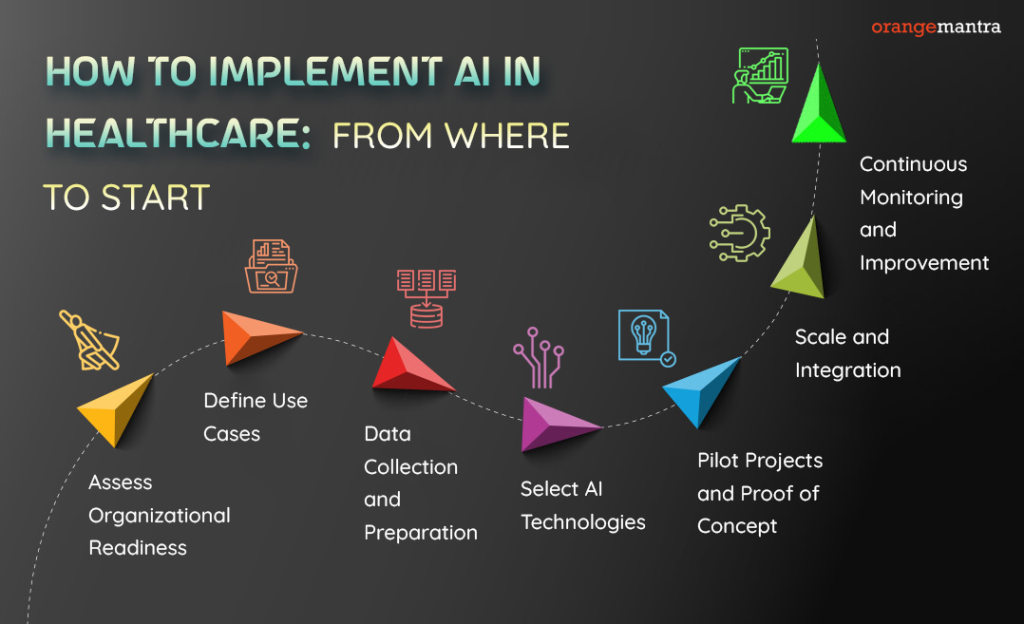
AI in healthcare operates through a combination of algorithms, data processing, and computational models designed to simulate human cognitive functions. The process typically involves several key stages:
#
- Data Collection and Preprocessing AI systems rely on high-quality, structured, and unstructured data. This includes:
- Electronic Health Records (EHRs): Patient histories, lab results, and treatment records.
- Medical Imaging: X-rays, MRIs, CT scans, and ultrasounds.
- Genomic Data: DNA sequences and genetic variations.
- Wearable Devices: Data from fitness trackers, smartwatches, and biosensors.
- Clinical Notes: Unstructured text from doctor’s notes and research papers. Data preprocessing involves cleaning, normalizing, and annotating datasets to ensure accuracy and consistency. For example, medical images may be labeled by radiologists to train supervised learning models.
#
- Model Training AI models are trained using machine learning (ML) techniques, which include:
- Supervised Learning: The model is trained on labeled data (e.g., images of tumors labeled as "malignant" or "benign").
- Unsupervised Learning: The model identifies patterns in unlabeled data (e.g., clustering patients based on similar symptoms).
- Reinforcement Learning: The model learns by trial and error (e.g., optimizing treatment plans based on patient outcomes).
- Deep Learning: A subset of ML that uses neural networks to process complex data like images and speech (e.g., convolutional neural networks for radiology).
#
- Algorithm Development Common AI algorithms used in healthcare include:
- Convolutional Neural Networks (CNNs): For image analysis (e.g., detecting lung cancer in CT scans).
- Recurrent Neural Networks (RNNs): For sequential data (e.g., predicting patient deterioration from time-series EHR data).
- Natural Language Processing (NLP): For extracting insights from clinical notes and research papers.
- Random Forests and Gradient Boosting: For predictive analytics (e.g., identifying high-risk patients for readmission).
#
- Validation and Testing Before deployment, AI models undergo rigorous validation to ensure accuracy, reliability, and generalizability. This involves:
- Cross-validation: Testing the model on diverse datasets.
- Clinical Trials: Evaluating performance in real-world settings.
- Bias Audits: Ensuring the model does not discriminate against certain patient groups.
#
- Deployment and Integration Once validated, AI models are integrated into healthcare workflows through:
- Clinical Decision Support Systems (CDSS): Providing real-time recommendations to clinicians.
- Diagnostic Tools: Assisting radiologists in interpreting medical images.
- Predictive Analytics Platforms: Forecasting disease outbreaks or patient risks.
- Robotics: Enabling AI-driven surgical robots (e.g., da Vinci Surgical System).
#
- Continuous Learning and Improvement AI systems in healthcare are designed to learn and adapt over time. This is achieved through:
- Feedback Loops: Incorporating clinician feedback to refine models.
- Federated Learning: Training models across multiple institutions without sharing raw data.
- Explainable AI (XAI): Providing transparent insights into how AI arrives at its conclusions (e.g., highlighting areas of concern in a medical image).
#Important Facts
#1. AI Enhances Diagnostic Accuracy - AI models can detect diseases such as breast cancer, lung cancer, and diabetic retinopathy with accuracy rates exceeding 90% in some cases. - A 2020 study published in Nature found that an AI system outperformed radiologists in detecting breast cancer in mammograms. - AI is particularly effective in rare disease detection, where human expertise may be limited.
#2. AI Accelerates Drug Discovery - Traditional drug discovery takes 10–15 years and costs $2–3 billion on average. - AI can reduce this timeline by 30–50% by predicting drug interactions, identifying potential compounds, and simulating clinical trials. - Companies like BenevolentAI and Recursion Pharmaceuticals use AI to discover new drugs for diseases like ALS and COVID-19.
#3. AI Improves Patient Outcomes - AI-driven predictive analytics can identify patients at high risk of sepsis, heart failure, or readmission, enabling early intervention. - A 2019 study by Google Health showed that an AI model could predict patient deterioration up to 24 hours in advance with high accuracy. - AI-powered chatbots and virtual assistants (e.g., IBM Watson Assistant) provide 24/7 patient support, reducing wait times and improving access to care.
#4. AI Reduces Healthcare Costs - The American Medical Association (AMA) estimates that AI could save the U.S. healthcare system $150 billion annually by 2026. - AI automates administrative tasks (e.g., billing, scheduling), reducing operational costs. - Predictive analytics helps hospitals optimize resource allocation, reducing unnecessary tests and procedures.
#5. AI Facilitates Personalized Medicine - AI analyzes genomic data to tailor treatments based on a patient’s genetic makeup.
- IBM Watson for Oncology assists oncologists in selecting personalized cancer treatment plans by analyzing patient data and medical literature. - AI enables precision oncology, where therapies are customized based on tumor genetics.
#6. AI in Medical Imaging - AI is revolutionizing radiology, pathology, and dermatology by automating image analysis.
- Google’s DeepMind developed an AI model that can detect over 50 eye diseases from retinal scans with 94% accuracy.
- Zebra Medical Vision uses AI to analyze X-rays and CT scans for fractures, tumors, and other abnormalities.
#7. AI and Robotics in Surgery
- AI-powered surgical robots (e.g., da Vinci System) enhance precision, reducing complications and recovery times. - A 2019 study in JAMA Surgery found that AI-assisted robotic surgery led to fewer complications compared to traditional methods. - AI is also used in remote surgery, where surgeons operate on patients located miles away using robotic systems.
#8. AI in Public Health and Epidemiology - AI models predict disease outbreaks (e.g., COVID-19, Ebola) by analyzing social media, travel patterns, and environmental data.
- BlueDot, an AI startup, was one of the first to predict the COVID-19 outbreak in December 2019. - AI helps track antibiotic resistance and vaccine hesitancy by analyzing public health data.
#9. Ethical and Regulatory Challenges
- Data Privacy: AI systems require access to sensitive patient data, raising concerns about HIPAA compliance and cybersecurity.
- Algorithmic Bias: AI models trained on non-diverse datasets may produce biased outcomes, disproportionately affecting minority groups.
- Regulatory Hurdles: Governments worldwide are developing AI-specific regulations (e.g., FDA’s AI/ML Framework, EU’s AI Act).
- Transparency: "Black box" AI models (e.g., deep learning) lack explainability, making it difficult for clinicians to trust their recommendations.
#10. Future Trends in AI Healthcare
- Generative AI: Tools like DALL·E and Stable Diffusion are being explored for medical image generation and drug design.
- AI in Mental Health: Chatbots and emotion recognition AI are being used to detect depression, anxiety, and PTSD.
- Brain-Computer Interfaces (BCIs): AI-powered BCIs (e.g., Neuralink) aim to restore motor functions in paralyzed patients.
- AI in Aging and Longevity: AI models predict age-related diseases and optimize anti-aging therapies.
#Timeline
- Foundational ideas
Core concepts and early methods shape Facts About AI in Healthcare.
- Practical use
Tools, examples, and real-world deployments make the topic easier to evaluate.
- Responsible implementation
Current work focuses on reliability, governance, performance, and measurable impact.
#Related Terms
#FAQ
What does Facts About AI in Healthcare cover?
Covers facts about ai in healthcare, including core concepts, practical examples, benefits, limitations, and risks in AI in Healthcare.
Why is Facts About AI in Healthcare important?
It helps readers understand key concepts, compare practical use cases, and evaluate how AI in Healthcare decisions affect outcomes, risks, and implementation choices.
What should readers verify before applying this topic?
Readers should compare benefits, limitations, data requirements, and related themes such as Facts, About, AI before using the ideas in real projects.
#References
- Facts About AI in Healthcare terminology and background research
- Facts About AI in Healthcare use cases, implementation examples, and limitations
- AI in Healthcare best practices, standards, and risk guidance
- Facts case studies, benchmarks, and current industry analysis


Comments
No comments yet. Start the discussion with a useful note.