

#Short Answer
Provides a broad overview of AI in finance, including common applications, benefits, challenges, and implementation considerations.
#Infobox
Artificial intelligence (AI) is transforming the finance sector by automating processes, enhancing decision-making, and improving customer experiences.
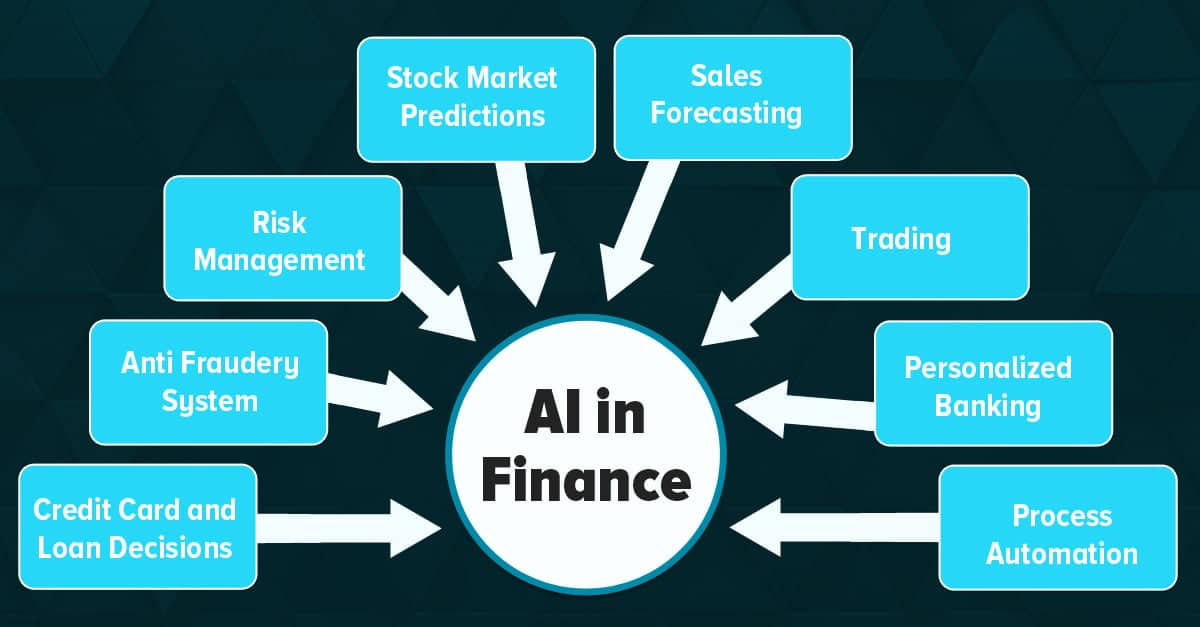
Artificial Intelligence in Finance Field Finance Focus Areas Risk management, fraud detection, algorithmic trading, customer service, credit scoring Key Technologies Machine learning, deep learning, natural language processing, robotic process automation Major Applications Fraud detection, robo-advisors, chatbots, credit underwriting, algorithmic trading Impact Increased efficiency, reduced costs, improved accuracy, enhanced customer experience Challenges Data privacy, regulatory compliance, algorithmic bias, cybersecurity risks Future Trends Generative AI, explainable AI, quantum computing, decentralized finance (DeFi)
#Overview
Artificial intelligence (AI) in finance refers to the application of machine learning (ML), deep learning, natural language processing (NLP), and other AI technologies to financial services and institutions. AI systems analyze vast datasets, identify patterns, and make data-driven decisions with minimal human intervention. In the finance sector, AI enhances efficiency, reduces operational costs, and improves accuracy in tasks such as risk assessment, fraud detection, and investment management.
The integration of AI in finance spans multiple domains, including banking, insurance, asset management, and fintech. Financial institutions leverage AI to automate repetitive tasks, personalize customer interactions, and develop predictive models for market trends. As AI technologies evolve, their role in finance continues to expand, driving innovation and reshaping traditional financial processes.
#History / Background
The concept of AI in finance dates back to the mid-20th century, with early experiments in computational finance and algorithmic trading. In the 1980s, financial institutions began adopting statistical models and early AI techniques to analyze market data and automate trading strategies. The development of neural networks in the 1990s further advanced AI applications in finance, enabling more sophisticated pattern recognition and predictive analytics.
The 2000s marked a significant turning point with the rise of big data and cloud computing, which provided the infrastructure for large-scale AI implementations. The 2010s saw the proliferation of fintech startups and traditional banks integrating AI into their core operations. Key milestones include the launch of robo-advisors, the adoption of AI-driven fraud detection systems, and the use of chatbots for customer service. Today, AI is a cornerstone of modern finance, with applications ranging from credit scoring to algorithmic trading.
#How It Works
#Machine Learning and Deep Learning
Machine learning (ML) algorithms, including supervised, unsupervised, and reinforcement learning, are fundamental to AI in finance. These algorithms train on historical financial data to identify trends, predict outcomes, and optimize decision-making. Deep learning, a subset of ML, uses neural networks with multiple layers to process complex datasets, such as time-series financial data or unstructured text from news articles and social media.
For example, ML models can analyze transaction histories to detect fraudulent activities by recognizing anomalies in spending patterns. In algorithmic trading, deep learning models process market data in real-time to execute trades based on predefined strategies or learned patterns.
#Natural Language Processing
Natural language processing (NLP) enables AI systems to understand, interpret, and generate human language. In finance, NLP is used to analyze earnings calls, news articles, and regulatory filings to extract sentiment and predict market movements. Chatbots and virtual assistants powered by NLP provide customer support, answering queries about account balances, transaction histories, or loan applications.
Sentiment analysis, a key NLP application, evaluates public opinion from social media or financial reports to gauge market sentiment. This information helps investors make informed decisions and financial institutions assess risk.
#Robotic Process Automation
Robotic process automation (RPA) uses software robots to automate repetitive, rule-based tasks such as data entry, reconciliation, and report generation. In finance, RPA reduces human error, accelerates processing times, and lowers operational costs. For instance, RPA can automatically extract data from invoices, validate transactions, and update accounting records without manual intervention.
#Important Facts
- Efficiency Gains: AI can process and analyze data up to 100 times faster than traditional methods, significantly reducing the time required for tasks such as risk assessment and fraud detection.
- Cost Reduction: Financial institutions report cost savings of up to 30% by automating routine tasks with AI, particularly in areas like customer service and back-office operations.
- Fraud Prevention: AI-powered fraud detection systems identify suspicious transactions in real-time, reducing financial losses due to fraud by up to 50%.
- Personalization: AI enables hyper-personalized financial services, such as tailored investment recommendations and customized loan offers, improving customer satisfaction and retention.
- Regulatory Compliance: AI helps financial institutions comply with regulations by automating compliance checks, monitoring transactions for suspicious activities, and generating audit reports.
- Market Prediction: AI models can predict market trends with an accuracy of up to 80% in certain scenarios, aiding investors and traders in making data-driven decisions.
- Challenges: Despite its benefits, AI in finance faces challenges such as data privacy concerns, algorithmic bias, and the need for explainable AI to ensure transparency and accountability.
#Timeline
Year Milestone 1950s Early experiments in computational finance and algorithmic trading. 1980s Adoption of statistical models and early AI techniques in financial institutions. 1990s Development of neural networks for financial pattern recognition. 2000s Rise of big data and cloud computing, enabling large-scale AI implementations. 2010 Launch of the first robo-advisors, such as Betterment and Wealthfront. 2012 Google's AI-powered algorithmic trading system, "Google Brain," demonstrates superior performance in financial markets. 2015 Major banks, including JPMorgan Chase and HSBC, begin integrating AI into their fraud detection systems. 2017 AI-powered chatbots become mainstream in customer service for banks and fintech companies. 2019 Regulatory bodies, such as the European Union, introduce guidelines for AI in finance, emphasizing transparency and accountability. 2020 AI-driven credit scoring models gain widespread adoption, enabling faster loan approvals. 2022 Generative AI, such as large language models, begins to be explored for financial forecasting and report generation. 2023 AI in finance reaches a market value of over $10 billion, with projections to grow at a CAGR of 30% over the next decade.
#Related Terms
#FAQ
What does AI In Finance: A Complete Overview cover?
Provides a broad overview of AI in finance, including common applications, benefits, challenges, and implementation considerations.
Why is AI In Finance: A Complete Overview important?
It helps readers understand key concepts, compare practical use cases, and evaluate how Business & Finance decisions affect outcomes, risks, and implementation choices.
What should readers verify before applying this topic?
Readers should compare the benefits, limitations, data requirements, and related themes such as Finance, Financial Technology, Decision Support before using the ideas in real projects.
#References
- AI In Finance: A Complete Overview terminology and background research
- AI In Finance: A Complete Overview use cases, implementation examples, and limitations
- Business & Finance best practices, standards, and risk guidance
- Finance case studies, benchmarks, and current industry analysis

.png)

Comments
No comments yet. Start the discussion with a useful note.