

#Short Answer
Explains how AI is applied in customer support to support best practices, with examples, workflows, benefits, and adoption challenges.
#Infobox
AI in customer support enhances efficiency, personalization, and scalability through automation and machine learning.
AI in Customer Support Field Artificial intelligence Focus Customer service automation, chatbots, sentiment analysis Key Technologies Natural language processing (NLP), machine learning, generative AI Applications Ticket routing, FAQ bots, voice assistants, predictive support Benefits 24/7 availability, cost reduction, improved response times Challenges Data privacy, accuracy, human oversight, integration complexity
#Overview
AI in customer support refers to the application of artificial intelligence technologies to automate, enhance, and personalize customer service interactions. It encompasses tools such as chatbots, virtual assistants, sentiment analysis systems, and predictive analytics to streamline support operations. By leveraging natural language processing (NLP), machine learning (ML), and generative AI, businesses can deliver faster, more accurate, and scalable support experiences. AI-driven customer support is widely adopted across industries including e-commerce, telecommunications, banking, and healthcare, where it helps reduce operational costs while improving customer satisfaction.
#History / Background
The integration of AI into customer support began in the late 1990s with the emergence of basic chatbots designed to handle simple queries. Early systems relied on rule-based logic and keyword matching, offering limited functionality. The introduction of natural language understanding (NLU) in the 2000s enabled more sophisticated interactions, though still constrained by technological limitations.
Breakthroughs in deep learning and NLP during the 2010s, particularly with models like Transformers and BERT, revolutionized AI customer support. These models allowed systems to understand context, intent, and sentiment with greater accuracy. The rise of cloud computing and big data further accelerated adoption, enabling real-time processing and continuous learning from customer interactions.
By 2020, generative AI models such as LLMs began powering advanced virtual assistants capable of generating human-like responses. Today, AI is a cornerstone of modern customer service strategies, with over 60% of companies integrating AI tools into their support workflows.
#How It Works
AI in customer support operates through a combination of core technologies and workflows:
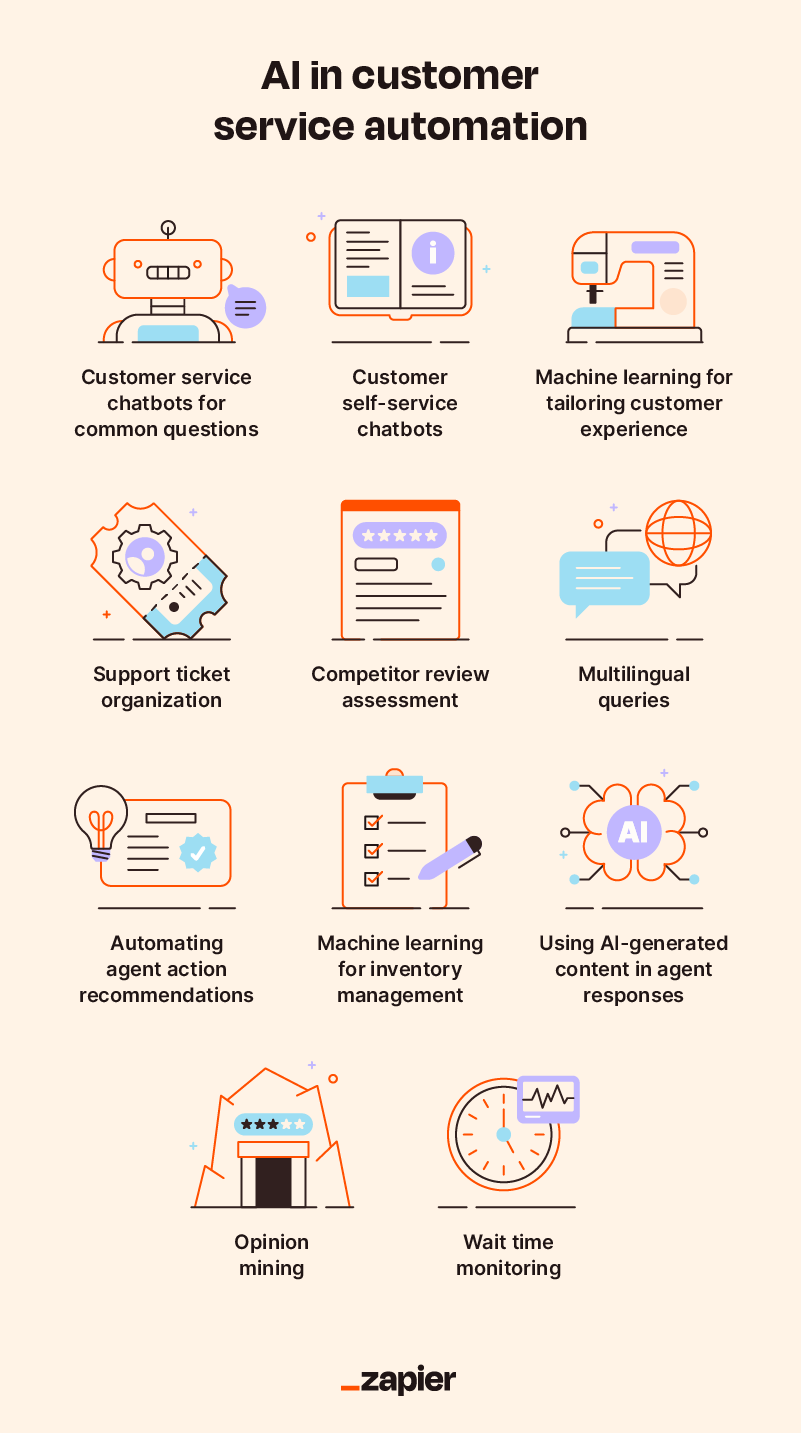
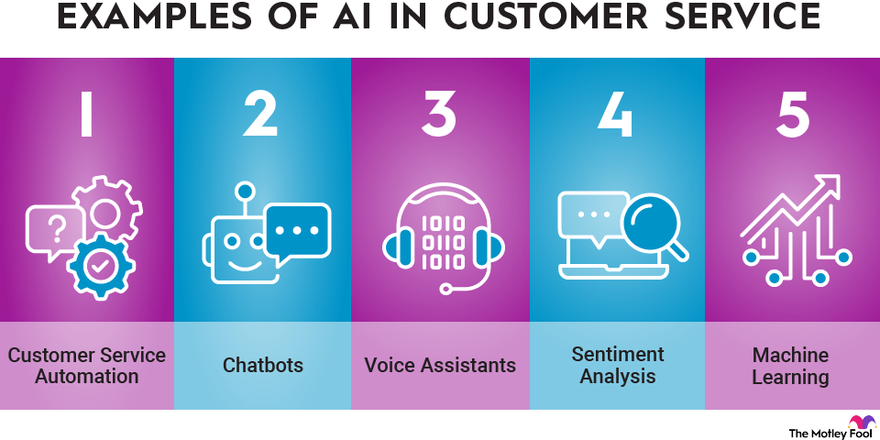
- Natural Language Processing (NLP): Enables systems to interpret and generate human language. NLP models analyze customer messages to detect intent, extract entities, and determine sentiment.
- Machine Learning: Continuously improves response accuracy by learning from past interactions. ML algorithms identify patterns in support tickets, enabling predictive routing and personalized recommendations.
- Automated Ticketing Systems: AI categorizes, prioritizes, and routes support tickets based on urgency, topic, and customer history. This reduces manual workload and speeds up resolution times.
- Chatbots and Virtual Assistants: Deployed on websites, apps, and messaging platforms, these tools handle routine inquiries, guide users through troubleshooting, and escalate complex issues to human agents when needed.
- Sentiment Analysis: Monitors customer emotions in real time by analyzing text or voice inputs. It flags negative sentiment for immediate intervention, helping prevent churn.
- Knowledge Base Integration: AI systems pull answers from structured knowledge bases, ensuring consistency and compliance with company policies. Advanced systems can generate answers dynamically using LLMs.
- Voice Assistants and IVR: AI-powered interactive voice response (IVR) systems use speech recognition and NLP to handle phone-based support, reducing wait times and improving accessibility.
#Important Facts
- AI can reduce customer service costs by up to 30% while improving satisfaction scores by 20–40%.
- Over 80% of customers expect immediate responses from support teams, a need AI can fulfill 24/7.
- AI-powered chatbots resolve up to 80% of routine customer queries without human intervention.
- Companies using AI in customer support report a 50% reduction in average handling time (AHT).
- Sentiment analysis accuracy has improved from ~65% in 2015 to over 90% in 2024 due to transformer models.
- AI systems can personalize responses based on customer history, purchase behavior, and demographic data.
- Integration with CRM systems like Salesforce and Zendesk allows AI to access real-time customer data for context-aware support.
- Regulatory compliance (e.g., GDPR, CCPA) requires careful handling of AI-generated customer data and consent management.
#Timeline
Year Milestone 1995 First commercial chatbot, ELIZA, demonstrates basic conversational AI. 2001 IBM introduces Watson, laying groundwork for advanced NLP in enterprise applications. 2011 Apple launches Siri, popularizing voice-based AI assistants. 2016 Amazon Alexa and Google Assistant expand AI-driven support into smart home ecosystems. 2018 BERT model released, significantly improving contextual understanding in customer queries. 2020 COVID-19 pandemic accelerates AI adoption in customer support due to remote work and increased digital interactions. 2022 Generative AI models like ChatGPT enable human-like, dynamic responses in support systems. 2023–2024 AI agents begin autonomously resolving complex support tickets with minimal human oversight.
#Related Terms
#FAQ
What does AI In Customer Support: Best Practices cover?
Explains how AI is applied in customer support to support best practices, with examples, workflows, benefits, and adoption challenges.
Why is AI In Customer Support: Best Practices important?
It helps readers understand key concepts, compare practical use cases, and evaluate how Business & Marketing decisions affect outcomes, risks, and implementation choices.
What should readers verify before applying this topic?
Readers should compare the benefits, limitations, data requirements, and related themes such as Comparison, Selection Criteria, Customer before using the ideas in real projects.
#References
- AI In Customer Support: Best Practices terminology and background research
- AI In Customer Support: Best Practices use cases, implementation examples, and limitations
- Business & Marketing best practices, standards, and risk guidance
- Comparison case studies, benchmarks, and current industry analysis


Comments
No comments yet. Start the discussion with a useful note.