

#Short Answer
Explains how AI works in customer service, covering data, models, workflows, practical examples, and adoption challenges.
#Infobox
Artificial intelligence (AI) is transforming customer service by automating responses, analyzing interactions, and enhancing efficiency through chatbots, virtual assistants, and predictive analytics.
AI in Customer Service Field Artificial intelligence Key Technologies Natural Language Processing (NLP), Machine Learning (ML), Speech Recognition, Predictive Analytics Primary Applications Chatbots, Virtual Assistants, Sentiment Analysis, Automated Ticketing, Voice Assistants Benefits 24/7 availability, cost reduction, scalability, personalized interactions, faster resolution Challenges Data privacy, ethical concerns, integration complexity, customer trust, language limitations Industries Adopting AI E-commerce, Banking, Healthcare, Telecommunications, Hospitality Notable Companies IBM Watson, Google Dialogflow, Amazon Lex, Microsoft Azure Bot Service
#Overview
Artificial intelligence (AI) in customer service refers to the use of AI-driven tools and technologies to automate, enhance, and personalize customer interactions across various channels, including websites, mobile apps, social media, and voice calls. AI systems leverage natural language processing (NLP), machine learning (ML), and predictive analytics to understand customer queries, provide instant responses, and resolve issues efficiently.
AI-powered customer service solutions range from simple chatbots that handle routine inquiries to advanced virtual assistants capable of managing complex conversations. These systems continuously learn from interactions, improving their accuracy and adaptability over time. By integrating AI, businesses can reduce operational costs, improve response times, and deliver a seamless customer experience while allowing human agents to focus on high-value tasks.
#History / Background
The concept of AI in customer service emerged in the late 20th century, with early experiments in automated customer support systems. One of the first notable implementations was Interactive Voice Response (IVR) systems in the 1980s, which used pre-recorded messages and touch-tone inputs to handle basic customer queries.
The 1990s saw the introduction of early chatbots, such as ELIZA, which simulated human conversation using pattern matching. However, these systems were limited in their ability to understand context and nuance.
The 2000s marked a significant shift with the advent of NLP and ML technologies. Companies like IBM and Microsoft began developing more sophisticated AI-driven customer service tools, including virtual assistants and automated email responses.
The 2010s witnessed a surge in AI adoption, driven by advancements in deep learning, cloud computing, and big data. The introduction of chatbots by companies like Amazon and Google revolutionized customer service by enabling real-time, scalable interactions. Today, AI in customer service is a multi-billion-dollar industry, with businesses across sectors leveraging these technologies to enhance efficiency and customer satisfaction.
#How It Works
#Natural Language Processing (NLP)
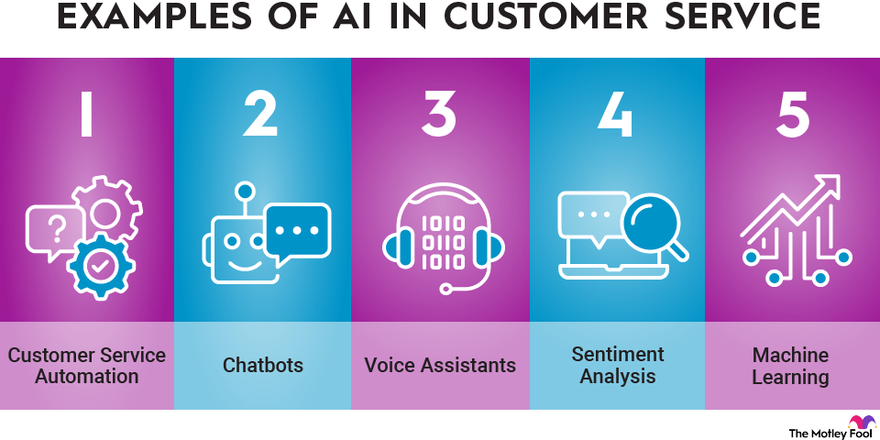
NLP is the core technology behind AI-powered customer service systems. It enables machines to understand, interpret, and generate human language. NLP algorithms break down customer queries into meaningful components, such as intent, entities, and sentiment, allowing the system to provide relevant responses.
Key NLP techniques include:
- Tokenization: Splitting text into individual words or phrases.
- Part-of-Speech Tagging: Identifying the grammatical structure of sentences.
- Named Entity Recognition (NER): Detecting specific entities like names, dates, or locations.
- Sentiment Analysis: Determining the emotional tone of a customer's message (positive, negative, or neutral).
#Machine Learning and Predictive Analytics
Machine learning algorithms analyze vast amounts of customer data to identify patterns, predict outcomes, and improve response accuracy. Predictive analytics uses historical data to forecast customer behavior, such as the likelihood of churn or the need for support.
For example, ML models can:
- Classify customer inquiries into categories (e.g., billing, technical support).
- Recommend personalized solutions based on past interactions.
- Detect anomalies in customer behavior that may indicate fraud or dissatisfaction.
#Chatbots and Virtual Assistants
Chatbots are AI-powered programs designed to simulate human conversation. They can be deployed on websites, messaging apps, or voice assistants to handle routine queries, such as order status, FAQs, or appointment scheduling. Advanced chatbots use NLP and ML to understand context and provide more natural responses.
Virtual assistants, such as Amazon Alexa or Apple Siri, extend this functionality to voice-based interactions. These assistants can perform tasks like placing orders, checking account balances, or providing real-time support.
#Automated Ticketing and Routing
AI systems can automatically generate and categorize support tickets based on customer inquiries. They can also route tickets to the most appropriate human agent based on factors like expertise, workload, and customer history. This ensures faster resolution and reduces the burden on support teams.
#Sentiment Analysis
Sentiment analysis tools evaluate customer feedback, reviews, and social media posts to gauge satisfaction levels. By analyzing tone, keywords, and context, AI can identify dissatisfied customers and escalate issues to human agents for resolution.
#Important Facts
- AI-powered customer service can reduce response times by up to 90% compared to traditional methods.
- By 2025, 80% of customer service interactions are expected to be handled by AI, according to Gartner.
- The global AI in customer service market is projected to reach $47.4 billion by 2030, growing at a CAGR of 27.4%.
- Companies using AI chatbots report a 30% reduction in customer service costs.
- AI can handle up to 80% of routine customer queries, freeing human agents for complex issues.
- Personalized AI interactions can increase customer satisfaction by 40%.
- AI-driven sentiment analysis helps businesses identify and address customer pain points in real time.
#Timeline
Year Milestone 1966 ELIZA, one of the first chatbots, is developed at MIT. 1980s Interactive Voice Response (IVR) systems are introduced for automated customer support. 1990s Early AI-driven customer service tools, such as virtual assistants, begin to emerge. 2000 IBM Watson is developed, laying the foundation for advanced NLP and AI applications. 2010 Apple introduces Siri, a voice-activated virtual assistant. 2016 Amazon launches Alexa, expanding AI-driven customer service to voice interactions. 2018 Google introduces Dialogflow, a platform for building AI-powered chatbots. 2020 The COVID-19 pandemic accelerates AI adoption in customer service due to increased remote interactions. 2023 Generative AI, such as large language models (LLMs), begins transforming customer service with more human-like interactions.
#Related Terms
#FAQ
What does AI In Customer Service: How It Works cover?
Explains how AI works in customer service, covering data, models, workflows, practical examples, and adoption challenges.
Why is AI In Customer Service: How It Works important?
It helps readers understand key concepts, compare practical use cases, and evaluate how Business & Marketing decisions affect outcomes, risks, and implementation choices.
What should readers verify before applying this topic?
Readers should compare the benefits, limitations, data requirements, and related themes such as Customer, Service, Work before using the ideas in real projects.
#References
- AI In Customer Service: How It Works terminology and background research
- AI In Customer Service: How It Works use cases, implementation examples, and limitations
- Business & Marketing best practices, standards, and risk guidance
- Customer case studies, benchmarks, and current industry analysis



Comments
No comments yet. Start the discussion with a useful note.