

#Short Answer
Explores how artificial intelligence shapes weather and accurate forecasting, covering practical use cases, benefits, limitations, and risks.
#Infobox
Artificial Intelligence in Weather Forecasting Field Meteorology, Climate science Key Technologies Machine learning, Deep learning, Numerical weather prediction First Applications 1950s–1960s Major Developments 1990s–Present Notable Institutions ECMWF, NOAA, JMA Impact Improved accuracy, faster predictions, extreme weather detection
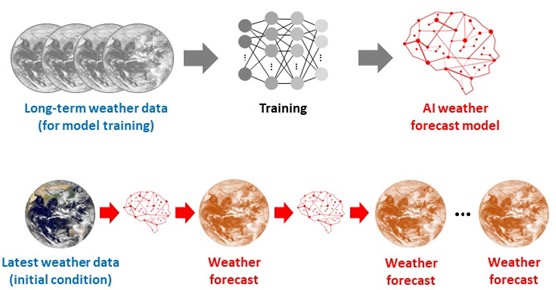
Artificial intelligence (AI) in weather forecasting refers to the application of machine learning, deep learning, and other AI techniques to enhance the accuracy, speed, and reliability of weather predictions. Traditional numerical weather prediction (NWP) models rely on complex physical equations, but AI complements these methods by identifying patterns in vast datasets, improving forecast precision, and enabling real-time adjustments. AI-driven weather forecasting has become a cornerstone of modern meteorology, particularly in detecting extreme weather events and optimizing resource allocation for disaster preparedness.
#Overview
Weather forecasting has evolved from reliance on manual observations and basic statistical models to sophisticated AI-driven systems. Traditional methods, such as numerical weather prediction (NWP), use physics-based equations to simulate atmospheric conditions. However, these models often struggle with high computational costs and limitations in handling chaotic weather systems. AI bridges these gaps by leveraging machine learning algorithms to process satellite imagery, radar data, historical weather records, and other meteorological inputs. The integration of AI has led to significant advancements in short-term and long-range forecasting, particularly in predicting hurricanes, heatwaves, and precipitation patterns.
#Key AI Technologies
- Machine Learning (ML): Supervised and unsupervised learning models analyze historical weather data to identify trends and anomalies.
- Deep Learning (DL): Convolutional neural networks (CNNs) and recurrent neural networks (RNNs) process spatial and temporal weather data, such as satellite images and time-series forecasts.
- Ensemble Methods: Combining multiple AI models to improve prediction robustness and reduce errors.
- Reinforcement Learning: Optimizes forecasting models by learning from past prediction errors and adjusting parameters dynamically.
#History / Background
The use of AI in weather forecasting dates back to the mid-20th century, coinciding with the advent of digital computing. Early efforts focused on statistical methods, such as linear regression, to correlate weather variables. The 1960s and 1970s saw the development of primitive AI techniques, including expert systems that mimicked human forecasters' decision-making processes. However, these systems were limited by computational power and data availability.
The 1990s marked a turning point with the introduction of machine learning algorithms, which enabled computers to learn from data without explicit programming. The rise of big data and high-performance computing in the 2000s accelerated AI adoption in meteorology. Projects like the ECMWF and NOAA began integrating AI into their forecasting pipelines. By the 2010s, deep learning revolutionized the field, with models like CNNs and LSTMs achieving breakthroughs in image recognition and time-series analysis for weather data.
#How It Works
#Data Collection and Preprocessing
AI weather forecasting begins with the aggregation of diverse data sources:
- Satellite Imagery: High-resolution images from geostationary and polar-orbiting satellites provide real-time data on cloud cover, temperature, and atmospheric composition.
- Radar and Lidar: Doppler radar systems track precipitation, wind speed, and storm intensity, while lidar measures atmospheric particles and pollutants.
- Surface Observations: Weather stations, buoys, and ships collect ground-level data on temperature, humidity, pressure, and wind.
- Historical Records: Decades of archived weather data serve as training datasets for AI models.
- Numerical Models: Outputs from physics-based NWP models provide a baseline for AI to refine predictions.
#Model Training and Prediction
Once data is collected, AI models undergo training to recognize patterns and relationships:
- Feature Extraction: Relevant features (e.g., cloud movement, temperature gradients) are extracted from raw data.
- Training: Supervised learning uses labeled historical data to teach the model to associate input patterns with known outcomes (e.g., predicting rainfall based on cloud patterns).
- Validation: Models are tested on unseen data to evaluate accuracy and generalization.
- Prediction: For real-time forecasting, the trained model processes new data to generate predictions, often in combination with NWP outputs.
#Post-Processing and Ensemble Forecasting
AI models are rarely used in isolation. Instead, they are integrated into ensemble forecasting systems, where multiple models (AI and traditional) run in parallel. The final forecast is generated by combining the outputs, often using weighted averages or machine learning-based meta-models. This approach reduces uncertainty and improves reliability, particularly for high-impact weather events.
#Important Facts
- Accuracy Improvement: AI models have reduced forecast errors by up to 25% in some cases, particularly for short-term predictions (1–3 days).
- Extreme Weather Detection: AI excels at identifying precursors to extreme events, such as hurricanes and heatwaves, often with greater lead time than traditional methods.
- Computational Efficiency: While NWP models require supercomputers, AI models can run on standard hardware, enabling faster and more accessible forecasting.
- Data Fusion: AI combines disparate data sources (e.g., satellite, radar, and social media) to create a holistic view of atmospheric conditions.
- Climate Change Adaptation: AI helps model long-term climate trends, aiding in the assessment of global warming impacts on weather patterns.
#Timeline
Year Milestone 1950s–1960s Early statistical and expert systems for weather prediction. 1970s–1980s Development of primitive machine learning techniques for meteorology. 1990s First widespread use of machine learning in weather forecasting (e.g., ECMWF, NOAA). 2000s Integration of AI with numerical weather prediction models. 2010s Deep learning breakthroughs (CNNs, LSTMs) revolutionize weather prediction accuracy. 2016 Google’s DeepMind partners with the UK Met Office to improve precipitation forecasts. 2018 NOAA launches AI-based hurricane intensity prediction models. 2020s AI models achieve near-human accuracy in short-term forecasts; real-time adjustments become standard.
#Related Terms
#FAQ
What does AI And Weather: Accurate Forecasting cover?
Explores how artificial intelligence shapes weather and accurate forecasting, covering practical use cases, benefits, limitations, and risks.
Why is AI And Weather: Accurate Forecasting important?
It helps readers understand key concepts, compare practical use cases, and evaluate how Artificial Intelligence decisions affect outcomes, risks, and implementation choices.
What should readers verify before applying this topic?
Readers should compare the benefits, limitations, data requirements, and related themes such as Weather, Accurate, Forecasting before using the ideas in real projects.
#References
- AI And Weather: Accurate Forecasting terminology and background research
- AI And Weather: Accurate Forecasting use cases, implementation examples, and limitations
- Artificial Intelligence best practices, standards, and risk guidance
- Weather case studies, benchmarks, and current industry analysis



Comments
No comments yet. Start the discussion with a useful note.