

#Short Answer
Explores how artificial intelligence shapes trading and algorithmic strategies, covering practical use cases, benefits, limitations, and risks.
#Infobox
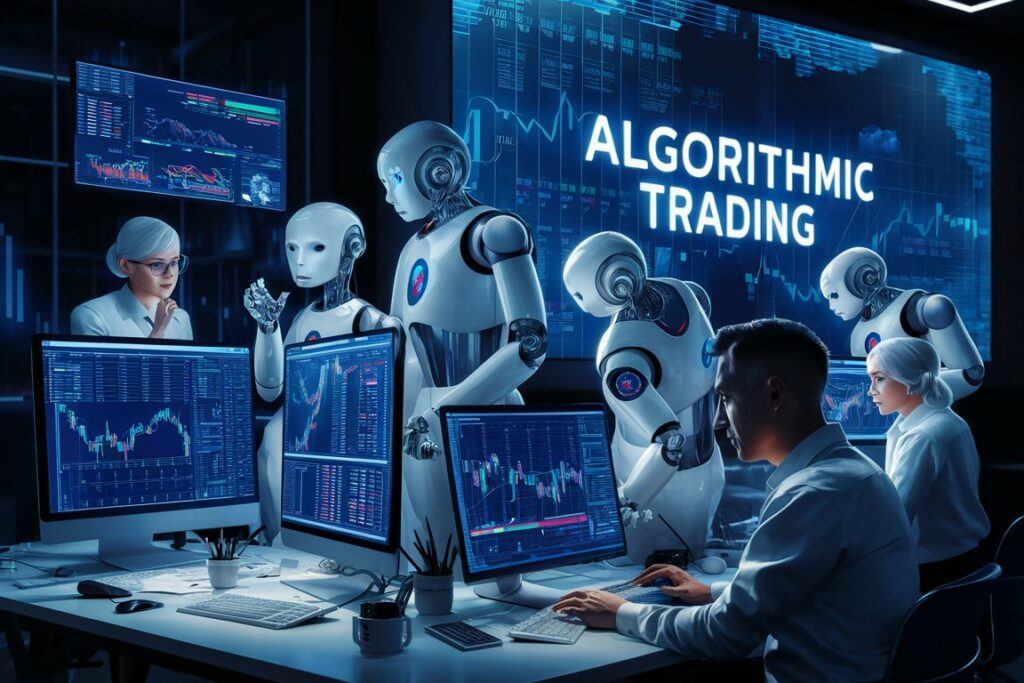
Artificial intelligence (AI) in algorithmic trading leverages machine learning and computational models to automate financial market strategies, enhancing decision-making, risk management, and execution efficiency.
AI in Algorithmic Trading Field Financial technology (FinTech), Quantitative finance Key People Quantitative analysts, Data scientists, Algorithmic traders First Introduced Early 2000s (systematic adoption in 2010s) Major Developments High-frequency trading (HFT), Reinforcement learning, Natural language processing (NLP) Notable Applications Portfolio optimization, Market-making, Arbitrage detection Related Fields Quantitative finance, Machine learning, Computational finance
#Overview
AI in algorithmic trading refers to the application of artificial intelligence techniques—such as machine learning, deep learning, and natural language processing—to automate and optimize trading strategies. Unlike traditional algorithmic trading, which relies on predefined rules and statistical models, AI-driven approaches adapt dynamically to changing market conditions by learning from historical and real-time data. This integration enhances predictive accuracy, reduces human bias, and enables the processing of vast datasets at speeds unattainable by manual methods.
Quantitative analysts (quants) and financial institutions increasingly adopt AI to gain a competitive edge in markets characterized by high volatility and complexity. AI models can identify subtle patterns in price movements, sentiment from news articles, and order book dynamics, which are often imperceptible to human traders. The technology spans various trading styles, including high-frequency trading (HFT), quantitative investing, and algorithmic execution strategies.
#History / Background
The roots of algorithmic trading trace back to the 1970s with the introduction of electronic trading platforms and the development of quantitative models by firms like Renaissance Technologies and D.E. Shaw. However, the systematic use of AI in trading began in the early 2000s, coinciding with advancements in computing power and the availability of large financial datasets.
In 2006, the launch of the quantitative finance boom saw hedge funds and proprietary trading firms integrating machine learning algorithms to refine trading signals. The 2010s marked a turning point with the rise of deep learning, enabling models to process unstructured data such as news articles, earnings calls, and social media feeds. The proliferation of cloud computing and big data technologies further democratized access to AI tools, allowing smaller firms to compete with institutional players.
Regulatory changes, such as the Regulation National Market System (NMS) in the U.S., also played a pivotal role by promoting market transparency and fostering algorithmic trading infrastructure.
#How It Works
AI-driven algorithmic trading operates through a multi-stage pipeline that integrates data acquisition, model training, strategy execution, and performance monitoring.
#Data Collection and Preprocessing
AI models rely on diverse data sources, including:
- Market Data: Price, volume, order book depth, and trade execution data.
- Alternative Data: Satellite imagery, credit card transactions, web traffic, and social media sentiment.
- Fundamental Data: Financial statements, earnings reports, and macroeconomic indicators.
- Textual Data: News articles, earnings call transcripts, and regulatory filings processed using NLP techniques.
Data preprocessing involves cleaning, normalization, and feature engineering to ensure consistency and relevance. Techniques such as time-series decomposition, Fourier transforms, and principal component analysis (PCA) are commonly used to extract meaningful patterns.
#Model Training and Selection
Several AI methodologies are employed in algorithmic trading:
- Supervised Learning: Used for classification (e.g., predicting price movements) and regression (e.g., forecasting returns). Models include random forests, support vector machines (SVM), and gradient boosting machines (GBM).
- Unsupervised Learning: Identifies hidden structures in data, such as clustering stocks by correlation or detecting anomalies in trading behavior. Techniques include k-means clustering and autoencoders.
- Reinforcement Learning (RL): Enables agents to learn optimal trading policies through trial and error by interacting with market environments. RL is particularly effective in dynamic and uncertain markets.
- Deep Learning: Neural networks, including convolutional neural networks (CNNs) for image-based data and recurrent neural networks (RNNs) for sequential data, are used to model complex dependencies.
- Natural Language Processing (NLP): Analyzes textual data to gauge market sentiment, detect corporate fraud, or predict earnings surprises.
#Strategy Execution and Risk Management
Once trained, AI models generate trading signals that are executed via algorithmic trading systems. Execution algorithms optimize order placement to minimize market impact and slippage. Risk management frameworks incorporate:
- Position Sizing: Determines the optimal allocation of capital based on model confidence and risk tolerance.
- Stop-Loss Mechanisms: Automatically exits positions to limit losses.
- Portfolio Hedging: Uses derivatives or correlated assets to offset risk.
- Backtesting: Validates strategies using historical data to assess performance under various market conditions.
#Important Facts
- Speed Advantage: AI systems can execute trades in microseconds, far outpacing human traders.
- Data Dependency: The quality and quantity of data directly impact model performance.
- Overfitting Risk: Models may perform well on historical data but fail in live markets due to overfitting.
- Regulatory Scrutiny: AI-driven trading is subject to regulations such as the MiFID II in Europe and the Dodd-Frank Act in the U.S.
- Black Swan Events: AI models may struggle to predict unprecedented market disruptions, such as the 2008 financial crisis or the COVID-19 pandemic.
- Ethical Concerns: Issues such as market manipulation, algorithmic bias, and systemic risk from flash crashes are ongoing debates.
#Timeline
Year Event 1971 Introduction of NASDAQ electronic trading platform. 1987 Program trading contributes to Black Monday crash. 1998 Renaissance Technologies' Medallion Fund achieves consistent returns using quantitative models. 2006 Machine learning adoption in hedge funds begins to grow. 2012 Deep learning models start being applied to financial time-series forecasting. 2016 Reinforcement learning gains traction in trading strategy optimization. 2020 AI-driven trading surges during the COVID-19 pandemic due to increased market volatility. 2023 Regulatory bodies increase scrutiny on AI-driven trading practices.
#Related Terms
#FAQ
What does AI And Trading: Algorithmic Strategies cover?
Explores how artificial intelligence shapes trading and algorithmic strategies, covering practical use cases, benefits, limitations, and risks.
Why is AI And Trading: Algorithmic Strategies important?
It helps readers understand key concepts, compare practical use cases, and evaluate how Business & Finance decisions affect outcomes, risks, and implementation choices.
What should readers verify before applying this topic?
Readers should compare the benefits, limitations, data requirements, and related themes such as Trading, Algorithmic, Strategie before using the ideas in real projects.
#References
- AI And Trading: Algorithmic Strategies terminology and background research
- AI And Trading: Algorithmic Strategies use cases, implementation examples, and limitations
- Business & Finance best practices, standards, and risk guidance
- Trading case studies, benchmarks, and current industry analysis



Comments
No comments yet. Start the discussion with a useful note.