

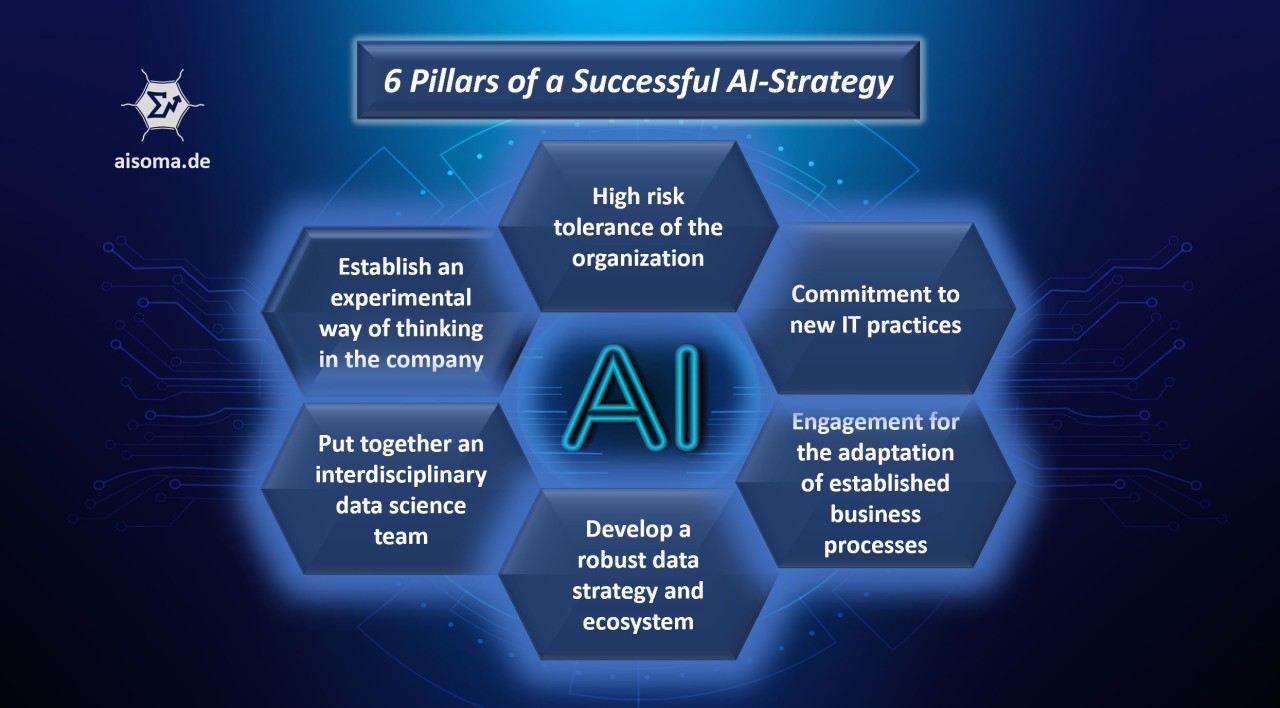
#Short Answer
Explores how artificial intelligence shapes strategy and planning for success, covering practical use cases, benefits, limitations, and risks.
#Infobox
AI Strategy: A structured approach to integrating artificial intelligence into business operations to enhance decision-making, automate processes, and drive innovation. Success depends on alignment with organizational goals, ethical considerations, and continuous adaptation to technological advancements.
AI Strategy Overview Key Components: Data Infrastructure, Talent Acquisition, Ethical Frameworks, Scalability, ROI Measurement Primary Goals: Efficiency, Innovation, Competitive Advantage, Customer Experience Challenges: Data Quality, Regulatory Compliance, Skill Gaps, Implementation Costs Success Metrics: Cost Reduction, Revenue Growth, Process Automation, Decision Accuracy
#Overview
Artificial Intelligence (AI) strategy refers to the deliberate planning and execution of AI technologies to achieve business objectives. It encompasses the identification of use cases, resource allocation, and the establishment of governance frameworks to ensure responsible and effective deployment. A well-defined AI strategy aligns with an organization's long-term vision, enabling it to leverage AI for competitive differentiation, operational efficiency, and innovation.
In today's data-driven landscape, AI strategy is no longer optional but a critical component of digital transformation. Companies that fail to integrate AI risk falling behind competitors who optimize processes, personalize customer interactions, and uncover insights through machine learning and predictive analytics. The strategy must address technical, ethical, and organizational challenges to ensure sustainable success.
#History / Background
#Early Foundations (1950s–1980s)
The concept of AI dates back to the 1950s, with early research focusing on symbolic reasoning and problem-solving. The term "artificial intelligence" was coined in 1956 at the Dartmouth Conference, where pioneers like John McCarthy and Marvin Minsky explored the potential of machines to simulate human intelligence. During this period, AI was largely theoretical, with limited practical applications due to computational constraints.
In the 1980s, the field saw a resurgence with the development of expert systems—AI programs designed to mimic human decision-making in specific domains. However, these systems relied heavily on rule-based logic and struggled with scalability and adaptability. The lack of robust data and computing power hindered widespread adoption.
#Machine Learning Revolution (1990s–2010s)
The late 20th century marked a shift toward machine learning (ML), where algorithms learned from data rather than relying on predefined rules. Key breakthroughs, such as the development of neural networks and support vector machines, enabled AI to tackle more complex tasks, including image recognition and natural language processing (NLP).
In 2011, IBM's Watson demonstrated the potential of AI by winning Jeopardy!, showcasing its ability to process and analyze vast amounts of unstructured data. Around the same time, companies like Google and Facebook began leveraging AI for search algorithms, ad targeting, and social media recommendations, laying the groundwork for modern AI-driven business models.
#AI in the Mainstream (2010s–Present)
The 2010s witnessed the democratization of AI, driven by advancements in deep learning, cloud computing, and big data. The introduction of frameworks like TensorFlow (2015) and PyTorch (2016) simplified AI development, enabling businesses of all sizes to experiment with ML models. Concurrently, the rise of generative AI—exemplified by tools like DALL·E and ChatGPT—revolutionized content creation, customer service, and software development.
Today, AI strategy is a boardroom priority, with organizations investing in AI to optimize supply chains, enhance cybersecurity, and personalize user experiences. Governments and regulatory bodies are also shaping AI governance, emphasizing transparency, fairness, and accountability in AI deployments.
#How It Works
#Core Components of an AI Strategy
An effective AI strategy is built on several foundational elements, each addressing a critical aspect of implementation:
- Data Infrastructure: AI relies on high-quality, diverse datasets for training models. Organizations must invest in data collection, storage, and preprocessing pipelines to ensure accuracy and relevance. This includes integrating data from multiple sources, such as customer interactions, IoT devices, and transactional systems.
- Talent and Skills: Successful AI deployment requires a multidisciplinary team, including data scientists, AI engineers, domain experts, and ethicists. Upskilling existing employees and hiring specialized talent are essential to bridge the AI skills gap.
- Technology Stack: The choice of AI tools and platforms depends on the use case. Common technologies include:
- Machine Learning Frameworks: TensorFlow, PyTorch, scikit-learn
- Cloud AI Services: AWS SageMaker, Google Vertex AI, Azure AI
- Natural Language Processing (NLP): BERT, spaCy, Hugging Face Transformers
- Computer Vision: OpenCV, YOLO, ResNet
- Ethical and Governance Frameworks: AI systems must adhere to principles of fairness, transparency, and accountability. This involves:
- Implementing bias detection and mitigation techniques
- Ensuring compliance with regulations like GDPR and the EU AI Act
- Establishing clear ownership and accountability for AI-driven decisions
- Scalability and Integration: AI solutions should be designed for scalability, allowing seamless integration with existing systems (e.g., ERP, CRM) and future-proofing for technological advancements.
#Implementation Phases
Developing an AI strategy typically involves the following phases:
- Assessment: Identify business challenges and opportunities where AI can add value. Conduct a feasibility study to evaluate data availability, technical requirements, and potential ROI.
- Pilot Projects: Start with small-scale AI initiatives to test feasibility and gather insights. Examples include chatbots for customer support or predictive maintenance in manufacturing.
- Scaling: Once a pilot proves successful, expand the solution across the organization. This may involve integrating AI with core business processes or deploying it in new departments.
- Optimization: Continuously monitor AI performance, refine models, and update governance policies to adapt to changing business needs and technological advancements.
#Important Facts
- AI Adoption Rates: According to a 2023 McKinsey report, 55% of organizations have adopted AI in at least one function, up from 50% in 2020. The highest adoption rates are in IT (63%), marketing and sales (57%), and supply chain management (52%).
- ROI of AI: Companies investing in AI report an average revenue increase of 38% and cost reduction of 34%, as per a Deloitte survey. However, ROI varies significantly by industry and use case.
- Ethical Concerns: A 2022 PwC survey found that 72% of consumers are concerned about AI bias, while 68% worry about data privacy. Organizations must prioritize ethical AI to maintain trust and compliance.
- Talent Shortage: The World Economic Forum estimates a global shortage of 85 million tech workers by 2030, with AI and data science roles being among the most in-demand. Reskilling initiatives are critical to addressing this gap.
- Regulatory Landscape: The EU AI Act, passed in 2024, is the first comprehensive AI regulation, classifying AI systems into risk categories and imposing strict requirements for high-risk applications. Other regions, including the U.S. and China, are developing similar frameworks.
- Generative AI Growth: The generative AI market is projected to reach $1.3 trillion by 2032, driven by advancements in large language models (LLMs) and multimodal AI. Businesses are increasingly using generative AI for content creation, software development, and customer engagement.
#Timeline
Year Event 1950 Alan Turing proposes the "Turing Test" to evaluate machine intelligence. 1956 Dartmouth Conference coins the term "artificial intelligence." 1966 ELIZA, an early NLP program, is developed at MIT. 1997 IBM's Deep Blue defeats world chess champion Garry Kasparov. 2011 IBM Watson wins Jeopardy!, showcasing AI's ability to process natural language. 2012 Google's AlexNet wins the ImageNet competition, demonstrating the power of deep learning. 2016 AlphaGo defeats Lee Sedol in the board game Go, marking a milestone in AI's ability to master complex strategy games. 2018 GDPR (General Data Protection Regulation) comes into effect, shaping AI governance in Europe. 2020 OpenAI releases GPT-3, a breakthrough in generative AI for text and code generation. 2022 Stable Diffusion and DALL·E 2 popularize text-to-image AI, sparking debates on creativity and ethics. 2023 ChatGPT reaches 100 million users in two months, highlighting the mainstream adoption of generative AI. 2024 The EU AI Act is enacted, becoming the first comprehensive AI regulation.
#Related Terms
#FAQ
What does AI And Strategy: Planning For Success cover?
Explores how artificial intelligence shapes strategy and planning for success, covering practical use cases, benefits, limitations, and risks.
Why is AI And Strategy: Planning For Success important?
It helps readers understand key concepts, compare practical use cases, and evaluate how Business & Marketing decisions affect outcomes, risks, and implementation choices.
What should readers verify before applying this topic?
Readers should compare the benefits, limitations, data requirements, and related themes such as Strategy, Planning, Success before using the ideas in real projects.
#References
- AI And Strategy: Planning For Success terminology and background research
- AI And Strategy: Planning For Success use cases, implementation examples, and limitations
- Business & Marketing best practices, standards, and risk guidance
- Strategy case studies, benchmarks, and current industry analysis



Comments
No comments yet. Start the discussion with a useful note.