

#Short Answer
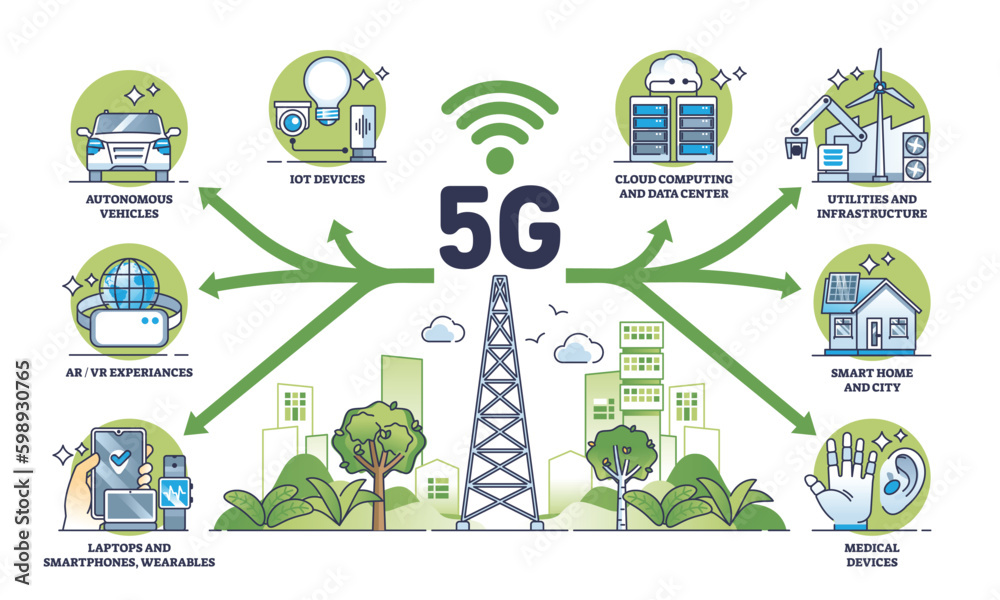
AI and 5G together create a transformative ecosystem where artificial intelligence enhances the capabilities of fifth-generation mobile networks. 5G delivers unprecedented speed, capacity, and reliability, enabling seamless connectivity for billions of devices. AI complements this by analyzing vast datasets in real time, optimizing network resources, and enabling predictive maintenance. This convergence supports mission-critical applications such as remote surgery, augmented reality (AR), and the Internet of Things (IoT), driving innovation across industries.
#Infobox
#Overview
AI and 5G together create a transformative ecosystem where artificial intelligence enhances the capabilities of fifth-generation mobile networks. 5G delivers unprecedented speed, capacity, and reliability, enabling seamless connectivity for billions of devices. AI complements this by analyzing vast datasets in real time, optimizing network resources, and enabling predictive maintenance. This convergence supports mission-critical applications such as remote surgery, augmented reality (AR), and the Internet of Things (IoT), driving innovation across industries.
The integration of AI into 5G networks is often referred to as intelligent 5G or AI-native 5G. It enables networks to self-optimize, self-heal, and adapt dynamically to changing conditions, reducing human intervention and improving efficiency. This evolution is essential for meeting the demands of a hyper-connected world where latency, reliability, and scalability are paramount.
#History / Background
#Evolution of 5G
The development of 5G began in the early 2010s, with the International Telecommunication Union (ITU) defining the requirements for IMT-2020 in 2015. The first commercial deployments of 5G networks were launched in 2019 by operators in South Korea, the United States, and China. 5G introduced three key service categories: enhanced Mobile Broadband (eMBB), Ultra-Reliable Low-Latency Communication (URLLC), and massive Machine Type Communication (mMTC).
These categories enabled faster downloads, near-instantaneous communication, and support for millions of connected devices per square kilometer—capabilities that were unattainable with 4G LTE.
#Rise of AI in Networks
Artificial intelligence has been increasingly integrated into telecommunications since the 2010s, initially for network optimization and fraud detection. As machine learning and deep learning matured, their applications expanded to include predictive maintenance, traffic forecasting, and anomaly detection. The concept of cognitive networks emerged, where AI-driven systems make autonomous decisions to improve network performance.
The formal integration of AI into 5G standards began with Release 16 and 17 of the 3rd Generation Partnership Project (3GPP), which introduced AI/ML-based enhancements for network slicing, beamforming, and handover management. This marked the transition from AI as a tool to AI as a foundational component of next-generation networks.
#How It Works
#5G Network Architecture
5G networks are built on a service-based architecture (SBA), separating the control plane and user plane for greater flexibility. Key components include:
- User Equipment (UE): Devices such as smartphones and IoT sensors.
- Radio Access Network (RAN): Includes base stations (gNB) that connect UEs to the core network.
- 5G Core (5GC): A cloud-native, software-defined core that supports network slicing and virtualization.
- Edge Computing: Brings computation closer to data sources, reducing latency.
#AI Integration in 5G
AI enhances 5G networks through several mechanisms:
- Network Slicing Optimization: AI predicts traffic demands and dynamically allocates resources to different slices (e.g., for IoT, autonomous vehicles, or video streaming).
- Predictive Maintenance: Machine learning models analyze equipment data to forecast failures before they occur, reducing downtime.
- Traffic Management: AI-driven algorithms optimize data routing, balancing load across the network and minimizing congestion.
- Self-Optimizing Networks (SON): AI enables networks to automatically adjust parameters like transmission power and handover thresholds to maintain performance.
- Security: AI detects and mitigates cyber threats in real time by identifying unusual patterns in network traffic.
Additionally, AI is used in beamforming, where antennas dynamically focus signals toward users, improving signal strength and energy efficiency. In the core network, AI supports autonomous orchestration, enabling dynamic provisioning of services without manual intervention.
#Important Facts
- 5G networks can achieve peak data rates of up to 20 Gbps, compared to 1 Gbps for 4G.
- Latency in 5G can be as low as 1 millisecond, enabling real-time applications like remote surgery.
- AI can reduce network energy consumption by up to 30% through intelligent resource allocation.
- The global 5G market is projected to reach $667.9 billion by 2026, with AI playing a critical role in its growth.
- Over 1.4 billion 5G subscriptions were recorded worldwide by the end of 2023.
- AI-driven network slicing allows operators to create multiple virtual networks on a single physical infrastructure, each tailored for specific use cases.
- 5G supports up to 1 million devices per square kilometer, a tenfold increase over 4G.
#Timeline
- ITU defines IMT-2020 requireme
ITU defines IMT-2020 requirements for 5G.
- 3GPP finalizes the first
3GPP finalizes the first 5G New Radio (NR) standard (Release 15).
- First commercial 5G deployment
First commercial 5G deployments in South Korea, the US, and China.
- 3GPP Release 16 introduces
3GPP Release 16 introduces AI/ML enhancements for 5G.
- Global 5G subscriptions exceed
Global 5G subscriptions exceed 500 million.
- AI-driven network slicing beco
AI-driven network slicing becomes a standard feature in 5G-Advanced.
- 5G-Advanced (Release 18) is
5G-Advanced (Release 18) is standardized, with full AI-native capabilities.
- AI-powered 5G networks begin
AI-powered 5G networks begin deployment in smart cities and industrial IoT.
#Related Terms
#FAQ
What does AI And 5G: High-Speed Networks cover?
Explores how artificial intelligence shapes 5G and high-speed networks, covering practical use cases, benefits, limitations, and risks.
Why is AI And 5G: High-Speed Networks important?
It helps readers understand key concepts, compare practical use cases, and evaluate how Business & Marketing decisions affect outcomes, risks, and implementation choices.
What should readers verify before applying this topic?
Readers should compare the benefits, limitations, data requirements, and related themes such as 5G, Highspeed, Network before using the ideas in real projects.
#References
- AI And 5G: High-Speed Networks terminology and background research
- AI And 5G: High-Speed Networks use cases, implementation examples, and limitations
- Business & Marketing best practices, standards, and risk guidance
- 5G case studies, benchmarks, and current industry analysis



Comments
No comments yet. Start the discussion with a useful note.