

#Short Answer
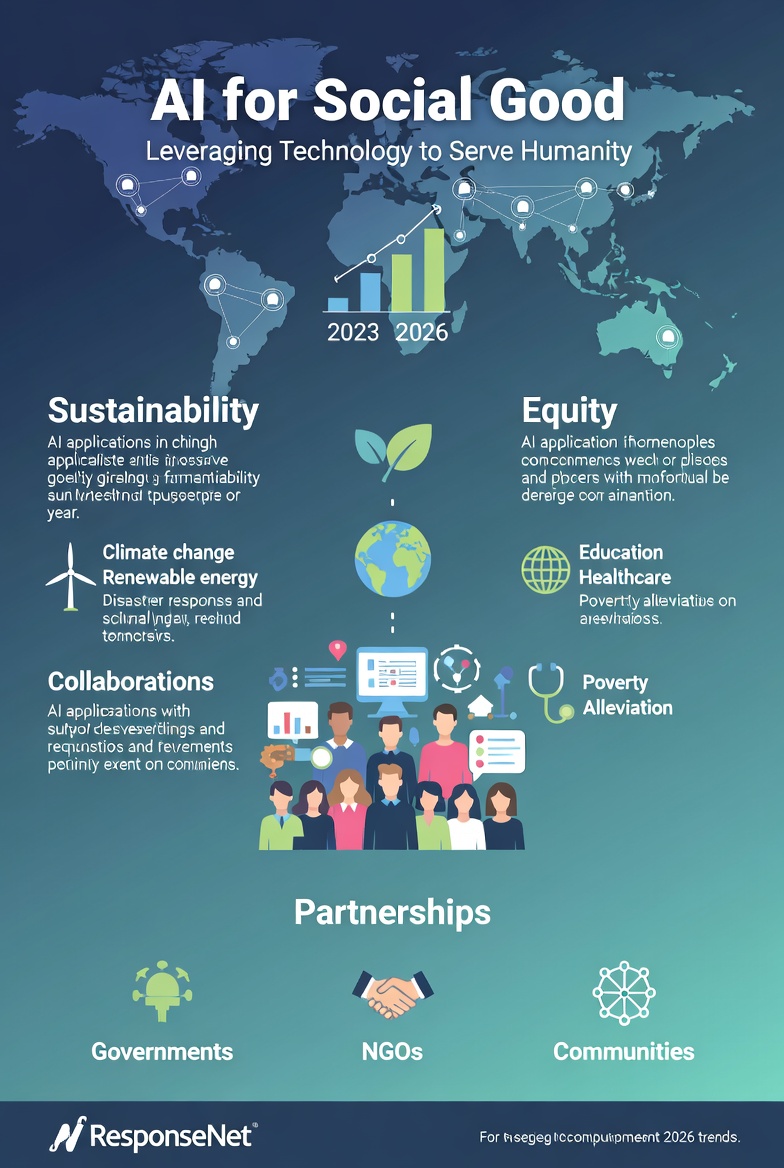
Explores how artificial intelligence shapes social good and making an impact, covering practical use cases, benefits, limitations, and risks.
#Infobox
Artificial Intelligence for Social Good Field Artificial intelligence Focus Social impact, sustainable development, ethical AI Key Applications Healthcare, education, climate change, poverty alleviation Notable Organizations UN, WHO, AI for Good First Introduced Early 2010s Current Status Rapidly expanding
#Overview
Artificial Intelligence for Social Good (AI4SG) is an interdisciplinary field that combines artificial intelligence with social impact initiatives to tackle pressing global issues. Unlike traditional AI applications focused on commercial or industrial gains, AI4SG prioritizes humanitarian, environmental, and societal benefits. This approach emphasizes accessibility, inclusivity, and sustainability, ensuring that AI advancements do not exacerbate existing inequalities but instead bridge gaps in healthcare, education, disaster response, and economic development.
The concept gained momentum in the early 2010s, driven by the exponential growth of AI capabilities and the increasing recognition of its potential to solve complex problems. Organizations such as the United Nations, World Health Organization, and private-sector initiatives like AI for Good have since championed AI4SG as a key strategy for achieving the Sustainable Development Goals (SDGs) by 2030.
#Key Principles
- Inclusivity: Ensuring AI solutions are accessible to marginalized and underserved populations.
- Ethics and Fairness: Addressing algorithmic bias and ensuring transparent, accountable AI systems.
- Sustainability: Developing AI models that minimize environmental impact and promote long-term social benefits.
- Collaboration: Fostering partnerships between governments, NGOs, academia, and private sectors.
#History & Background
#Early Developments
The roots of AI for social good can be traced back to early AI research in the mid-20th century, though its formalization as a distinct field occurred much later. In the 1950s and 1960s, pioneers like Alan Turing and John McCarthy laid the groundwork for AI, but applications were largely theoretical or confined to military and academic settings.
By the 1980s and 1990s, AI began to see practical applications in healthcare (e.g., expert systems for diagnosis) and finance. However, the focus remained on efficiency rather than social impact. The term "AI for Social Good" emerged in the 2010s, coinciding with advancements in deep learning and the proliferation of big data.
#Milestones
- 2015: The UN SDGs were adopted, providing a global framework for AI4SG initiatives.
- 2017: The AI for Good initiative was launched by the ITU, UN, and other partners to accelerate AI solutions for global challenges.
- 2018: The European Commission published ethical guidelines for trustworthy AI, emphasizing social responsibility.
- 2020: The COVID-19 pandemic highlighted AI's role in public health, from contact tracing to vaccine development.
- 2022: The White House released the AI Bill of Rights, outlining principles for ethical AI deployment.
#How It Works
#Core Technologies
AI for Social Good leverages several AI subfields to drive impact:
- Machine Learning (ML): Used for predictive analytics in healthcare (e.g., disease outbreak forecasting) and agriculture (e.g., crop yield optimization).
- Natural Language Processing (NLP): Enables chatbots for mental health support, translation services for refugees, and sentiment analysis for policy feedback.
- Computer Vision: Applied in disaster response (e.g., satellite imagery analysis for flood detection) and wildlife conservation (e.g., poaching prevention).
- Robotics: Deployed in search-and-rescue missions and assistive technologies for people with disabilities.
- Reinforcement Learning: Optimizes resource allocation in public services, such as traffic management or energy distribution.
#Implementation Frameworks
AI4SG projects typically follow a structured approach:
- Problem Identification: Collaborating with communities to define challenges (e.g., food insecurity, educational gaps).
- Data Collection & Preparation: Gathering relevant datasets (e.g., satellite imagery, health records) while ensuring privacy and ethical compliance.
- Model Development: Training AI models using techniques like transfer learning to adapt pre-existing models to new contexts.
- Deployment & Monitoring: Piloting solutions in real-world settings and iterating based on feedback.
- Scaling & Evaluation: Expanding successful models while measuring impact against metrics like cost-effectiveness or lives improved.
#Important Facts
- Economic Impact: AI could contribute up to $15.7 trillion to the global economy by 2030, with a significant portion benefiting social sectors.
- Healthcare: AI-powered diagnostic tools can reduce misdiagnosis rates by up to 30% in some conditions, such as breast cancer.
- Climate Change: Machine learning models predict extreme weather events with 90% accuracy, aiding early warning systems.
- Education: AI tutors and adaptive learning platforms improve literacy rates by 20% in pilot programs across Africa and South Asia.
- Bias Mitigation: Projects like Fairlearn (Microsoft) and AI Fairness 360 (IBM) provide toolkits to detect and reduce bias in AI systems.
- Funding: Global AI4SG funding exceeded $1 billion in 2023, with governments and philanthropies leading investments.
#Timeline
Year Event 1950 Alan Turing proposes the "Turing Test," laying groundwork for AI ethics discussions. 1997 IBM's Deep Blue defeats world chess champion Garry Kasparov, demonstrating AI's potential in complex problem-solving. 2012 AlexNet, a deep learning model, wins the ImageNet competition, sparking widespread interest in AI applications. 2015 The UN adopts the Sustainable Development Goals (SDGs), integrating AI as a tool for achievement. 2017 AI for Good initiative is launched by the ITU and UN, hosting annual summits to accelerate AI solutions. 2019 Google's AI detects diabetic retinopathy in rural India with 90% accuracy, reducing preventable blindness. 2020 AI models like AlphaFold (DeepMind) predict protein structures, accelerating drug discovery for diseases like COVID-19. 2021 UNESCO releases global recommendations on AI ethics, emphasizing social good as a core principle. 2023 Microsoft and the UN launch the AI for Humanitarian Action program, focusing on crisis response.
#Related Terms
#FAQ
What does AI And Social Good: Making An Impact cover?
Explores how artificial intelligence shapes social good and making an impact, covering practical use cases, benefits, limitations, and risks.
Why is AI And Social Good: Making An Impact important?
It helps readers understand key concepts, compare practical use cases, and evaluate how Artificial Intelligence decisions affect outcomes, risks, and implementation choices.
What should readers verify before applying this topic?
Readers should compare the benefits, limitations, data requirements, and related themes such as Social, Good, Making before using the ideas in real projects.
#References
- AI And Social Good: Making An Impact terminology and background research
- AI And Social Good: Making An Impact use cases, implementation examples, and limitations
- Artificial Intelligence best practices, standards, and risk guidance
- Social case studies, benchmarks, and current industry analysis



Comments
No comments yet. Start the discussion with a useful note.