


#Short Answer
Explores how artificial intelligence shapes servers and scaling infrastructure, covering practical use cases, benefits, limitations, and risks.
#Infobox
Artificial Intelligence (AI) servers are specialized computing systems designed to handle the intensive workloads of AI applications, including machine learning, deep learning, and data processing. These servers provide the necessary computational power, memory, and scalability to support AI-driven tasks.
AI and Servers: Scaling Infrastructure Field Artificial intelligence Focus Scaling infrastructure for AI workloads Key Technologies GPUs, TPUs, high-performance CPUs, memory, storage, networking Primary Use Cases Machine learning, deep learning, natural language processing, computer vision Scalability Methods Distributed computing, cloud-based solutions, edge computing Industries Technology, healthcare, finance, automotive, retail
#Overview
AI and servers refer to the infrastructure designed to support artificial intelligence workloads, which require significant computational resources. Unlike traditional servers, AI servers are optimized for parallel processing, high-speed data transfer, and large-scale memory capacity. These systems are essential for training and deploying AI models, enabling businesses and researchers to process vast datasets and perform complex calculations efficiently.
The evolution of AI has driven the demand for specialized servers capable of handling the unique requirements of machine learning (ML) and deep learning (DL) algorithms. These servers often incorporate advanced hardware such as Graphics Processing Units (GPUs), Tensor Processing Units (TPUs), and high-performance Central Processing Units (CPUs) to accelerate computations. Additionally, AI servers are designed with scalability in mind, allowing organizations to expand their infrastructure as their AI workloads grow.
#History / Background
The concept of AI servers emerged alongside the development of artificial intelligence itself. Early AI systems relied on general-purpose computers, which were limited in their ability to handle complex algorithms. The introduction of GPUs in the late 1990s and early 2000s marked a turning point, as these processors were capable of performing parallel computations, making them ideal for AI tasks such as neural network training.
In 2006, Geoffrey Hinton and his team demonstrated the effectiveness of deep learning using GPUs, which led to a surge in AI research and development. Companies like NVIDIA began producing GPUs specifically optimized for AI workloads, while Google developed its own custom hardware, the Tensor Processing Unit (TPU), in 2016 to further accelerate AI computations.
The rise of cloud computing in the 2010s enabled organizations to access AI servers on-demand, reducing the need for expensive on-premises infrastructure. Today, AI servers are a critical component of modern data centers, supporting applications in fields such as healthcare, finance, and autonomous vehicles.
#How It Works
#Hardware Components
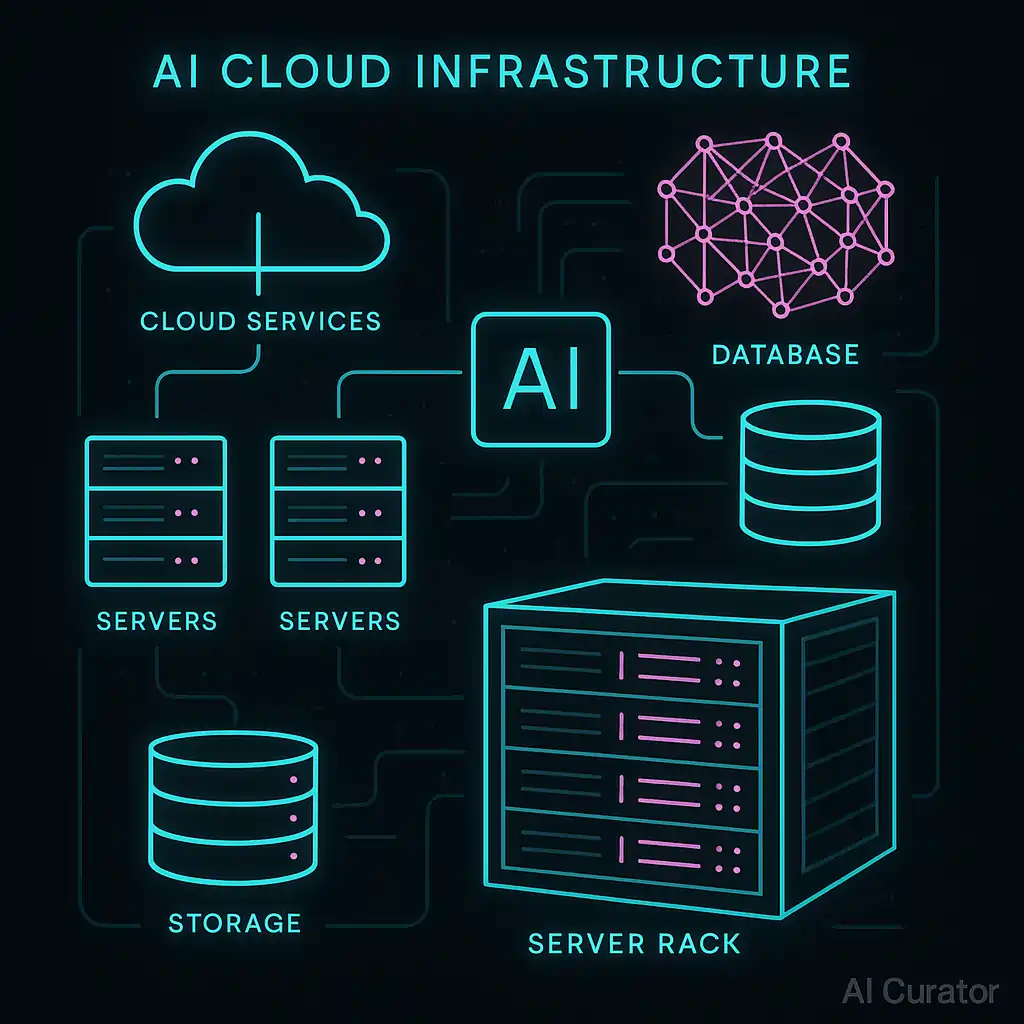
AI servers are built with specialized hardware to handle the demands of AI workloads:
- Graphics Processing Units (GPUs): GPUs are designed for parallel processing, making them ideal for training deep learning models. They can perform thousands of calculations simultaneously, significantly speeding up AI tasks.
- Tensor Processing Units (TPUs): Developed by Google, TPUs are custom-built processors optimized for tensor operations, which are fundamental to machine learning and deep learning models.
- High-Performance CPUs: While GPUs and TPUs handle parallel tasks, CPUs manage general-purpose computations and system operations.
- Memory (RAM): AI servers require large amounts of memory to store and process datasets. High-bandwidth memory (HBM) is often used to meet these demands.
- Storage: Solid-state drives (SSDs) and high-capacity hard drives are used to store training data and model weights.
- Networking: Fast networking technologies, such as InfiniBand or Ethernet, ensure low-latency communication between servers in a distributed AI system.
#Software Stack
AI servers rely on a combination of software frameworks and libraries to execute AI workloads:
- Machine Learning Frameworks: Tools like TensorFlow, PyTorch, and Keras provide the infrastructure for building and training AI models.
- Operating Systems: Linux-based systems are commonly used due to their stability and support for parallel processing.
- Containerization: Technologies like Docker and Kubernetes enable the deployment of AI models in scalable, isolated environments.
- Cloud Platforms: Services like Amazon Web Services (AWS), Microsoft Azure, and Google Cloud Platform offer AI servers as part of their cloud infrastructure.
#Scaling Infrastructure
Scaling AI infrastructure involves expanding computational resources to meet growing demands. There are several approaches to scaling:
- Vertical Scaling: Increasing the power of individual servers by adding more GPUs, CPUs, or memory.
- Horizontal Scaling: Adding more servers to a cluster to distribute the workload. This approach is common in distributed AI systems.
- Hybrid Scaling: Combining vertical and horizontal scaling to optimize performance and cost.
- Edge Computing: Deploying AI servers closer to the data source to reduce latency and improve real-time processing.
#Important Facts
- AI servers consume significantly more power than traditional servers due to their high computational demands.
- The global AI server market is projected to reach $30 billion by 2027, driven by the increasing adoption of AI technologies.
- NVIDIA dominates the AI server market, with its GPUs being used in over 90% of AI training workloads.
- AI servers are essential for applications such as autonomous vehicles, drug discovery, and financial forecasting.
- The performance of AI servers is often measured in FLOPS (Floating Point Operations Per Second), with modern systems capable of achieving over 1 exaFLOP.
#Timeline
Year Event 1950s Early AI research begins, using general-purpose computers for simple AI tasks. 1990s GPUs are introduced, enabling parallel processing for AI workloads. 2006 Geoffrey Hinton demonstrates the effectiveness of deep learning using GPUs. 2012 AlexNet, a deep learning model, achieves breakthrough performance in image recognition, driving demand for AI servers. 2016 Google introduces the Tensor Processing Unit (TPU) to accelerate AI computations. 2018 NVIDIA releases its A100 GPU, designed specifically for AI and machine learning workloads. 2020 The COVID-19 pandemic accelerates the adoption of AI in healthcare, increasing demand for AI servers. 2023 AI servers become a critical component of data centers, supporting generative AI models like large language models.
#Related Terms
#FAQ
What does AI And Servers: Scaling Infrastructure cover?
Explores how artificial intelligence shapes servers and scaling infrastructure, covering practical use cases, benefits, limitations, and risks.
Why is AI And Servers: Scaling Infrastructure important?
It helps readers understand key concepts, compare practical use cases, and evaluate how Technology decisions affect outcomes, risks, and implementation choices.
What should readers verify before applying this topic?
Readers should compare the benefits, limitations, data requirements, and related themes such as Server, Scaling, Infrastructure before using the ideas in real projects.
#References
- AI And Servers: Scaling Infrastructure terminology and background research
- AI And Servers: Scaling Infrastructure use cases, implementation examples, and limitations
- Technology best practices, standards, and risk guidance
- Server case studies, benchmarks, and current industry analysis


Comments
No comments yet. Start the discussion with a useful note.