

#Short Answer
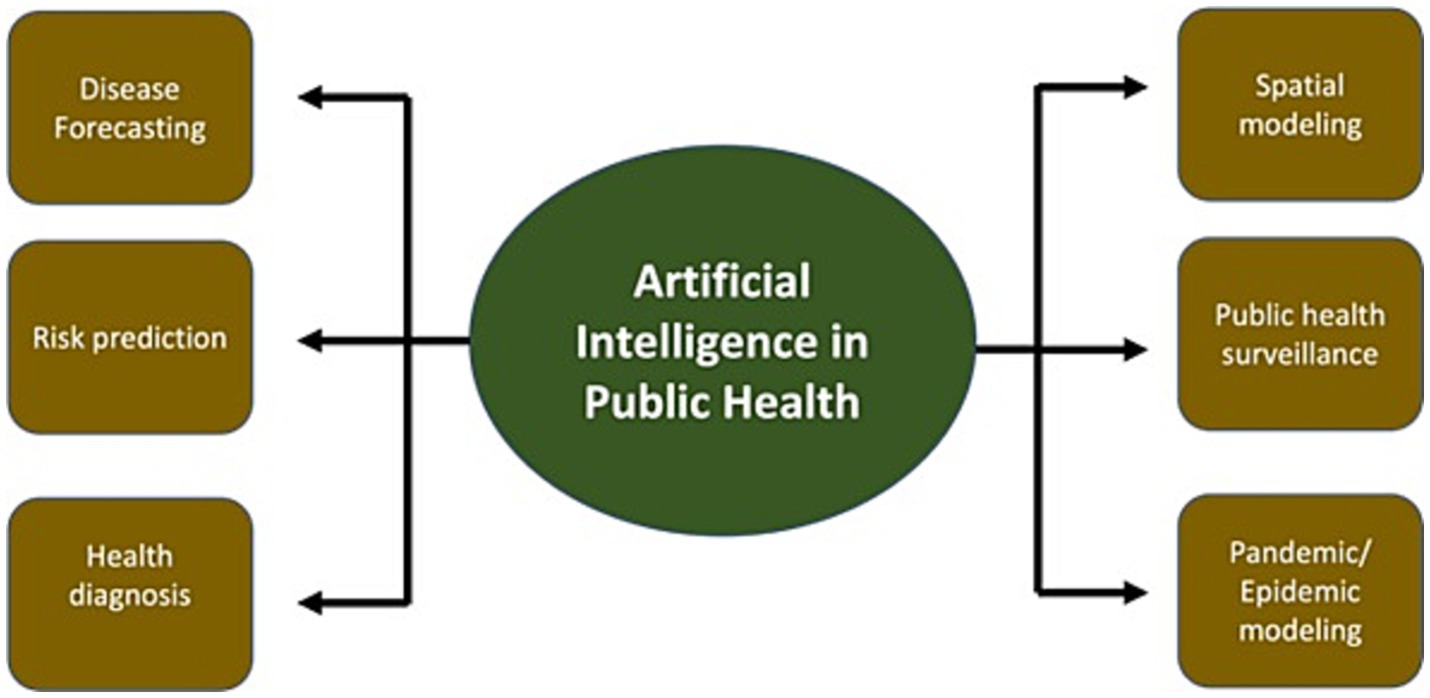
Explores how artificial intelligence shapes public health and population insights, covering practical use cases, benefits, limitations, and risks.
#Infobox
Artificial intelligence in public health involves using AI technologies to analyze health data, predict outbreaks, optimize resource allocation, and improve healthcare delivery. Artificial Intelligence in Public Health Field Artificial intelligence Subfield Public health Key Applications Disease prediction, outbreak detection, health data analysis, resource optimization, personalized medicine Major Techniques Machine learning, deep learning, natural language processing, computer vision Notable Tools IBM Watson Health, Google DeepMind, BlueDot, HealthMap Impact Improved early warning systems, reduced healthcare costs, enhanced decision-making
#Overview
Artificial intelligence (AI) in public health refers to the application of AI technologies to analyze vast datasets, predict health trends, and optimize interventions for population-level health outcomes. AI systems leverage machine learning (ML), deep learning, natural language processing (NLP), and computer vision to process structured and unstructured health data, including electronic health records (EHRs), epidemiological reports, social media, and environmental sensors. These technologies enable public health agencies to detect disease outbreaks earlier, allocate resources more efficiently, and tailor interventions to high-risk populations.
AI-driven public health initiatives span multiple domains, from infectious disease surveillance to chronic disease management and health policy design. By automating data analysis and identifying patterns invisible to human analysts, AI enhances the speed and accuracy of public health responses. However, challenges such as data privacy, algorithmic bias, and integration with existing health systems remain critical considerations.
#History / Background
The integration of AI into public health has evolved alongside advancements in computing power, data availability, and algorithmic sophistication. Early applications in the 1970s and 1980s focused on rule-based expert systems for medical diagnosis, such as MYCIN, which used AI to identify bacterial infections. However, these systems were limited by computational constraints and lacked scalability.
The 1990s saw the emergence of data-driven approaches with the rise of machine learning, enabling systems to learn from data rather than rely solely on predefined rules. Projects like the Global Public Health Intelligence Network (GPHIN) used keyword-based algorithms to monitor global disease outbreaks from news reports, laying the groundwork for modern AI-driven surveillance.
The 2000s brought significant progress with the advent of big data and cloud computing. The 2009 H1N1 influenza pandemic demonstrated the potential of AI for real-time outbreak tracking, while initiatives like Google Flu Trends (2008) attempted to predict flu activity using search query data. Despite early successes, these models faced criticism for overfitting and lack of validation.
The 2010s marked a turning point with the proliferation of deep learning and the availability of high-quality health datasets. The 2014 Ebola epidemic in West Africa accelerated AI adoption in public health, with organizations like the World Health Organization (WHO) and CDC exploring AI for outbreak prediction and response. The COVID-19 pandemic (2020–2022) further cemented AI's role, with tools like BlueDot and HealthMap providing early warnings of the outbreak in Wuhan, China.
#How It Works
#Data Collection and Processing
AI systems in public health rely on diverse data sources, including:
- Electronic Health Records (EHRs): Structured data from hospitals and clinics, including patient histories, lab results, and diagnoses.
- Epidemiological Reports: Official data from health agencies, such as case counts, mortality rates, and vaccination records.
- Environmental Data: Climate, air quality, and pollution metrics that influence disease spread.
- Social Media and Web Data: Unstructured data from platforms like Twitter, Reddit, and news articles, analyzed using NLP to detect health trends.
- Wearable Devices: Data from fitness trackers and smartwatches, such as heart rate variability and activity levels, used for early illness detection.
- Genomic Data: DNA sequencing information to track pathogen mutations and identify drug-resistant strains.
Once collected, data is preprocessed to remove noise, standardize formats, and ensure consistency. Techniques like normalization, imputation, and feature engineering are applied before feeding data into AI models.
#Machine Learning and Deep Learning
AI models in public health fall into several categories:
- Supervised Learning: Used for classification and regression tasks, such as predicting disease outbreaks or patient readmission risks. Algorithms like logistic regression, random forests, and support vector machines (SVMs) are commonly employed.
- Unsupervised Learning: Identifies patterns in unlabeled data, such as clustering patients with similar symptoms or detecting anomalies in health trends. Techniques include k-means clustering and autoencoders.
- Reinforcement Learning: Optimizes decision-making in dynamic environments, such as allocating vaccines during a pandemic or managing hospital bed capacity.
- Deep Learning: Excels at processing complex, high-dimensional data, such as medical imaging (e.g., X-rays for tuberculosis detection) or time-series data (e.g., predicting flu trends). Convolutional neural networks (CNNs) and recurrent neural networks (RNNs) are widely used.
#Natural Language Processing and Computer Vision
Natural Language Processing (NLP): Analyzes unstructured text data from medical records, research papers, and social media to extract meaningful insights. For example, NLP can identify mentions of symptoms in patient forums or track misinformation during health crises.
Computer Vision: Processes medical images, such as CT scans or pathology slides, to detect abnormalities. Applications include identifying tumors in radiology images or monitoring disease progression in dermatology.
#Integration with Public Health Systems
AI tools are integrated into public health workflows through:
- Surveillance Systems: Automated dashboards that aggregate and visualize health data in real-time, such as the HealthMap platform.
- Decision Support Systems: Tools that provide evidence-based recommendations to policymakers, such as the IBM Watson Health platform.
- Predictive Modeling: Algorithms that forecast disease spread, such as the SEIR model enhanced with AI for parameter estimation.
- Chatbots and Virtual Assistants: AI-driven interfaces that provide health information, triage patients, or manage chronic conditions.
#Important Facts
- Early Detection: AI systems like BlueDot and HealthMap detected the COVID-19 outbreak in Wuhan up to 9 days before the WHO's official announcement.
- Resource Optimization: AI has been used to predict hospital bed shortages during the COVID-19 pandemic, enabling better resource allocation in Italy and New York.
- Personalized Medicine: AI models analyze genetic and lifestyle data to recommend tailored treatments for chronic diseases like diabetes and cancer.
- Vaccine Development: AI accelerated the development of COVID-19 vaccines by simulating protein structures and identifying potential drug candidates.
- Misinformation Detection: NLP models track and debunk health-related misinformation on social media, reducing vaccine hesitancy.
- Cost Savings: AI-driven predictive analytics in public health can reduce healthcare costs by up to 20% through early intervention and reduced hospitalizations.
- Global Surveillance: The GPHIN monitors over 10,000 sources in 9 languages to detect global health threats.
#Timeline
Year Event 1970s Development of early expert systems like MYCIN for medical diagnosis. 1980s Introduction of rule-based AI systems in public health surveillance. 1990s Rise of machine learning for analyzing epidemiological data; GPHIN launched. 2008 Google Flu Trends uses search queries to predict flu activity. 2014 AI tools used to track Ebola outbreaks in West Africa. 2016 DeepMind's AI predicts acute kidney injury in hospitals. 2018 WHO launches the AI for Health initiative to promote AI in global health. 2020 BlueDot and HealthMap detect COVID-19 outbreak in Wuhan; AI accelerates vaccine development. 2021 AI models predict COVID-19 variants and optimize vaccine distribution. 2022 WHO releases guidelines on ethical AI in public health.
#Related Terms
#FAQ
What does AI And Public Health: Population Insights cover?
Explores how artificial intelligence shapes public health and population insights, covering practical use cases, benefits, limitations, and risks.
Why is AI And Public Health: Population Insights important?
It helps readers understand key concepts, compare practical use cases, and evaluate how Healthcare AI decisions affect outcomes, risks, and implementation choices.
What should readers verify before applying this topic?
Readers should compare the benefits, limitations, data requirements, and related themes such as Public, Health, Population before using the ideas in real projects.
#References
- AI And Public Health: Population Insights terminology and background research
- AI And Public Health: Population Insights use cases, implementation examples, and limitations
- Healthcare AI best practices, standards, and risk guidance
- Public case studies, benchmarks, and current industry analysis


Comments
No comments yet. Start the discussion with a useful note.