

#Short Answer
Explores how artificial intelligence shapes HR and hiring and onboarding, covering practical use cases, benefits, limitations, and risks.
#Infobox
Artificial intelligence in human resources streamlines hiring, onboarding, and employee support through automation, predictive analytics, and natural language processing.
Artificial Intelligence in Human Resources Field Human resource management Key Applications Recruitment, onboarding, employee engagement, performance management Technologies Used Machine learning, natural language processing, predictive analytics, chatbots Benefits Reduced time-to-hire, improved candidate experience, cost efficiency Challenges Bias in algorithms, data privacy concerns, integration complexity Notable Tools Workday, Greenhouse, BambooHR, IBM Watson
#Overview
Artificial intelligence (AI) in human resources (HR) refers to the application of machine learning, natural language processing (NLP), and predictive analytics to automate and enhance HR functions, particularly in hiring and onboarding. AI-driven HR systems analyze large datasets to identify patterns, predict employee behavior, and streamline administrative tasks. These technologies enable organizations to reduce bias in recruitment, improve candidate matching, and accelerate the onboarding process.
In hiring, AI tools such as applicant tracking systems (ATS) and chatbots screen resumes, conduct initial interviews, and schedule assessments. For onboarding, AI personalizes training programs, automates document processing, and provides real-time support to new employees. The integration of AI in HR not only enhances efficiency but also fosters a more data-driven approach to workforce management.
#History / Background
The concept of AI in HR emerged in the late 20th century with the development of early applicant tracking systems. However, significant advancements occurred in the 2010s with the rise of big data and cloud computing. Companies like IBM and Google began integrating AI into their HR processes, leveraging machine learning to analyze employee performance and predict turnover.
In 2016, the launch of IBM Watson for HR marked a turning point, enabling cognitive computing to assist in talent acquisition and employee engagement. The proliferation of cloud-based HR software, such as Workday and BambooHR, further accelerated AI adoption by offering scalable solutions for mid-sized and large enterprises.
Regulatory frameworks, such as the General Data Protection Regulation (GDPR) in the European Union, have influenced AI-driven HR practices by emphasizing data privacy and ethical considerations. Today, AI in HR continues to evolve, with emerging technologies like generative AI and sentiment analysis enhancing decision-making processes.
#How It Works
#Recruitment Automation
AI-powered recruitment tools automate the screening of job applications by analyzing resumes, cover letters, and online profiles. Machine learning algorithms identify keywords, skills, and experience levels to shortlist candidates that best match job requirements. Some systems also use NLP to interpret the context of responses in video interviews, assessing candidates' communication skills and cultural fit.
Chatbots, such as Mya and Paradox, engage with applicants in real-time, answering queries about job roles, application status, and company policies. These tools reduce the administrative burden on HR teams and improve the candidate experience by providing instant responses.
#Predictive Analytics
Predictive analytics in HR uses historical data to forecast future workforce trends, such as employee turnover, performance, and hiring needs. By analyzing patterns in employee behavior, AI models can identify high-risk employees who may be considering leaving, allowing HR teams to intervene proactively. Similarly, predictive analytics helps organizations anticipate skill gaps and plan recruitment strategies accordingly.
#Onboarding Processes
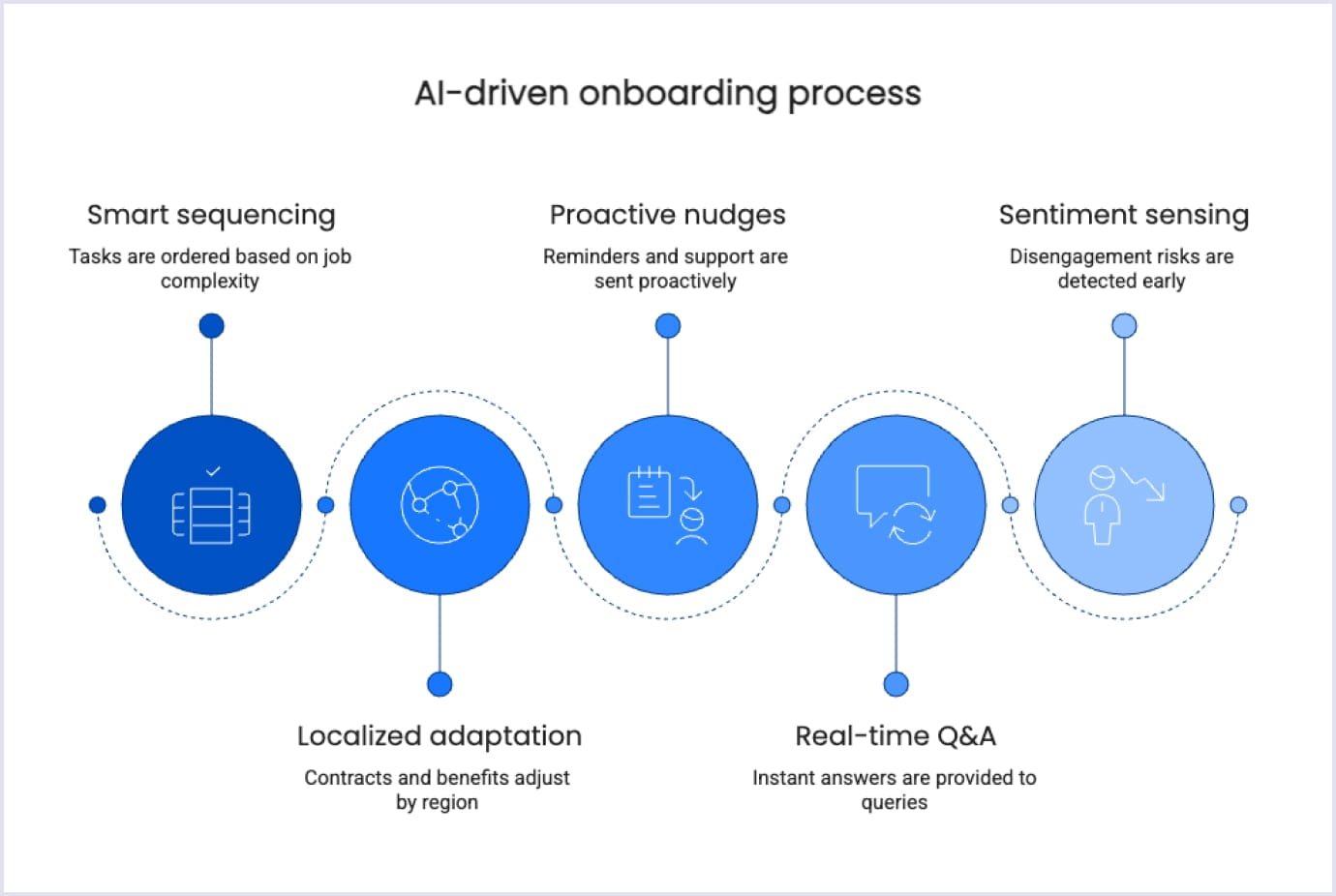
AI enhances onboarding by personalizing training programs based on an employee's role, experience, and learning pace. Virtual assistants guide new hires through company policies, benefits enrollment, and IT setup, ensuring a smooth transition. Some platforms use gamification to make onboarding more engaging, while others leverage sentiment analysis to gauge employee satisfaction during the initial weeks.
Automated document processing reduces manual errors in paperwork, such as employment contracts and tax forms, by extracting and validating data from digital submissions. AI-driven onboarding systems also integrate with learning management systems (LMS) to track progress and provide targeted feedback.
#Important Facts
- Efficiency Gains: Companies using AI in recruitment report a 75% reduction in time-to-hire and a 30% decrease in hiring costs.
- Bias Mitigation: AI tools can reduce unconscious bias by focusing on skills and qualifications rather than demographic factors, though algorithmic bias remains a concern.
- Employee Retention: Predictive analytics can identify employees at risk of leaving with 80% accuracy, enabling proactive retention strategies.
- Global Adoption: The AI in HR market is projected to reach $3.6 billion by 2025, growing at a CAGR of 9.4%.
- Data Privacy: Compliance with regulations like GDPR and the California Consumer Privacy Act (CCPA) is critical for AI-driven HR systems.
#Timeline
Year Milestone 1990s Early applicant tracking systems (ATS) emerge, automating resume screening. 2005 IBM introduces Watson, laying the groundwork for cognitive HR applications. 2012 Google implements AI-driven people analytics to predict employee performance. 2016 IBM Watson for HR launches, offering AI-powered talent management solutions. 2018 GDPR comes into effect, influencing AI-driven HR practices in the EU. 2020 COVID-19 accelerates remote hiring and virtual onboarding tools. 2022 Generative AI tools like chatbots and virtual assistants become mainstream in HR. 2024 AI in HR adoption reaches 60% of large enterprises, with a focus on ethical AI.
#Related Terms
#FAQ
What does AI And HR: Hiring And Onboarding cover?
Explores how artificial intelligence shapes HR and hiring and onboarding, covering practical use cases, benefits, limitations, and risks.
Why is AI And HR: Hiring And Onboarding important?
It helps readers understand key concepts, compare practical use cases, and evaluate how Business & Marketing decisions affect outcomes, risks, and implementation choices.
What should readers verify before applying this topic?
Readers should compare the benefits, limitations, data requirements, and related themes such as HR, Hiring, Onboarding before using the ideas in real projects.
#References
- AI And HR: Hiring And Onboarding terminology and background research
- AI And HR: Hiring And Onboarding use cases, implementation examples, and limitations
- Business & Marketing best practices, standards, and risk guidance
- HR case studies, benchmarks, and current industry analysis

Comments
No comments yet. Start the discussion with a useful note.