


#Short Answer
Explains why ai ethics matters more than ever, including key reasons, examples, benefits, trade-offs, and risks.
#Infobox
#Overview
Artificial intelligence (AI) has rapidly transformed industries, economies, and daily life, offering unprecedented opportunities for innovation and efficiency. However, its rapid advancement has also raised critical ethical concerns, including algorithmic bias, lack of transparency, and unintended societal consequences. AI ethics has emerged as a vital discipline to address these challenges, ensuring that AI systems are developed and deployed in ways that align with human values, fairness, and accountability. The importance of AI ethics has grown in tandem with the increasing integration of AI into high-stakes domains such as healthcare, criminal justice, finance, and employment. Without robust ethical frameworks, AI systems risk perpetuating discrimination, eroding privacy, and undermining public trust. Ethical AI practices not only mitigate harm but also foster innovation by aligning technological progress with societal well-being.
#History / Background
#Early Foundations (1950s–2000s)
The roots of AI ethics can be traced back to the early days of AI research, when pioneers like Alan Turing and Joseph Weizenbaum grappled with the moral implications of intelligent machines. Turing’s 1950 paper "Computing Machinery and Intelligence" posed fundamental questions about machine consciousness and ethics, while Weizenbaum’s 1976 work "Computer Power and Human Reason" warned against the uncritical acceptance of AI systems in human decision-making. During this period, AI ethics was largely theoretical, with discussions centered on the philosophical implications of machine intelligence rather than practical concerns. The field remained niche until the late 20th century, when advancements in computing power and data availability began to make AI a tangible reality.
#Rise of Ethical Concerns (2010s)
The 2010s marked a turning point, as AI systems became more pervasive and their societal impacts more visible. High-profile incidents, such as racial bias in facial recognition algorithms and gender discrimination in hiring tools, highlighted the urgent need for ethical oversight. Researchers like Joy Buolamwini and Timnit Gebru exposed biases in commercial AI systems, sparking global debates on algorithmic fairness. In 2016, the Partnership on AI was founded by major tech companies (including Google, Microsoft, and IBM) to promote ethical AI development. Around the same time, the European Union began drafting regulations to govern AI, culminating in the EU AI Act (proposed in 2021), which aims to classify AI systems by risk level and impose strict compliance requirements.
#Modern Era
(2020s–Present)
Today, AI ethics is a multidisciplinary field encompassing computer science, law, philosophy, and social sciences. Key developments include: - The rise of explainable AI (XAI), which seeks to make AI decision-making processes transparent. - The establishment of AI ethics boards in tech companies (e.g., Google’s Advanced Technology External Advisory Council). - The growing influence of AI governance frameworks, such as the OECD AI Principles and UNESCO’s Recommendation on the Ethics of AI. Despite progress, challenges persist, including the lack of standardized ethical guidelines, corporate resistance to regulation, and the global disparity in AI ethics enforcement.
#How It Works
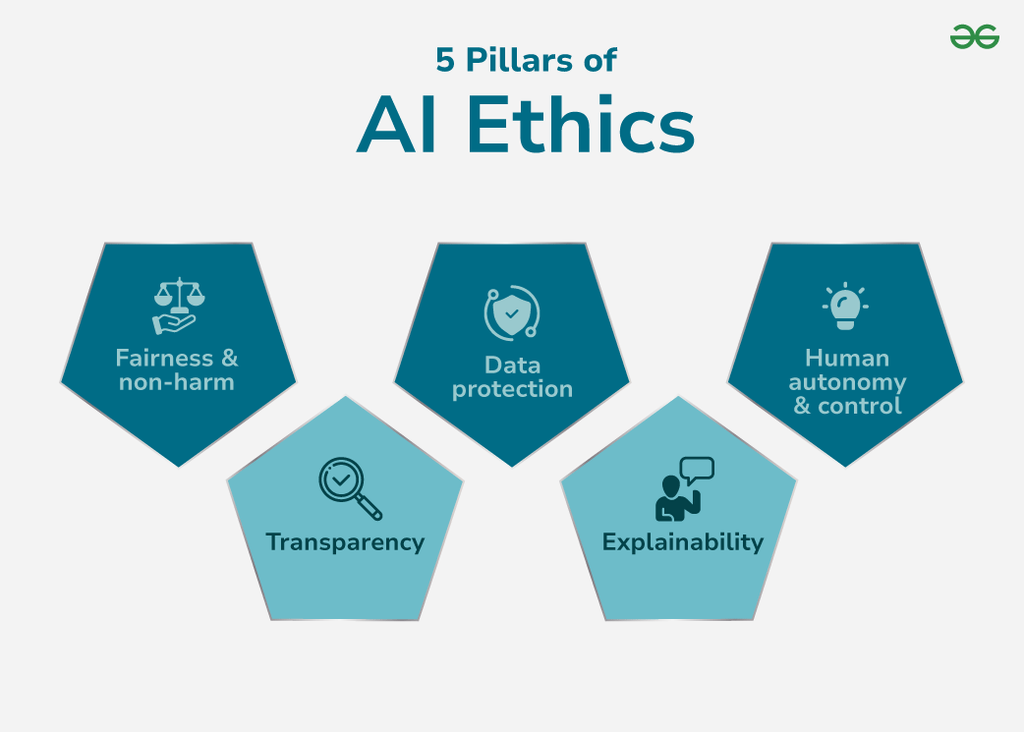
AI ethics operates through a combination of principles, frameworks, and practices designed to guide the development and deployment of AI systems. The following are core components:
#
- Fairness and Bias Mitigation AI systems can inadvertently perpetuate or amplify biases present in training data. Ethical AI requires:
- Bias audits: Regular assessments of datasets and algorithms to identify and correct discriminatory patterns.
- Diverse data collection: Ensuring training datasets represent diverse populations to avoid skewed outcomes.
- Fairness metrics: Implementing tools like disparate impact analysis and equalized odds to measure and mitigate bias.
#
- Transparency and Explainability Black-box AI models (e.g., deep neural networks) often lack interpretability, making it difficult to understand their decision-making processes. Ethical AI promotes:
- Explainable AI (XAI): Techniques such as LIME (Local Interpretable Model-agnostic Explanations) and SHAP (SHapley Additive exPlanations) to provide insights into model predictions.
- Documentation standards: Requiring AI developers to disclose data sources, model limitations, and potential biases (e.g., Model Cards by Google).
- Human-in-the-loop systems: Involving human oversight in critical decision-making processes.
#
- Accountability and Responsibility Determining accountability for AI-driven harms is complex, as multiple stakeholders (developers, companies, users) may share responsibility. Ethical frameworks emphasize:
- Clear ownership: Assigning responsibility for AI system outcomes to specific entities.
- Impact assessments: Conducting Algorithmic Impact Assessments (AIAs) to evaluate potential societal effects before deployment.
- Redress mechanisms: Establishing channels for individuals to challenge AI-driven decisions (e.g., right to explanation under GDPR).
#
- Privacy and Security AI systems often rely on vast amounts of personal data, raising concerns about surveillance and misuse. Ethical AI addresses this through:
- Data minimization: Collecting only the data necessary for a given task.
- Differential privacy: Techniques to anonymize data while preserving utility.
- Secure AI development: Implementing robust cybersecurity measures to prevent data breaches.
#
- Human-Centric Design Ethical AI prioritizes human well-being by:
- Aligning with human values: Incorporating ethical constraints into AI objectives (e.g., value alignment in reinforcement learning).
- Participatory design: Involving affected communities in the development process to ensure AI systems meet their needs.
- Safety guarantees: Implementing fail-safes and kill switches to prevent harmful outcomes (e.g., Asimov’s Laws of Robotics, adapted for modern AI).
#Important Facts
- Algorithmic Bias is Pervasive: Studies have shown that facial recognition systems misidentify people of color at significantly higher rates than white individuals. For example, a 2018 NIST report found that some algorithms had error rates up to 100 times higher for certain demographic groups.
- Explainable AI is Not Yet Standard: Despite advances in XAI, many commercial AI systems remain opaque. A 2022 survey by the AI Now Institute found that only 12% of companies disclosed details about their AI models’ decision-making processes.
- AI Ethics Regulations are Fragmented: While the EU AI Act imposes strict rules on high-risk AI systems, other regions (e.g., the U.S.) rely on voluntary guidelines, leading to inconsistent enforcement.
- Ethical AI Can Drive Innovation: Companies that prioritize ethics often gain a competitive edge. For example, Microsoft’s Fairlearn toolkit has been adopted by over 10,000 organizations to mitigate bias in AI models.
- Public Trust is Declining: A 2023 Pew Research Center poll revealed that 61% of Americans believe AI will worsen inequality, highlighting the need for ethical safeguards.
#Timeline
- Foundational ideas
Core concepts and early methods shape Why AI Ethics Matters More Than Ever.
- Practical use
Tools, examples, and real-world deployments make the topic easier to evaluate.
- Responsible implementation
Current work focuses on reliability, governance, performance, and measurable impact.
#Related Terms
#FAQ
What does Why AI Ethics Matters More Than Ever cover?
Explains why ai ethics matters more than ever, including key reasons, examples, benefits, trade-offs, and risks.
Why is Why AI Ethics Matters More Than Ever important?
It helps readers understand key concepts, compare practical use cases, and evaluate how AI Ethics decisions affect outcomes, risks, and implementation choices.
What should readers verify before applying this topic?
Readers should compare benefits, limitations, data requirements, and related themes such as AI, Ethics, Matters before using the ideas in real projects.
#References
- Why AI Ethics Matters More Than Ever terminology and background research
- Why AI Ethics Matters More Than Ever use cases, implementation examples, and limitations
- AI Ethics best practices, standards, and risk guidance
- AI case studies, benchmarks, and current industry analysis


Comments
No comments yet. Start the discussion with a useful note.