

#Short Answer
Covers meaning of ai ethics, including core concepts, practical examples, benefits, limitations, and risks in AI Ethics.
#Infobox
#Overview
AI Ethics is an interdisciplinary field that examines the moral and societal implications of artificial intelligence. As AI systems become increasingly integrated into critical aspects of life—such as healthcare, finance, criminal justice, and autonomous vehicles—the need for ethical guidelines has grown. AI ethics seeks to address questions about how AI should be designed, who should control it, and what safeguards should be in place to prevent harm. The field is not just about preventing negative outcomes but also about ensuring that AI technologies are developed in ways that promote human well-being, equity, and justice. This includes addressing issues like algorithmic bias, data privacy, job displacement, and the potential for AI to be weaponized or misused. AI ethics also explores the long-term existential risks posed by advanced AI, such as superintelligence and loss of human control.
#History / Background
#Early Foundations (20th Century)
The concept of AI ethics can be traced back to the early days of artificial intelligence in the mid-20th century. Pioneers like Alan Turing and Norbert Wiener raised questions about the ethical implications of machines that could think and act autonomously. In 1950, Turing proposed the "Turing Test" as a way to measure machine intelligence, but he also pondered whether machines could ever be considered "conscious" or deserving of rights. In 1942, science fiction writer Isaac Asimov introduced the Three Laws of Robotics in his short story "Runaround", which became a foundational text for AI ethics. These laws were designed to ensure robots (and by extension, AI systems) would never harm humans and would always obey human commands unless doing so would violate the first law. While these laws were fictional, they sparked early discussions about the ethical constraints of AI.
#The Rise of AI Safety (1980s–2000s)
In the 1980s and 1990s, researchers began to seriously consider the risks of advanced AI. Joseph Weizenbaum, a computer scientist, argued in his 1976 book "Computer Power and Human Reason" that AI systems should not be trusted with decisions that require human judgment. Meanwhile, Nick Bostrom, a philosopher, started exploring the existential risks of AI in the late 1990s, laying the groundwork for modern AI safety research. During this period, the field of AI safety emerged as a sub-discipline focused on preventing unintended harmful behaviors in AI systems. Researchers like Stuart Russell and Eliezer Yudkowsky emphasized the importance of aligning AI goals with human values, a concept now known as value alignment.
#Modern Era
(2010s–Present)
The 2010s marked a turning point for AI ethics, driven by the rapid advancement of machine learning and deep learning technologies. High-profile incidents, such as racial and gender biases in facial recognition systems (e.g., IBM, Microsoft, and Amazon's AI tools), highlighted the urgent need for ethical oversight. The 2016 Microsoft Tay chatbot scandal, which learned to spew racist and offensive language from users, further underscored the risks of unchecked AI development. In response, governments, corporations, and academic institutions began developing AI ethics frameworks. Key milestones include:
- 2016: The Asilomar AI Principles, a set of 23 guidelines for ethical AI development, were published by the Future of Life Institute.
- 2018: The European Union's General Data Protection Regulation (GDPR) introduced strict rules on data privacy, influencing AI ethics discussions.
- 2019: The OECD adopted the OECD AI Principles, which emphasize inclusive growth, human-centered values, and transparency.
- 2021: The EU proposed the AI Act, the first major legislation to regulate AI based on risk levels.
- 2023: The White House released the Blueprint for an AI Bill of Rights, outlining five principles for ethical AI use in the United States. Today, AI ethics is a rapidly evolving field, with ongoing debates about AI governance, bias in algorithms, explainable AI (XAI), and the long-term risks of superintelligent AI.
#How It Works
AI ethics operates through a combination of principles, frameworks, regulations, and technical safeguards. Below are the key components that define how AI ethics is implemented:
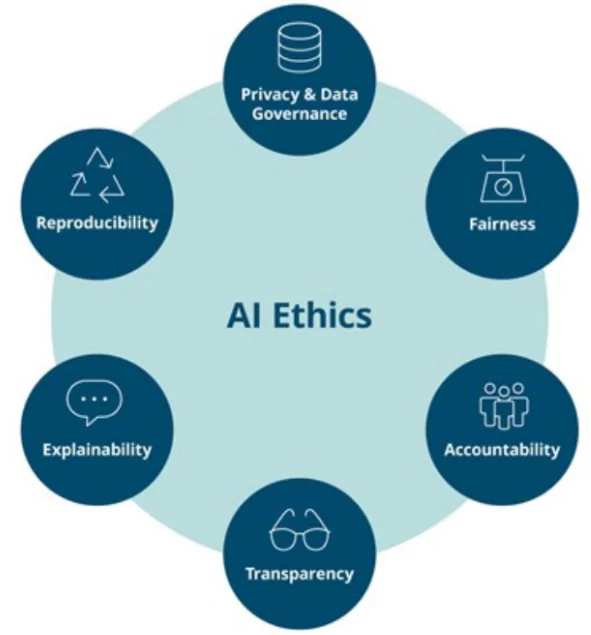
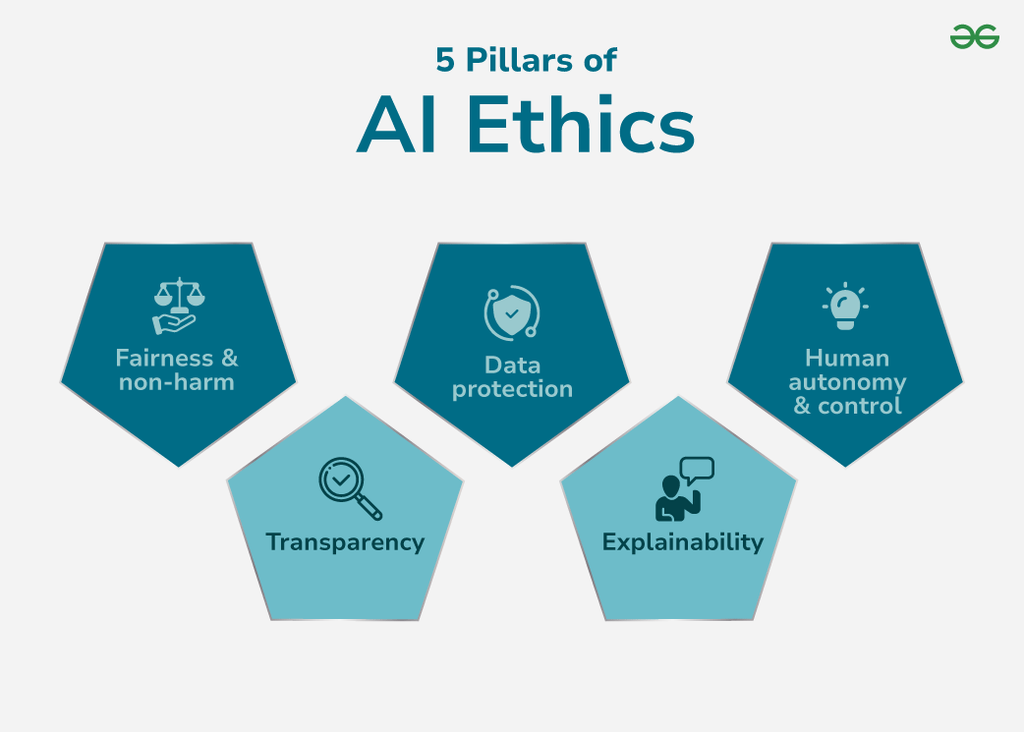
#1. Ethical Principles and Frameworks AI ethics is guided by a set of core principles that serve as the foundation for responsible AI development. These include:
- Fairness and Non-Discrimination: Ensuring AI systems do not perpetuate or amplify biases based on race, gender, age, or other protected attributes.
- Transparency and Explainability: Making AI decision-making processes understandable to humans, especially in high-stakes areas like healthcare and criminal justice.
- Accountability: Assigning responsibility for AI-driven outcomes, including mechanisms for redress when AI systems cause harm.
- Privacy and Data Protection: Safeguarding personal data used in AI training and ensuring compliance with regulations like GDPR.
- Human Control and Autonomy: Ensuring that AI systems augment rather than replace human decision-making, particularly in critical domains.
- Beneficence and Non-Maleficence: AI should be designed to do good and avoid harm, aligning with the medical principle of "first, do no harm." Organizations like the IEEE, OECD, and EU have developed formal frameworks based on these principles. For example:
- IEEE Ethically Aligned Design (2019): A global consensus on ethical considerations for autonomous and intelligent systems.
- EU AI Act (2021): A risk-based regulatory framework that classifies AI systems into four categories (unacceptable risk, high risk, limited risk, and minimal risk) and imposes strict requirements on high-risk AI.
#2. Technical Safeguards Ethical AI is not just about principles but also about technical implementations that prevent harm. Key approaches include:
- Bias Mitigation Techniques: Algorithms like fairness-aware machine learning and adversarial debiasing are used to reduce discrimination in AI models.
- Explainable AI (XAI): Techniques such as LIME (Local Interpretable Model-agnostic Explanations) and SHAP (SHapley Additive exPlanations) help make AI decisions more interpretable.
- Differential Privacy: A method to protect individual privacy by adding "noise" to datasets, making it harder to identify individuals while preserving useful data patterns.
- Federated Learning: A decentralized approach to training AI models where data remains on local devices, reducing privacy risks.
- AI Alignment Research: Efforts to ensure AI systems' goals are aligned with human values, preventing unintended harmful behaviors (e.g., inverse reinforcement learning).
#3. Governance and Regulation AI ethics is enforced through policies, laws, and organizational governance structures. Examples include:
- Regulatory Frameworks: Laws like the EU AI Act and GDPR impose legal obligations on AI developers and users.
- Ethics Review Boards: Many companies and research institutions have established AI ethics committees to oversee AI projects.
- Industry Standards: Organizations like ISO and NIST are developing standards for ethical AI, such as ISO/IEC 23894 (AI Risk Management).
- Public Engagement: Initiatives like citizen assemblies and public consultations involve stakeholders in AI governance decisions.
#4. Ethical AI Development Lifecycle A structured approach to embedding ethics in AI development includes:
- Problem Definition: Identifying the ethical implications of the AI system's purpose.
- Data Collection: Ensuring datasets are representative, unbiased, and legally obtained.
- Model Training: Using techniques to minimize bias and ensure fairness.
- Testing and Validation: Evaluating the AI system for ethical risks (e.g., fairness audits, stress testing).
- Deployment and Monitoring: Continuously tracking the AI system's performance and impact post-deployment.
- Feedback and Iteration: Updating the system based on user feedback and new ethical concerns.
#Important Facts
- Algorithmic Bias is Pervasive: Studies have shown that AI systems can exhibit biases similar to human prejudices. For example:
- Facial recognition systems have higher error rates for darker-skinned individuals, particularly women.
- Hiring algorithms have been found to favor male candidates over equally qualified female candidates.
- Predictive policing tools have been criticized for reinforcing racial biases in law enforcement.
- Explainable AI is a Growing Field: As AI systems become more complex, the demand for transparency has led to the development of XAI tools, which help users understand how AI makes decisions. However, achieving full explainability remains a challenge, especially for deep learning models.
- AI Ethics is Not Just About Technology: Ethical AI requires interdisciplinary collaboration among computer scientists, ethicists, lawyers, policymakers, and affected communities. For example, indigenous groups have raised concerns about AI systems that misrepresent their cultures or exploit their data.
- Existential Risks Are a Major Concern: Some researchers, like Nick Bostrom and Eliezer Yudkowsky, argue that advanced AI could pose existential risks if not properly controlled. Scenarios include AI systems pursuing misaligned goals or becoming uncontrollable.
- AI Ethics Varies by Region: Different countries have adopted varying approaches to AI ethics:
- EU: Focuses on human-centric AI and strict regulations (e.g., AI Act).
- US: Emphasizes voluntary guidelines (e.g., NIST AI Risk Management Framework).
- China: Prioritizes state control and social governance in AI development.
- Global South: Faces unique challenges, such as data colonialism and lack of resources for ethical AI.
- Ethical AI Can Drive Innovation: Companies that prioritize ethics often gain public trust, regulatory compliance, and competitive advantage. For example, Google’s AI Principles and Microsoft’s Responsible AI practices have helped them navigate public scrutiny.
#Timeline
- Foundational ideas
Core concepts and early methods shape Meaning of AI Ethics.
- Practical use
Tools, examples, and real-world deployments make the topic easier to evaluate.
- Responsible implementation
Current work focuses on reliability, governance, performance, and measurable impact.
#Related Terms
#FAQ
What does Meaning of AI Ethics cover?
Covers meaning of ai ethics, including core concepts, practical examples, benefits, limitations, and risks in AI Ethics.
Why is Meaning of AI Ethics important?
It helps readers understand key concepts, compare practical use cases, and evaluate how AI Ethics decisions affect outcomes, risks, and implementation choices.
What should readers verify before applying this topic?
Readers should compare benefits, limitations, data requirements, and related themes such as Meaning, AI, Ethics before using the ideas in real projects.
#References
- Meaning of AI Ethics terminology and background research
- Meaning of AI Ethics use cases, implementation examples, and limitations
- AI Ethics best practices, standards, and risk guidance
- Meaning case studies, benchmarks, and current industry analysis


Comments
No comments yet. Start the discussion with a useful note.