

#Short Answer
Covers facts about ai ethics, including core concepts, practical examples, benefits, limitations, and risks in AI Ethics.
#Infobox
#History / Background
Early Foundations (1950s–1990s) The concept of AI ethics can be traced back to the early days of artificial intelligence. In 1950, mathematician and computer scientist Alan Turing posed the question, "Can machines think?" in his seminal paper Computing Machinery and Intelligence. This laid the groundwork for discussions about the ethical implications of intelligent machines. In 1956, John McCarthy coined the term "artificial intelligence" during the Dartmouth Conference, marking the formal beginning of AI as a field. However, ethical discussions remained largely theoretical during this period, focusing on the potential of AI rather than its risks. Isaac Asimov’s Three Laws of Robotics, introduced in his 1942 short story Runaround, provided an early ethical framework for AI. These laws aimed to ensure that robots (and by extension, AI systems) would prioritize human safety and well-being. While largely fictional, Asimov’s laws influenced later ethical discussions in robotics and AI.
Rise of Ethical Concerns (2000s–2010s) As AI technologies advanced, so did concerns about their ethical implications. In the early 2000s, scholars began to critically examine the societal impact of AI, particularly in areas such as privacy, surveillance, and algorithmic decision-making. One of the earliest formal efforts to address AI ethics was the IEEE Global Initiative on Ethics of Autonomous Systems, launched in 2016. This initiative aimed to create ethical guidelines for autonomous systems, emphasizing principles such as transparency, accountability, and human control. In 2018, the European Union released the Ethics Guidelines for Trustworthy AI, which outlined seven key requirements for ethical AI: 1. Human agency and oversight 2. Technical robustness and safety 3. Privacy and data governance 4. Transparency 5. Diversity, non-discrimination, and fairness 6. Societal and environmental well-being 7. Accountability
Modern Developments (2020s–Present) In recent years, AI ethics has become a central topic in both academic and policy discussions. High-profile incidents, such as biased hiring algorithms, facial recognition errors, and autonomous vehicle accidents, have highlighted the need for robust ethical frameworks. In 2021, the Algorithmic Accountability Act was introduced in the United States, aiming to regulate the use of automated decision-making systems in critical areas such as employment, housing, and credit. Similarly, the EU AI Act, proposed in 2021, seeks to classify AI systems based on their risk levels and impose strict regulations on high-risk applications. The field has also seen the emergence of AI ethics research centers, such as the AI Now Institute at New York University and the Berkeley Center for Human-Compatible AI. These institutions conduct interdisciplinary research to address the ethical challenges posed by AI.
#How It Works
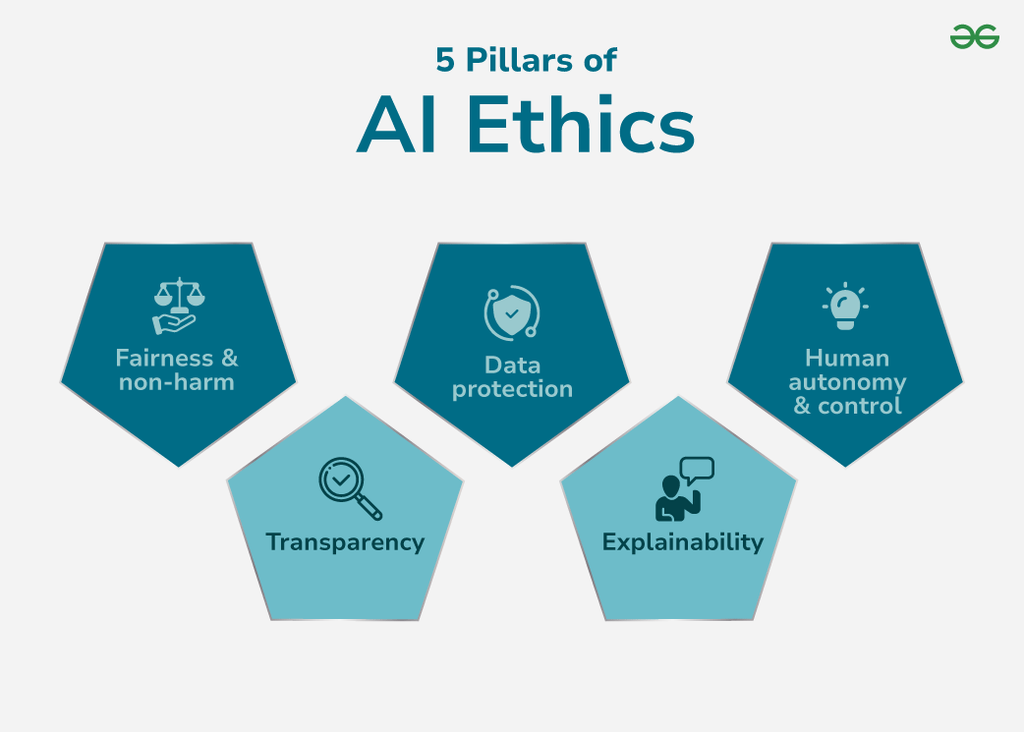
Core Principles AI ethics operates on several core principles that guide the development and deployment of AI systems:
- Fairness and Non-Discrimination AI systems should be designed to avoid bias and ensure equitable outcomes. This involves using diverse datasets, testing for bias, and implementing fairness-aware algorithms.
- Transparency and Explainability AI systems should be designed in a way that allows users and stakeholders to understand how decisions are made. Techniques such as explainable AI (XAI) and interpretable machine learning are used to achieve this.
- Accountability Clear mechanisms should be in place to assign responsibility when AI systems cause harm. This includes establishing legal frameworks, ethical review boards, and audit trails.
- Privacy and Data Governance AI systems should respect user privacy and comply with data protection regulations such as the General Data Protection Regulation (GDPR). This involves anonymizing data, obtaining informed consent, and implementing data minimization practices.
- Human Oversight AI systems should be designed to allow for human intervention and oversight. This ensures that critical decisions are not made solely by machines.
- Safety and Robustness AI systems should be tested for vulnerabilities and designed to handle unexpected situations safely. This includes robustness testing, fail-safe mechanisms, and continuous monitoring.
Ethical Frameworks and Guidelines Several frameworks and guidelines have been developed to operationalize AI ethics:
- Asimov’s Laws of Robotics: A fictional but influential set of rules designed to ensure robots prioritize human safety.
- IEEE Ethically Aligned Design: A framework that emphasizes human rights, well-being, and sustainability in AI design.
- EU AI Act: A regulatory framework that classifies AI systems based on risk and imposes strict requirements for high-risk applications.
- OECD AI Principles: A set of five principles adopted by the OECD to promote trustworthy AI, including inclusive growth, human-centered values, transparency, robustness, and accountability.
Tools and Techniques AI ethics employs various tools and techniques to address ethical concerns:
- Bias Detection and Mitigation: Algorithms such as fairness-aware machine learning and adversarial debiasing are used to identify and reduce bias in AI systems.
- Explainable AI (XAI): Techniques such as LIME (Local Interpretable Model-agnostic Explanations) and SHAP (SHapley Additive exPlanations) help make AI decisions more interpretable.
- Ethical Impact Assessments: Similar to environmental impact assessments, these evaluations assess the potential ethical risks of AI systems before deployment.
- Ethical Review Boards: Independent bodies that review AI projects to ensure they align with ethical guidelines.
#Important Facts
- Algorithmic Bias is Pervasive Studies have shown that AI systems can perpetuate and even amplify biases present in training data. For example, facial recognition systems have higher error rates for people with darker skin tones, and hiring algorithms have been found to favor male candidates.
- Transparency is a Major Challenge Many AI systems, particularly deep learning models, operate as "black boxes," making it difficult to understand how they arrive at decisions. This lack of transparency can erode trust and make it challenging to identify and correct errors.
- AI and Job Displacement The World Economic Forum estimates that by 2025, AI and automation could displace 85 million jobs globally. However, it also predicts the creation of 97 million new jobs, highlighting the need for reskilling and upskilling initiatives.
- Privacy Concerns in AI AI systems often rely on vast amounts of personal data, raising concerns about surveillance and data misuse. Regulations such as GDPR aim to protect user privacy, but enforcement remains a challenge.
- Autonomous Weapons and AI Ethics The development of autonomous weapons systems (AWS) raises ethical questions about accountability and the potential for AI to be used in warfare. The Campaign to Stop Killer Robots advocates for a ban on fully autonomous weapons.
- AI in Healthcare AI has the potential to revolutionize healthcare, from diagnosing diseases to personalized treatment plans. However, ethical concerns include data privacy, consent, and the potential for AI to exacerbate healthcare disparities.
- Ethical AI Startups Companies such as Element AI and Facialytics are developing AI tools that prioritize ethics, fairness, and transparency. These startups often focus on niche applications, such as bias detection in hiring algorithms.
- Public Perception of AI Ethics Surveys indicate that public trust in AI varies widely. A 2023 Pew Research Center survey found that 53% of Americans are more concerned than excited about the increased use of AI in daily life.
#Timeline
- Foundational ideas
Core concepts and early methods shape Facts About AI Ethics.
- Practical use
Tools, examples, and real-world deployments make the topic easier to evaluate.
- Responsible implementation
Current work focuses on reliability, governance, performance, and measurable impact.
#Related Terms
#FAQ
What does Facts About AI Ethics cover?
Covers facts about ai ethics, including core concepts, practical examples, benefits, limitations, and risks in AI Ethics.
Why is Facts About AI Ethics important?
It helps readers understand key concepts, compare practical use cases, and evaluate how AI Ethics decisions affect outcomes, risks, and implementation choices.
What should readers verify before applying this topic?
Readers should compare benefits, limitations, data requirements, and related themes such as Facts, About, AI before using the ideas in real projects.
#References
- Facts About AI Ethics terminology and background research
- Facts About AI Ethics use cases, implementation examples, and limitations
- AI Ethics best practices, standards, and risk guidance
- Facts case studies, benchmarks, and current industry analysis


Comments
No comments yet. Start the discussion with a useful note.