

#Short Answer
Highlights leading computer vision tools in 2026, comparing use cases, strengths, selection criteria, and practical value for readers.
#Infobox
#Overview
Computer vision tools in 2026 represent a convergence of deep learning, edge computing, and automated machine learning (AutoML). The landscape is dominated by frameworks that balance accuracy, speed, and scalability, catering to industries such as healthcare, autonomous vehicles, retail, and surveillance. Key advancements include foundation models for vision tasks, self-supervised learning, and neural rendering for 3D reconstruction. Open-source tools remain foundational, while proprietary solutions focus on enterprise-grade deployments with robust APIs and compliance features.
The integration of transformer architectures (e.g., Vision Transformers, Swin Transformers) has redefined benchmarks in image classification and object detection. Tools like YOLO-NAS and DETR-X leverage these architectures to achieve state-of-the-art performance with reduced computational overhead. Meanwhile, segmentation models such as Segment Anything Model (SAM) enable zero-shot learning for novel objects, eliminating the need for extensive labeled datasets. Cloud platforms continue to expand their offerings, with AWS Rekognition and Google Vision AI providing pre-trained models for common tasks like facial recognition, text extraction, and content moderation.
#History / Background
The evolution of computer vision tools can be traced back to the 1960s with early edge detection algorithms and optical character recognition (OCR). The field gained momentum in the 1990s with the introduction of Haar cascades and SIFT (Scale-Invariant Feature Transform), which enabled robust feature matching. The 2010s marked a paradigm shift with the rise of deep learning, particularly convolutional neural networks (CNNs), popularized by AlexNet (2012) and later architectures like ResNet and Inception.
The launch of OpenCV in 2000 provided a standardized library for real-time computer vision, accelerating research and industrial adoption. TensorFlow (2015) and PyTorch (2016) democratized access to deep learning, enabling developers to build custom models without extensive expertise. The 2020s saw the emergence of transformer-based models, first in NLP (e.g., BERT) and later in vision tasks (e.g., ViT, DETR). The Segment Anything Model (SAM), introduced in 2023, revolutionized segmentation by introducing a promptable model capable of handling unseen objects.
By 2026, the field has matured into a modular ecosystem, where tools are designed for interoperability. Frameworks like MMDetection and Detectron2 provide unified pipelines for training and deploying vision models, while ONNX (Open Neural Network Exchange) enables cross-platform compatibility. The shift toward edge AI has also driven innovations in model compression, quantization, and hardware acceleration (e.g., NVIDIA Jetson, Google Coral).
#How It Works
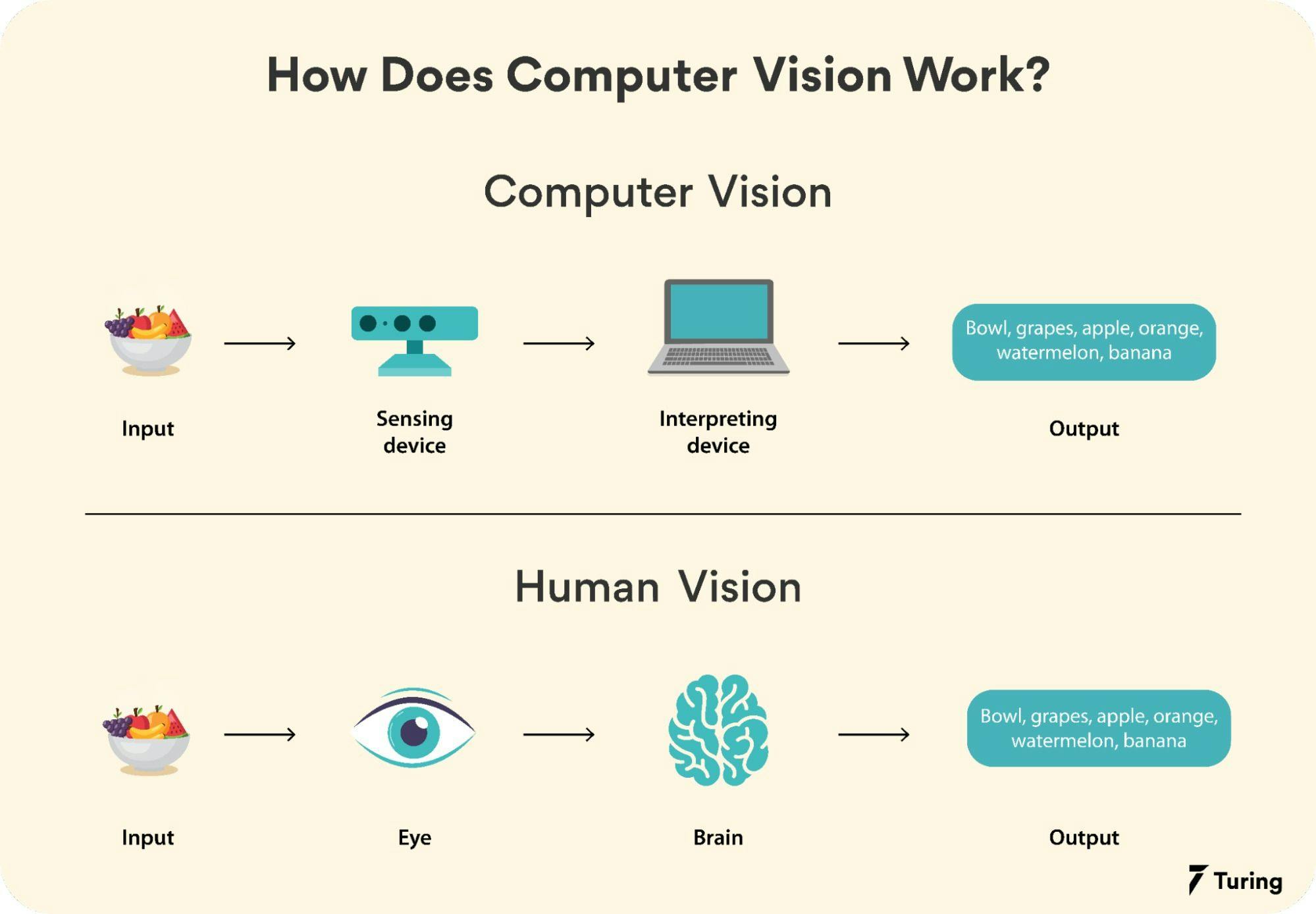
Computer vision tools in 2026 operate through a combination of data preprocessing, model training, inference optimization, and deployment strategies. The process typically begins with data collection and annotation, where images or videos are labeled for tasks such as classification, detection, or segmentation. Modern tools leverage self-supervised learning to reduce dependency on labeled data, using techniques like contrastive learning or masked autoencoding.
For object detection, models like YOLO-NAS or DETR-X use anchor-free architectures or transformer-based decoders to predict bounding boxes and class probabilities. Segmentation models such as SAM employ a prompt encoder to interpret user inputs (e.g., points, boxes) and generate masks dynamically. Classification models rely on Vision Transformers (ViTs) or CNNs to extract features and classify images into predefined categories.
During inference, tools optimize performance through quantization (reducing model size), pruning (removing redundant parameters), and hardware acceleration (e.g., GPU/TPU utilization). Cloud-based tools like AWS Rekognition handle scaling automatically, while edge deployments use TensorRT or OpenVINO to optimize models for specific hardware. AutoML features automate hyperparameter tuning, architecture search, and model deployment, reducing the barrier to entry for non-experts.
#Important Facts
- YOLO-NAS achieves 80+ FPS on consumer GPUs while maintaining COCO mAP of 58.3, making it ideal for real-time applications.
- Segment Anything Model (SAM) can segment any object in an image with a single click, eliminating the need for per-class training data.
- TensorFlow Vision supports TPU acceleration, enabling training of large-scale models in hours rather than days.
- MMDetection provides a unified framework for 100+ detection models, including Faster R-CNN, RetinaNet, and Cascade R-CNN.
- Edge AI tools like NVIDIA Jetson Orin deliver 200 TOPS of performance while consuming under 15W of power.
- Federated learning is increasingly integrated into vision tools, allowing models to train on decentralized data without compromising privacy.
- Neural rendering techniques enable 3D reconstruction from 2D images, with applications in AR/VR and digital twins.
- Quantization-aware training reduces model size by 4x with minimal accuracy loss, critical for edge deployments.
#Timeline
YearEvent2000OpenCV 1.0 released, providing a standardized library for computer vision.2012AlexNet wins ImageNet competition, sparking the deep learning revolution in computer vision.2015TensorFlow 1.0 launched, enabling large-scale deep learning.2016PyTorch introduced, offering dynamic computation graphs for easier prototyping.2017YOLOv3 released, popularizing real-time object detection.2020Vision Transformer (ViT) demonstrates transformer-based models can outperform CNNs in image classification.2021DETR (Detection Transformer) introduced, replacing traditional detection pipelines with transformers.2023Segment Anything Model (SAM) released, enabling zero-shot segmentation.2024YOLO-NAS launched, combining NAS with YOLO architecture for optimized performance.2025MMDetection 3.0 released, supporting 200+ detection models and AutoML integration.2026Edge AI tools achieve sub-millisecond inference on low-power devices, enabling widespread adoption in IoT.
#Related Terms
#FAQ
What does Best Computer Vision Tools In 2026 cover?
Highlights leading computer vision tools in 2026, comparing use cases, strengths, selection criteria, and practical value for readers.
Why is Best Computer Vision Tools In 2026 important?
It helps readers understand key concepts, compare practical use cases, and evaluate how Computer Vision decisions affect outcomes, risks, and implementation choices.
What should readers verify before applying this topic?
Readers should compare the benefits, limitations, data requirements, and related themes such as Comparison, Selection Criteria, 2026 Trends before using the ideas in real projects.
#References
- Best Computer Vision Tools In 2026 terminology and background research
- Best Computer Vision Tools In 2026 use cases, implementation examples, and limitations
- Computer Vision best practices, standards, and risk guidance
- Comparison case studies, benchmarks, and current industry analysis

Comments
No comments yet. Start the discussion with a useful note.