

#Short Answer
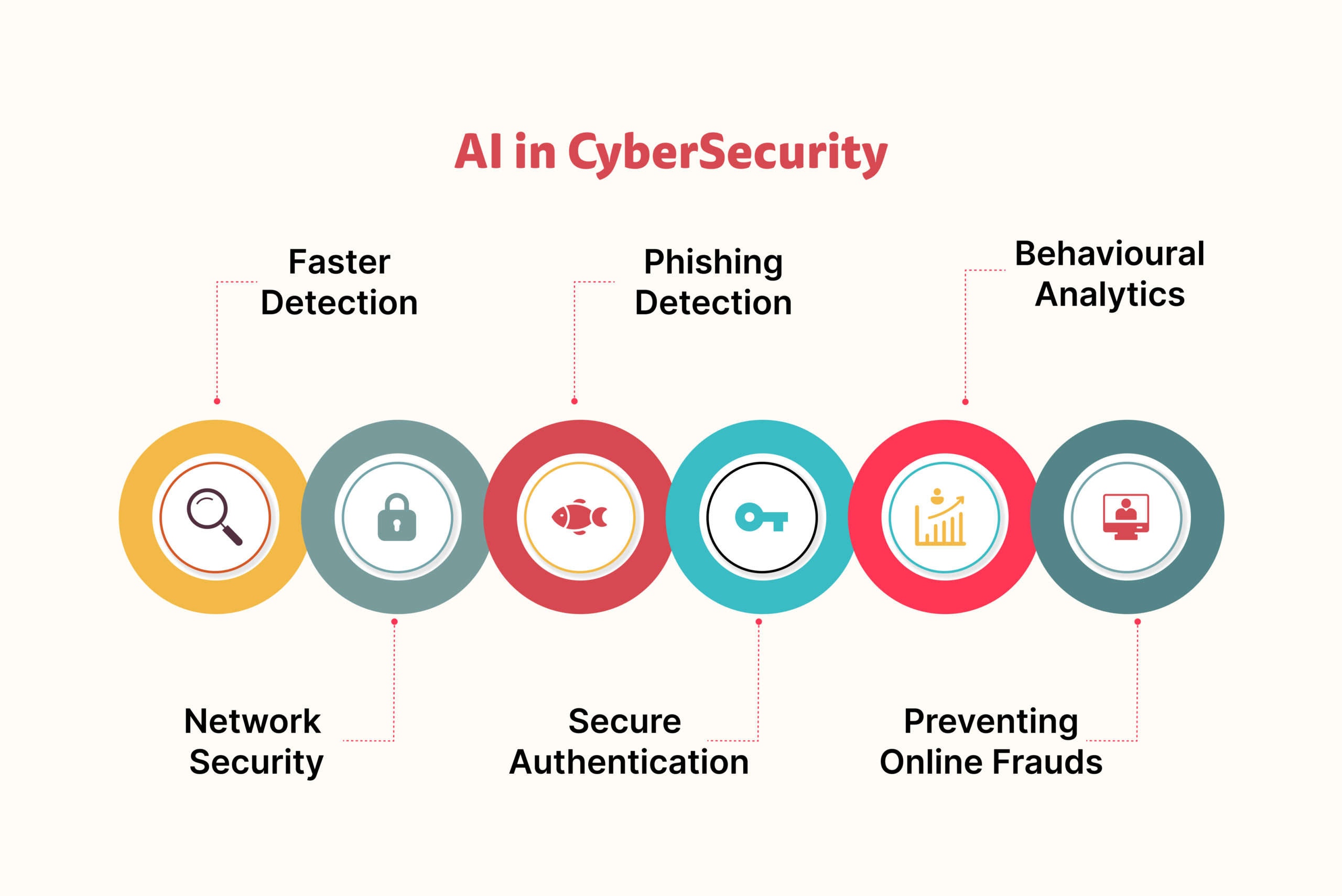
Artificial Intelligence (AI) has become a cornerstone of modern cybersecurity strategies, enabling organizations to combat increasingly sophisticated cyber threats. AI-driven cybersecurity leverages advanced algorithms to process large datasets, detect anomalies, and predict potential attacks before they cause damage. Unlike traditional rule-based systems, AI models continuously learn from new data, improving their ability to identify both known and unknown threats.
#Infobox
#Overview
Artificial Intelligence (AI) has become a cornerstone of modern cybersecurity strategies, enabling organizations to combat increasingly sophisticated cyber threats. AI-driven cybersecurity leverages advanced algorithms to process large datasets, detect anomalies, and predict potential attacks before they cause damage. Unlike traditional rule-based systems, AI models continuously learn from new data, improving their ability to identify both known and unknown threats.
The integration of AI in cybersecurity addresses critical challenges such as the growing volume of cyberattacks, the complexity of modern malware, and the shortage of skilled cybersecurity professionals. By automating threat detection and response, AI reduces human error and accelerates incident resolution, making it an essential tool for enterprises, governments, and individuals alike.
#History / Background
#Early developments
The concept of using AI for cybersecurity emerged in the late 20th century, with early research focusing on rule-based expert systems and heuristic approaches. In the 1980s and 1990s, organizations began experimenting with AI to automate threat detection, though these systems were limited by computational power and data availability.
One of the first notable applications was the development of intrusion detection systems (IDS) that used statistical models to identify unusual network behavior. These systems laid the groundwork for more advanced AI-driven security solutions.
#Modern advancements
The 2010s marked a significant shift with the rise of machine learning (ML) and deep learning (DL) techniques. The availability of big data and advancements in computing power enabled AI models to process vast datasets efficiently. Companies like IBM, Palo Alto Networks, and Darktrace pioneered AI-driven cybersecurity platforms that could detect zero-day threats and adapt to evolving attack strategies.
Today, AI is integrated into various cybersecurity domains, including endpoint protection, network security, and threat intelligence. The rise of cloud computing and the Internet of Things (IoT) has further expanded the need for AI-powered security solutions to protect interconnected devices and systems.
#How It Works
#Machine Learning in Cybersecurity
Machine learning algorithms, particularly supervised and unsupervised learning, are widely used in AI-driven cybersecurity. These algorithms analyze historical data to identify patterns associated with malicious activities. For example:
- Supervised Learning: Models are trained on labeled datasets containing examples of both normal and malicious activities. This enables the system to classify new, unseen data accurately.
- Unsupervised Learning: Used to detect anomalies by identifying deviations from normal behavior without prior labeling. This is particularly useful for identifying zero-day attacks.
- Reinforcement Learning: AI systems learn from their actions and improve over time by receiving feedback on their decisions, enhancing their ability to respond to dynamic threats.
#Deep Learning and Neural Networks
Deep learning, a subset of machine learning, uses neural networks with multiple layers to process complex data structures. In cybersecurity, deep learning is applied to:
- Image and Video Analysis: Detecting malicious content in files or identifying suspicious activities in surveillance footage.
- Natural Language Processing (NLP): Analyzing text-based threats such as phishing emails or social engineering attacks.
- Behavioral Biometrics: Identifying users based on unique patterns in their interactions with devices, such as typing speed or mouse movements.
#Key AI-Driven Cybersecurity Tools
Several AI-powered tools and platforms have become industry standards:
- Endpoint Detection and Response (EDR): Tools like CrowdStrike and SentinelOne use AI to monitor endpoints for suspicious activities and respond to threats in real time.
- Network Traffic Analysis (NTA): Solutions like Darktrace employ AI to analyze network traffic and detect anomalies indicative of cyberattacks.
- User and Entity Behavior Analytics (UEBA): Platforms like Splunk use AI to track user behavior and identify insider threats or compromised accounts.
- Threat Intelligence Platforms: AI-driven platforms aggregate and analyze threat data from multiple sources to provide actionable insights and predictive warnings.
#Important Facts
- Accuracy: AI-powered systems can reduce false positives by up to 90% compared to traditional signature-based detection methods.
- Speed: AI can analyze and respond to threats in milliseconds, significantly faster than human analysts.
- Adaptability: AI models continuously learn from new threats, making them more effective against evolving attack vectors.
- Scalability: AI systems can process vast amounts of data across multiple environments, including cloud, on-premises, and hybrid systems.
- Cost-Effectiveness: While initial implementation costs can be high, AI reduces long-term operational expenses by automating routine tasks and improving efficiency.
#Timeline
- Early intrusion detection syst
Early intrusion detection systems (IDS) using rule-based AI models are developed.
- Heuristic-based AI systems eme
Heuristic-based AI systems emerge for malware detection and network security.
- Machine learning techniques ar
Machine learning techniques are integrated into cybersecurity tools for anomaly detection.
- Deep learning models begin
Deep learning models begin to be applied in cybersecurity for image and text analysis.
- Darktrace is founded, pioneeri
[Darktrace](# 'Darktrace') is founded, pioneering AI-driven autonomous cybersecurity solutions.
- Google’s TensorFlow framework
Google’s [TensorFlow](# 'TensorFlow') framework accelerates AI adoption in cybersecurity.
- AI-powered endpoint protection
AI-powered endpoint protection platforms like [CrowdStrike](# 'CrowdStrike') gain widespread adoption.
- AI-driven threat intelligence
AI-driven threat intelligence platforms become essential for real-time threat detection and response.
- Generative AI models are
Generative AI models are explored for creating synthetic attack scenarios to improve defensive AI systems.
#Related Terms
#FAQ
What does AI Security: Preventing Attacks cover?
AI security: preventing attacks covers practical examples, benefits, limitations, and important considerations for readers.
Why is AI Security: Preventing Attacks important?
It helps readers understand key concepts, compare practical use cases, and evaluate how Security & Privacy decisions affect outcomes, risks, and implementation choices.
What should readers verify before applying this topic?
Readers should compare the benefits, limitations, data requirements, and related themes such as Security, Preventing, Attack before using the ideas in real projects.
#References
- AI Security: Preventing Attacks terminology and background research
- AI Security: Preventing Attacks use cases, implementation examples, and limitations
- Security & Privacy best practices, standards, and risk guidance
- Security case studies, benchmarks, and current industry analysis



Comments
No comments yet. Start the discussion with a useful note.