

#Short Answer
Explains how AI works in space exploration, covering data, models, workflows, practical examples, and adoption challenges.
#Infobox
Artificial Intelligence (AI) enhances space exploration by enabling autonomous decision-making, real-time data analysis, and adaptive problem-solving in spacecraft and rovers, reducing human intervention and improving mission efficiency.
Artificial Intelligence in Space Exploration Field: Space Technology, Artificial Intelligence Key Applications: Autonomous Navigation, Data Analysis, Robotics, Mission Planning Major Agencies: NASA, ESA, ISRO, CNSA, Roscosmos First AI Deployment: 1960s (early expert systems) Notable Missions: Mars rovers (Perseverance, Curiosity), Voyager probes, Hubble Space Telescope AI Technologies Used: Machine Learning, Deep Learning, Computer Vision, Natural Language Processing
#Overview
Artificial Intelligence (AI) has become a cornerstone of modern space exploration, transforming how missions are planned, executed, and analyzed. By leveraging AI-driven algorithms, space agencies can process vast amounts of data, make autonomous decisions, and adapt to unforeseen challenges in real time. From autonomous navigation in Mars rovers to predictive maintenance in satellites, AI enhances efficiency, reduces operational costs, and extends the lifespan of spacecraft.
AI in space exploration encompasses a range of technologies, including machine learning, computer vision, natural language processing, and robotics. These tools enable spacecraft to interpret sensor data, recognize patterns, and respond to environmental changes without constant human oversight. As missions venture deeper into the solar system and beyond, AI will play an increasingly critical role in ensuring mission success and scientific discovery.
#History / Background
#Early Developments (1960s–1980s)
The integration of AI into space exploration began in the 1960s with the development of early expert systems and rule-based algorithms. NASA’s Apollo missions utilized primitive AI techniques for trajectory calculations and life-support system monitoring. In the 1970s, the Viking missions to Mars employed basic AI for image processing and data analysis, marking one of the first uses of AI in planetary science.
#Advancements in the 1990s–2000s
The 1990s saw significant progress with the introduction of neural networks and fuzzy logic in space applications. NASA’s Deep Space 1 mission (1998) featured an autonomous navigation system called AutoNav, which used AI to adjust the spacecraft’s trajectory without ground intervention. The Mars Exploration Rovers (Spirit and Opportunity), launched in 2003, utilized AI for obstacle avoidance and scientific target selection, demonstrating the potential of AI in planetary exploration.
#Modern Era (2010s–Present)
The 2010s marked a paradigm shift with the adoption of deep learning and reinforcement learning in space missions. NASA’s Perseverance rover (2020) employs AI-powered Terrain-Relative Navigation (TRN) to land safely on Mars and autonomously select scientific targets. The James Webb Space Telescope (JWST) uses AI for image processing and exoplanet detection, while private companies like SpaceX and Blue Origin integrate AI into their reusable rocket systems for autonomous landing and reusability.
#How It Works
#Autonomous Navigation and Guidance
AI enables spacecraft to navigate independently by processing data from LiDAR, cameras, and inertial measurement units (IMUs). Algorithms such as SLAM (Simultaneous Localization and Mapping) allow rovers to map their surroundings in real time and avoid obstacles. For example, NASA’s Perseverance rover uses AI to analyze terrain and adjust its path autonomously, reducing the risk of mission failure.
#Data Analysis and Scientific Discovery
Space telescopes and probes generate massive datasets that require AI for efficient analysis. Machine learning models are trained to identify celestial objects, classify exoplanets, and detect anomalies in spacecraft telemetry. The Hubble Space Telescope employs AI to enhance image resolution and remove noise, while the Kepler mission used AI to discover thousands of exoplanets by analyzing light curves.
#Robotics and Manipulation
AI-powered robotic systems are essential for tasks such as sample collection, repair, and assembly in space. The Canadarm2 on the International Space Station (ISS) uses AI for precise manipulation of payloads, while NASA’s Astrobee robots autonomously navigate and perform maintenance tasks aboard the ISS. Future missions, such as those to the Moon and Mars, will rely on AI-driven robots for construction and resource utilization.
#Predictive Maintenance and Fault Detection
AI systems monitor spacecraft health by analyzing sensor data for signs of wear or malfunction. Predictive maintenance algorithms can forecast component failures before they occur, allowing for preemptive repairs. For instance, the Curiosity rover uses AI to detect anomalies in its wheels and drill systems, extending its operational lifespan.
#Natural Language Processing and Human-Machine Interaction
AI facilitates communication between ground control and spacecraft through natural language processing (NLP). Systems like NASA’s ROBONAUT use AI to interpret voice commands and assist astronauts with tasks. Additionally, AI-powered chatbots and virtual assistants help streamline mission planning and data retrieval.
#Important Facts
- AI reduces mission costs: By minimizing the need for real-time human intervention, AI lowers operational expenses for long-duration missions.
- Autonomous landing systems: AI enables precise landings on celestial bodies, as demonstrated by NASA’s Perseverance rover and SpaceX’s Starship prototype.
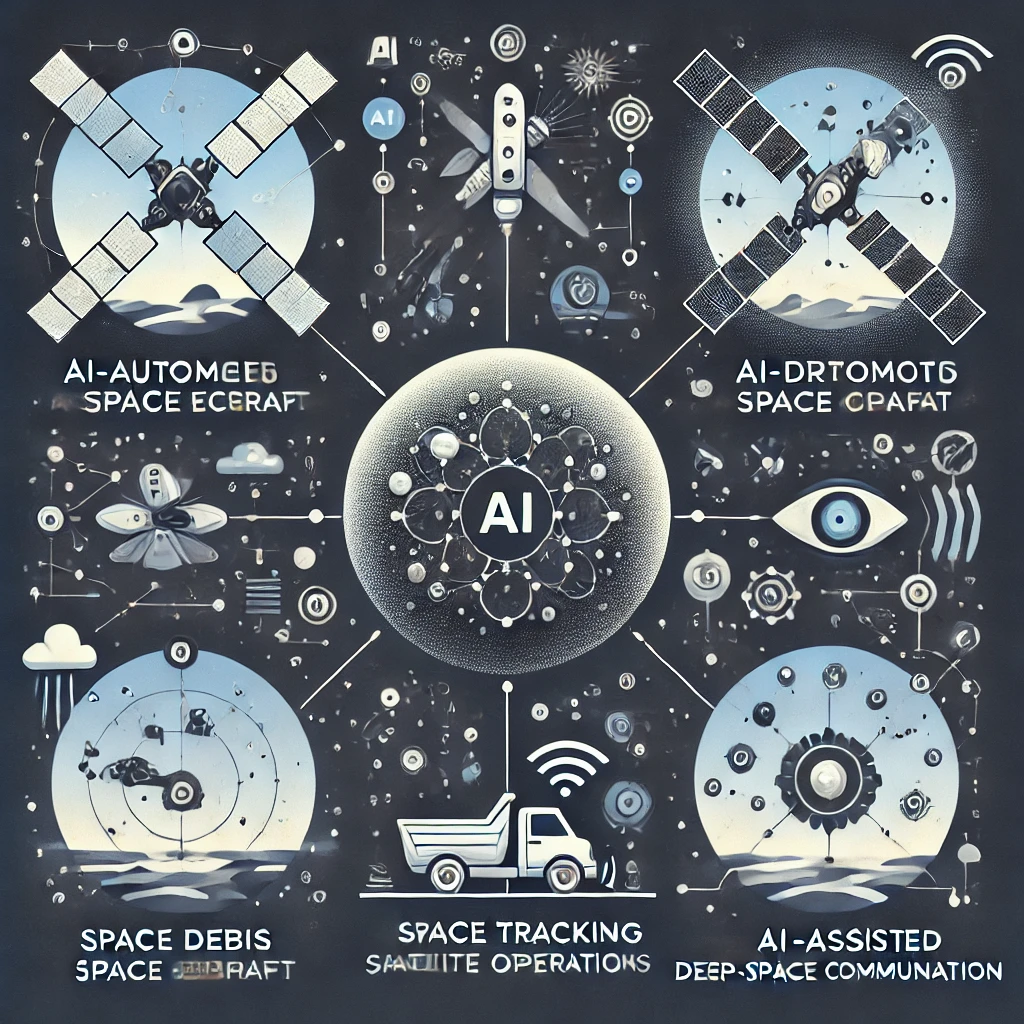
- AI in deep space communication: NASA’s Deep Space Network uses AI to optimize signal processing and reduce latency in communications with distant spacecraft.
- Exoplanet discovery: AI algorithms have identified over 5,000 exoplanets by analyzing data from missions like Kepler and TESS.
- AI for space debris mitigation: Machine learning models track and predict the trajectories of space debris, helping to avoid collisions with operational satellites.
- Robotic assistants in space: The Astrobee robots on the ISS use AI to perform inventory management, environmental monitoring, and crew support.
- AI in satellite constellations: Companies like Planet Labs use AI to process daily imagery from hundreds of satellites, enabling real-time Earth observation.
#Timeline
Year Event 1960s Early AI applications in Apollo missions for trajectory calculations. 1976 Viking missions use AI for Mars image processing. 1998 NASA’s Deep Space 1 deploys AutoNav, an autonomous navigation system. 2003 Mars Exploration Rovers (Spirit and Opportunity) use AI for obstacle avoidance. 2012 NASA’s Curiosity rover employs AI for autonomous navigation and scientific target selection. 2018 NASA’s OSIRIS-REx mission uses AI to select a sample collection site on asteroid Bennu. 2020 Perseverance rover lands on Mars with AI-powered Terrain-Relative Navigation. 2021 James Webb Space Telescope deploys AI for image processing and exoplanet detection. 2023 SpaceX’s Starship prototype demonstrates AI-driven autonomous landing.
#Related Terms
#FAQ
What does AI In Space Exploration: How It Works cover?
Explains how AI works in space exploration, covering data, models, workflows, practical examples, and adoption challenges.
Why is AI In Space Exploration: How It Works important?
It helps readers understand key concepts, compare practical use cases, and evaluate how Business & Marketing decisions affect outcomes, risks, and implementation choices.
What should readers verify before applying this topic?
Readers should compare the benefits, limitations, data requirements, and related themes such as Space, Exploration, Work before using the ideas in real projects.
#References
- AI In Space Exploration: How It Works terminology and background research
- AI In Space Exploration: How It Works use cases, implementation examples, and limitations
- Business & Marketing best practices, standards, and risk guidance
- Space case studies, benchmarks, and current industry analysis
Comments
No comments yet. Start the discussion with a useful note.