

#Short Answer
Explains how AI works in entertainment, covering data, models, workflows, practical examples, and adoption challenges.
#Infobox
Artificial Intelligence (AI) in entertainment refers to the application of machine learning, natural language processing, and other AI technologies to enhance, automate, or innovate creative and interactive experiences across film, music, gaming, and live performances. These systems analyze data, generate content, personalize experiences, and even interact with audiences in real time.
AI in Entertainment: Key Facts Field Applications Notable Examples Film & Animation Deepfake generation, script analysis, CGI enhancement DeepMind’s AI for animation, Sora by OpenAI Music AI-generated compositions, voice synthesis, mixing Boomy, AIVA, Endel Gaming Procedural content generation, NPC behavior, adaptive difficulty NVIDIA’s ACE for Games, AI Dungeon Live Performances Virtual performers, real-time emotion detection, audience interaction Hatsune Miku, AI-powered DJs Streaming & Recommendation Personalized content suggestions, dynamic pricing Netflix, Spotify, YouTube algorithms
#Overview
Artificial Intelligence has become a transformative force in the entertainment industry, reshaping how content is created, distributed, and consumed. From generating hyper-realistic visuals in films to composing original music and designing immersive game worlds, AI tools are enabling creators to push the boundaries of creativity while improving efficiency and accessibility. AI-driven personalization algorithms curate entertainment experiences tailored to individual preferences, while real-time interaction systems allow audiences to engage with virtual entities as if they were human.
Beyond automation, AI is fostering entirely new forms of entertainment, such as AI-generated films, interactive storytelling platforms, and synthetic performers. The integration of AI in entertainment also raises ethical considerations, including concerns about deepfakes, copyright infringement, and the displacement of human creators. As the technology evolves, the entertainment landscape continues to shift toward hybrid human-AI collaboration, where machines augment human creativity rather than replace it.
#History / Background
#Early Concepts and Experiments (1950s–1990s)
The roots of AI in entertainment can be traced back to the mid-20th century, when early computer scientists explored the potential of artificial intelligence. In 1951, the first AI program capable of playing chess, Nim, was developed, laying the groundwork for AI’s role in interactive entertainment. By the 1960s and 1970s, researchers experimented with text-based AI systems, such as ELIZA (1966), which simulated human conversation and inspired early chatbot applications.
In the 1980s and 1990s, AI began appearing in video games, with titles like Pac-Man (1980) featuring simple AI-driven enemy behaviors. The introduction of M.U.L.E. (1983) showcased procedural content generation, where game worlds were partially created by algorithms. Meanwhile, in film, early CGI experiments like Tron (1982) hinted at AI’s potential in visual storytelling.
#Rise of Machine Learning and Digital Entertainment (2000s–2010s)
The 2000s marked a turning point with the advent of machine learning and big data. Companies like Netflix and Spotify began leveraging AI to refine recommendation systems, using collaborative filtering and neural networks to predict user preferences. In gaming, AI-driven NPCs (non-player characters) became more sophisticated, with titles like The Sims (2000) and F.E.A.R. (2005) demonstrating dynamic, adaptive behaviors.
AI also entered the music industry, with tools like IBM Watson Beat (2016) generating original compositions based on user inputs. In film, deep learning techniques enabled realistic facial reenactments, as seen in Rogue One: A Star Wars Story (2016), where AI was used to de-age actors. The launch of AlphaGo (2016) by DeepMind further highlighted AI’s creative potential, as it defeated human champions in the complex board game Go.
#Modern Era: Generative AI and Synthetic Media (2020s–Present)
The 2020s have witnessed an explosion of generative AI tools, democratizing content creation across entertainment sectors. Platforms like DALL·E, MidJourney, and Stable Diffusion allow users to generate high-quality images from text prompts, while Sora (2024) by OpenAI creates short videos from textual descriptions. In music, AI tools like AIVA and Boomy compose entire tracks, and Suno AI generates lyrics and melodies.
Gaming has seen a surge in AI-generated content, with engines like NVIDIA ACE for Games enabling real-time facial animation and emotional expression in NPCs. Virtual influencers and performers, such as Lil Miquela and Hatsune Miku, have gained massive followings, blurring the line between human and AI-driven entertainment. Meanwhile, AI-powered deepfake technology has sparked debates about authenticity in media, leading to calls for regulation and ethical guidelines.
#How It Works
#Core AI Technologies in Entertainment
AI in entertainment relies on several foundational technologies, each tailored to specific applications:
1. Machine Learning and Neural Networks
Machine learning (ML) algorithms, particularly deep learning models like convolutional neural networks (CNNs) and recurrent neural networks (RNNs), are central to AI’s role in entertainment. These models are trained on vast datasets to recognize patterns, generate content, and make predictions. For example:
- Computer Vision: CNNs analyze and generate visual content, enabling applications like deepfake generation, facial recognition, and CGI enhancement.
- Natural Language Processing (NLP): RNNs and transformer models (e.g., GPT, BERT) process and generate human-like text, powering chatbots, scriptwriting tools, and music lyrics.
- Generative Adversarial Networks (GANs): GANs consist of two neural networks—a generator and a discriminator—that compete to create realistic outputs, such as images, music, or even entire game levels.
2. Procedural Content Generation (PCG)
PCG uses algorithms to automatically create game environments, quests, characters, and narratives. This technique is widely used in open-world games like The Elder Scrolls series and Minecraft, where worlds are generated dynamically based on player actions. AI enhances PCG by introducing unpredictability and adaptability, ensuring that content remains fresh and engaging.
3. Reinforcement Learning (RL)
RL enables AI systems to learn optimal behaviors through trial and error, making it ideal for training NPCs and game agents. For instance, AlphaStar (2019) by DeepMind mastered the complex real-time strategy game StarCraft II by playing millions of matches against itself. In film, RL is used to optimize CGI rendering times and improve animation fluidity.
4. Emotion and Behavior Analysis
AI models can analyze facial expressions, voice tones, and body language to detect emotions, which is applied in interactive storytelling, virtual performers, and audience engagement systems. For example, AI-driven cameras in live concerts can adjust lighting and camera angles based on crowd reactions in real time.
5. Personalization Algorithms
Recommendation systems use collaborative filtering, matrix factorization, and deep learning to predict user preferences. Platforms like Netflix and Spotify analyze viewing/listening history, user ratings, and contextual data to suggest content. These algorithms continuously refine their suggestions as they gather more data, creating a feedback loop that enhances user engagement.
#Workflow Integration
AI tools are integrated into entertainment workflows in various ways:
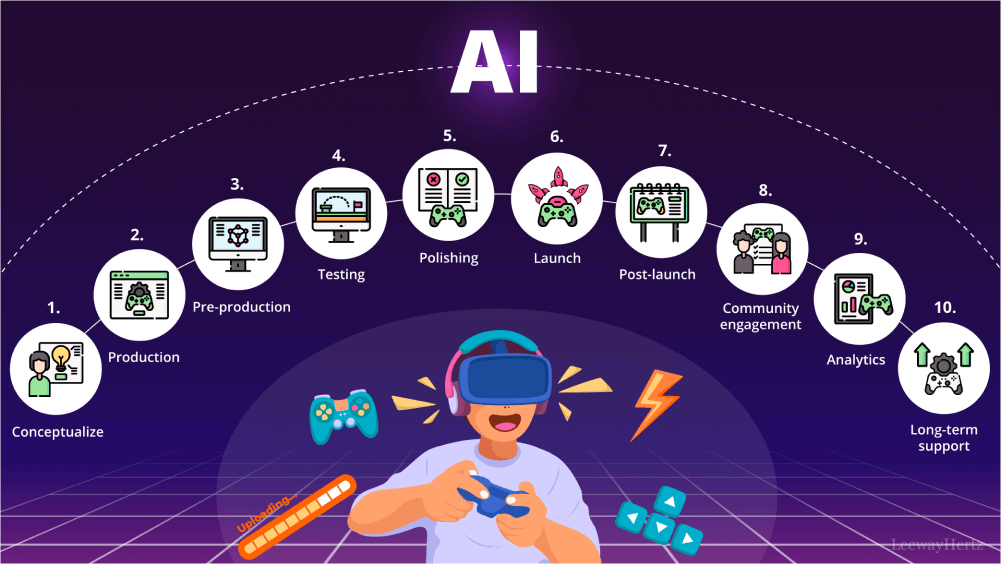
- Pre-Production: AI assists in scriptwriting (e.g., ScriptBook), storyboarding, and casting by analyzing scripts for plot holes or predicting box office success.
- Production: AI enhances CGI (e.g., DeepComposer by NVIDIA for music), automates rotoscoping, and optimizes lighting and camera movements.
- Post-Production: AI tools like Adobe Sensei and Runway ML automate video editing, color grading, and special effects.
- Distribution: AI-driven platforms optimize content delivery, adjusting streaming quality based on network conditions and personalizing marketing campaigns.
- Interactive Experiences: AI enables real-time audience interaction, such as chatbots in live streams, dynamic game narratives, and virtual influencers that respond to comments.
#Important Facts
- AI-Generated Music: Tools like AIVA and Soundraw can compose original music in various genres, with some tracks being indistinguishable from human compositions.
- Deepfake Technology: AI-generated deepfakes can convincingly replicate the likeness and voice of celebrities, raising concerns about misinformation and impersonation.
- Procedural Game Design: Games like No Man’s Sky use AI to generate over 18 quintillion unique planets, each with distinct ecosystems and resources.
- Virtual Performers: Hatsune Miku, a holographic AI-powered singer, has sold out venues worldwide and collaborated with major artists like Lady Gaga.
- AI in Film Editing: Runway ML and Adobe Premiere Pro use AI to automatically edit footage, select the best takes, and even generate subtitles in multiple languages.
- Ethical Concerns: The use of AI in entertainment has sparked debates about job displacement, copyright infringement (e.g., AI trained on artists’ work without consent), and the authenticity of AI-generated content.
- Real-Time Rendering: NVIDIA’s ACE for Games technology enables real-time ray tracing and facial animation, reducing the time and cost of CGI production.
- AI-Generated Scripts: Platforms like ScriptBook use AI to analyze scripts for commercial viability, predicting box office performance with up to 84% accuracy.
#Timeline
Key Milestones in AI Entertainment Year Event Impact 1951 First AI program, Nim, plays chess Demonstrates AI’s potential in interactive entertainment. 1966 ELIZA, an early chatbot, simulates human conversation Inspires early AI-driven storytelling and virtual assistants. 1980 Pac-Man features AI-driven enemy behaviors Introduces simple AI in video games. 1982 Film Tron uses early CGI Showcases AI’s role in visual effects. 2000 Netflix launches its recommendation algorithm Pioneers AI-driven personalization in streaming. 2005 Game F.E.A.R. features advanced AI NPCs Demonstrates dynamic, adaptive enemy behaviors. 2016 DeepMind’s AlphaGo defeats a human Go champion Proves AI’s creative and strategic capabilities. 2016 IBM Watson Beat composes original music Marks the entry of AI in music composition. 2017 Hatsune Miku performs live with AI-driven holograms Introduces virtual performers to mainstream audiences. 2019 DeepMind’s AlphaStar masters StarCraft II Showcases AI’s ability to handle complex, real-time strategy games. 2020 OpenAI releases GPT-3, enabling advanced text generation Revolutionizes AI-driven storytelling and scriptwriting. 2022 DALL·E 2 and MidJourney popularize AI image generation Democratizes visual content creation for artists and creators. 2023 Suno AI and Udio launch AI music generators Enables users to create original songs from text prompts. 2024 OpenAI releases Sora, generating videos from text Expands AI’s role in video production and filmmaking.
#Related Terms
#FAQ
What does AI In Entertainment: How It Works cover?
Explains how AI works in entertainment, covering data, models, workflows, practical examples, and adoption challenges.
Why is AI In Entertainment: How It Works important?
It helps readers understand key concepts, compare practical use cases, and evaluate how Business & Marketing decisions affect outcomes, risks, and implementation choices.
What should readers verify before applying this topic?
Readers should compare the benefits, limitations, data requirements, and related themes such as Entertainment, Work, Business Strategy before using the ideas in real projects.
#References
- AI In Entertainment: How It Works terminology and background research
- AI In Entertainment: How It Works use cases, implementation examples, and limitations
- Business & Marketing best practices, standards, and risk guidance
- Entertainment case studies, benchmarks, and current industry analysis
Comments
No comments yet. Start the discussion with a useful note.