

#Short Answer
Explains how AI is applied in diagnostics to support faster accurate results, with examples, workflows, benefits, and adoption challenges.
#Infobox
Artificial intelligence (AI) in diagnostics enhances medical analysis through machine learning and data processing, enabling faster and more accurate disease detection and treatment planning.
Artificial Intelligence in Medical Diagnostics Field Medical diagnostics Key Technologies Machine learning, deep learning, neural networks, computer vision Primary Applications Radiology, pathology, cardiology, oncology, dermatology Advantages Faster results, reduced human error, early detection, cost efficiency Challenges Data privacy, algorithm bias, regulatory approval, integration with existing systems Notable Developers IBM Watson Health, Google Health, Aidoc, Zebra Medical Vision First Introduced 1970s (early expert systems) Widespread Adoption 2010s (deep learning era)
#Overview
Artificial intelligence (AI) in diagnostics refers to the application of machine learning (ML), deep learning, and other AI technologies to analyze medical data and assist in disease identification, risk assessment, and treatment planning. AI-driven diagnostic tools process vast datasets—such as medical imaging, lab results, and patient histories—faster and often with greater accuracy than traditional methods. These systems leverage algorithms trained on large datasets to recognize patterns, detect anomalies, and provide actionable insights to healthcare professionals.
AI diagnostics spans multiple medical specialties, including radiology, pathology, cardiology, oncology, and dermatology. By automating repetitive tasks and augmenting clinical decision-making, AI aims to improve patient outcomes, reduce diagnostic errors, and optimize healthcare workflows. The integration of AI into diagnostic processes is part of a broader digital transformation in medicine, often referred to as digital health or health informatics.
#History / Background
The concept of using AI for medical diagnosis dates back to the 1970s, when early expert systems like MYCIN were developed to assist in diagnosing infectious diseases. These rule-based systems relied on predefined knowledge bases and logical inference but were limited by their inability to learn from new data.
In the 1980s and 1990s, advancements in computing power and the availability of larger datasets led to the development of more sophisticated AI models. Projects such as computer-aided diagnosis (CAD) systems for mammography gained traction, helping radiologists detect breast cancer more effectively.
The 2010s marked a turning point with the rise of deep learning, particularly convolutional neural networks (CNNs), which excel at image recognition tasks. The availability of large annotated medical imaging datasets and improvements in GPU computing enabled AI systems to achieve human-level performance in certain diagnostic tasks. Landmark achievements, such as Google’s DeepMind AI detecting eye diseases from retinal scans and IBM Watson’s oncology applications, demonstrated the potential of AI in real-world clinical settings.
#How It Works
#Data Collection and Preprocessing
AI diagnostic systems begin with the collection of high-quality medical data, which may include:
- Medical images (X-rays, MRIs, CT scans, ultrasounds)
- Electronic health records (EHRs)
- Genomic data
- Laboratory test results
- Patient-reported outcomes
This data is preprocessed to remove noise, standardize formats, and enhance relevant features. For image-based diagnostics, techniques such as normalization, contrast enhancement, and segmentation are applied to prepare the data for model training.
#Model Training
AI models, particularly deep learning architectures like CNNs and recurrent neural networks (RNNs), are trained on labeled datasets. In supervised learning, the model learns to associate input data (e.g., a chest X-ray) with correct output labels (e.g., "pneumonia present" or "normal").
Training involves:
- Feature extraction: Identifying relevant patterns in the data.
- Optimization: Adjusting model parameters to minimize prediction errors.
- Validation: Testing the model on unseen data to assess performance.
#Inference and Decision Support
Once trained, the AI model can analyze new patient data and generate predictions or classifications. For example:
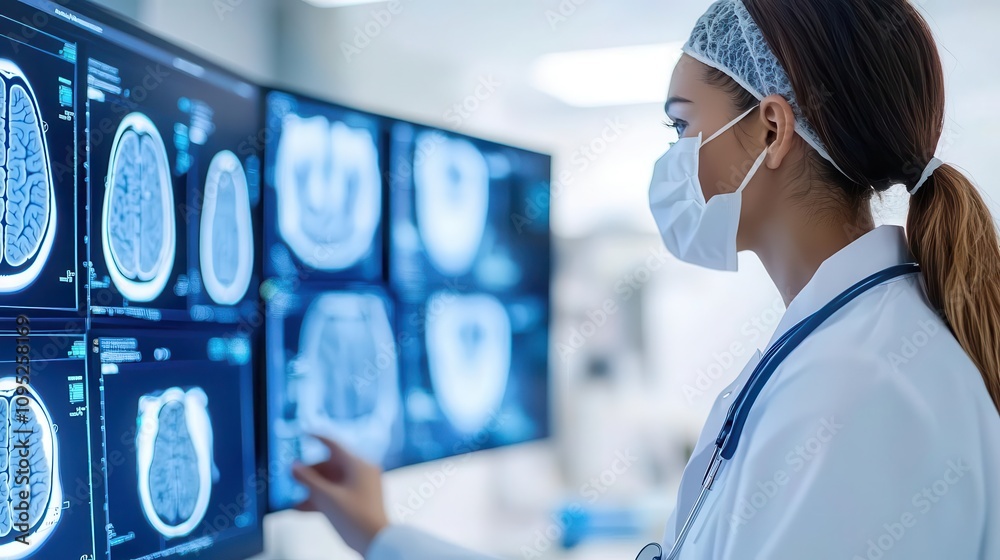
- A radiology AI may detect a lung nodule in a CT scan and flag it for further review.
- An AI pathology tool might analyze a biopsy slide to identify cancerous cells.
- A cardiovascular AI could assess an echocardiogram to predict heart failure risk.
These outputs are presented to clinicians as decision support tools, highlighting areas of concern and suggesting potential diagnoses. The final clinical decision remains with the healthcare provider, ensuring a human-in-the-loop approach.
#Important Facts
- Accuracy: AI models have demonstrated performance comparable to or exceeding that of human experts in specific diagnostic tasks, such as detecting diabetic retinopathy or breast cancer in mammograms.
- Speed: AI can process and analyze medical images in seconds, significantly reducing turnaround times compared to traditional methods.
- Scalability: AI systems can analyze large volumes of data simultaneously, making them ideal for high-throughput screening programs.
- Bias and Fairness: AI models may inherit biases present in training data, leading to disparities in performance across different demographic groups. Addressing bias is a critical challenge in AI diagnostics.
- Regulatory Approval: AI diagnostic tools must undergo rigorous validation and receive approval from regulatory bodies such as the U.S. Food and Drug Administration (FDA) or European Medicines Agency (EMA) before clinical use.
- Cost Efficiency: By reducing unnecessary tests and improving early detection, AI diagnostics can lower healthcare costs in the long term.
- Interpretability: Many AI models, particularly deep learning systems, operate as "black boxes," making it difficult to explain their decisions. Efforts are underway to develop interpretable AI models for clinical use.
#Timeline
Year Event 1970s Development of early expert systems like MYCIN for infectious disease diagnosis. 1980s Introduction of computer-aided diagnosis (CAD) systems for mammography. 1998 FDA approves the first CAD system for breast cancer detection. 2012 AlexNet, a deep learning model, wins the ImageNet competition, sparking interest in AI for medical imaging. 2016 Google DeepMind's AI achieves human-level performance in detecting eye diseases from retinal scans. 2017 IBM Watson for Oncology is deployed in hospitals to assist in cancer treatment planning. 2018 FDA approves the first AI-powered diagnostic tool for detecting diabetic retinopathy without a clinician's review. 2020 AI models are used to analyze chest X-rays for COVID-19 detection during the pandemic. 2023 Advancements in multimodal AI enable integration of imaging, genomic, and clinical data for comprehensive diagnostics.
#Related Terms
#FAQ
What does AI In Diagnostics: Faster Accurate Results cover?
Explains how AI is applied in diagnostics to support faster accurate results, with examples, workflows, benefits, and adoption challenges.
Why is AI In Diagnostics: Faster Accurate Results important?
It helps readers understand key concepts, compare practical use cases, and evaluate how Healthcare AI decisions affect outcomes, risks, and implementation choices.
What should readers verify before applying this topic?
Readers should compare the benefits, limitations, data requirements, and related themes such as Diagnostic, Faster, Accurate before using the ideas in real projects.
#References
- AI In Diagnostics: Faster Accurate Results terminology and background research
- AI In Diagnostics: Faster Accurate Results use cases, implementation examples, and limitations
- Healthcare AI best practices, standards, and risk guidance
- Diagnostic case studies, benchmarks, and current industry analysis


Comments
No comments yet. Start the discussion with a useful note.