


#Short Answer
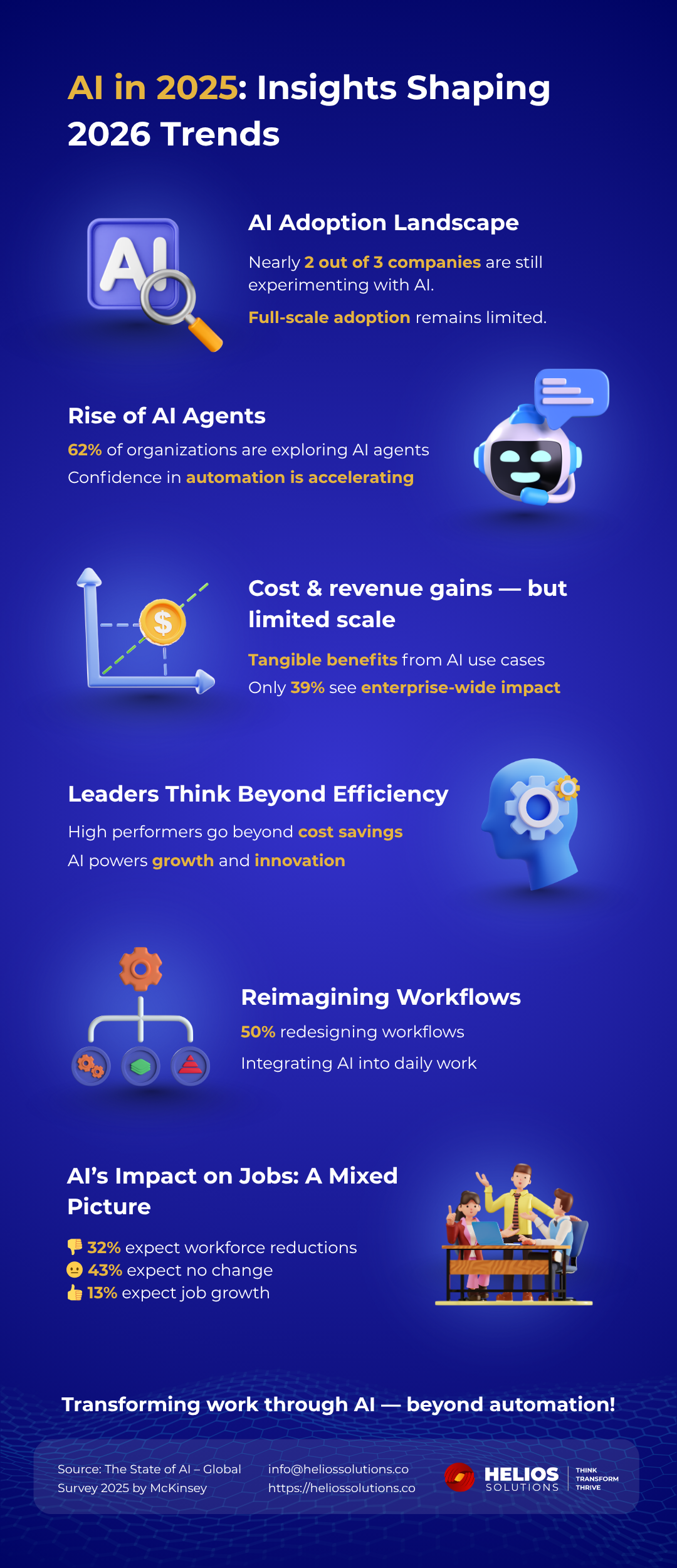
Reviews AI in 2026 trends and predictions, focusing on emerging tools, adoption patterns, opportunities, and risks.
#Infobox
Artificial Intelligence in 2026 Field Artificial Intelligence Year 2026 Key Trends Ethical AI, Generative AI, AI Governance, Edge AI, Quantum AI Major Developments Regulatory frameworks, AI-driven healthcare, autonomous systems Impact Areas Healthcare, Education, Finance, Environment, Governance
#Overview
Artificial Intelligence (AI) in 2026 represents a transformative phase in technological evolution, characterized by the maturation of generative models, stricter ethical guidelines, and broader societal adoption. The year marks a shift from experimental deployments to standardized, regulated AI systems that prioritize transparency, accountability, and human-centric design. Key areas of growth include AI governance, explainable AI (XAI), and the convergence of AI with other emerging technologies such as quantum computing and edge computing.
AI systems in 2026 are anticipated to demonstrate improved contextual understanding, reduced bias, and enhanced adaptability to dynamic environments. The integration of AI into critical infrastructure—such as healthcare diagnostics, financial risk assessment, and climate modeling—will deepen, driven by advancements in computational power and data availability. However, challenges related to data privacy, algorithmic fairness, and the ethical implications of autonomous decision-making remain central to ongoing discourse.
#History and background
#Early developments
The foundations of AI in 2026 were laid in the early 21st century with the advent of machine learning and deep learning techniques. The 2010s saw rapid progress in neural networks, particularly with the introduction of transformer architectures in 2017, which enabled breakthroughs in natural language processing (NLP) and generative AI. By the mid-2020s, AI systems had evolved from narrow, task-specific tools to more generalized models capable of handling multi-modal inputs, including text, images, and audio.
#Regulatory evolution
Regulatory bodies worldwide began implementing comprehensive AI governance frameworks in the early 2020s, responding to public concerns about bias, privacy, and accountability. The European Union's Artificial Intelligence Act (AI Act), proposed in 2021 and finalized by 2024, set a global precedent by classifying AI systems into risk categories and imposing strict compliance requirements for high-risk applications. Other regions followed with similar legislation, fostering a more standardized approach to AI ethics and safety.
#Technological milestones
- 2022: Introduction of diffusion models for high-fidelity image and video generation.
- 2023: Widespread adoption of federated learning to enhance data privacy in AI training.
- 2024: Breakthroughs in neuromorphic computing, enabling energy-efficient AI chips inspired by biological neural networks.
- 2025: First commercial quantum AI processors demonstrating speed advantages in optimization tasks.
#How it works
#Core technologies
AI systems in 2026 rely on a combination of advanced machine learning algorithms, high-performance computing, and robust data pipelines. Key technologies include:
- Generative AI: Models such as large language models (LLMs) and diffusion models generate coherent text, images, and multimedia content based on learned patterns from vast datasets.
- Explainable AI (XAI): Techniques like SHAP (SHapley Additive exPlanations) and LIME (Local Interpretable Model-agnostic Explanations) provide transparency by highlighting the decision-making process of AI models.
- Edge AI: On-device AI processing reduces latency and enhances privacy by executing computations locally rather than in centralized cloud servers.
- Quantum AI: Hybrid quantum-classical algorithms leverage quantum computing's parallel processing capabilities to solve complex optimization and simulation problems.
#Data and training
AI models in 2026 are trained on diverse, high-quality datasets curated to minimize bias and ensure representativeness. Techniques such as synthetic data generation, data augmentation, and federated learning are employed to address data scarcity and privacy concerns. Transfer learning and few-shot learning enable models to adapt to new tasks with minimal additional training data.
#Deployment and integration
AI deployment in 2026 follows a phased approach, beginning with sandbox testing in controlled environments before full-scale integration. Organizations implement AI governance frameworks to monitor performance, detect anomalies, and ensure compliance with regulatory standards. Continuous learning mechanisms allow AI systems to update their models in real-time based on new data, improving accuracy and relevance over time.
#Important facts
- Market Growth: The global AI market is projected to exceed $500 billion by 2026, driven by increased enterprise adoption and consumer applications.
- Ethical AI: Over 80% of Fortune 500 companies have adopted AI ethics guidelines, up from 30% in 2022.
- AI in Healthcare: AI-driven diagnostics and personalized treatment plans are expected to reduce healthcare costs by 15-20% in developed nations.
- Carbon Footprint: The energy efficiency of AI models has improved by 40% since 2023, thanks to advancements in model pruning and hardware optimization.
- Regulatory Compliance: Non-compliance with AI regulations can result in fines exceeding $10 million for high-risk applications in the EU and US.
#Timeline
Year Event 2022 Introduction of diffusion models for high-quality image generation. 2023 Widespread adoption of federated learning for privacy-preserving AI training. 2024 Finalization of the EU AI Act, setting global regulatory standards. 2025 First commercial quantum AI processors demonstrate speed advantages in optimization tasks. 2026 AI systems achieve human-level performance in complex decision-making scenarios across multiple domains.
#Related Terms
#FAQ
What does AI In 2026: Trends And Predictions cover?
Reviews AI in 2026 trends and predictions, focusing on emerging tools, adoption patterns, opportunities, and risks.
Why is AI In 2026: Trends And Predictions important?
It helps readers understand key concepts, compare practical use cases, and evaluate how Artificial Intelligence decisions affect outcomes, risks, and implementation choices.
What should readers verify before applying this topic?
Readers should compare the benefits, limitations, data requirements, and related themes such as 2026 Trends, 2026, Trend before using the ideas in real projects.
#References
- AI In 2026: Trends And Predictions terminology and background research
- AI In 2026: Trends And Predictions use cases, implementation examples, and limitations
- Artificial Intelligence best practices, standards, and risk guidance
- 2026 Trends case studies, benchmarks, and current industry analysis



Comments
No comments yet. Start the discussion with a useful note.