

#Short Answer
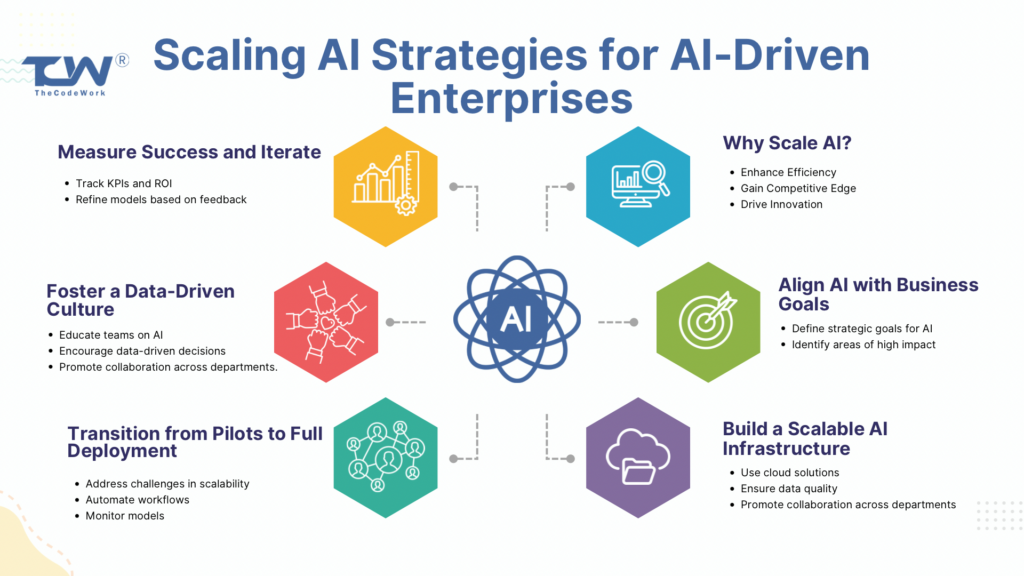
Shows how AI can support enterprises through scaling up, including tools, examples, benefits, and responsible-use tips.
#Infobox
Scaling AI for enterprises involves deploying artificial intelligence systems at an organizational level to enhance efficiency, decision-making, and innovation while ensuring scalability, governance, and ethical compliance.
Field Artificial Intelligence, Enterprise Technology Focus Scalability, Integration, Governance Key Technologies Machine Learning, Deep Learning, Cloud Computing, MLOps Applications Process Automation, Predictive Analytics, Customer Insights, Supply Chain Optimization Challenges Data Quality, Ethical Concerns, Regulatory Compliance, Talent Shortage Adoption Rate ~35% of large enterprises (2024)
#Overview
Artificial Intelligence (AI) for enterprises refers to the strategic implementation of AI technologies across business operations to drive automation, enhance productivity, and unlock new revenue streams. Scaling AI involves transitioning from isolated pilot projects to organization-wide deployment, ensuring seamless integration with existing systems while maintaining performance, security, and compliance.
Enterprises adopt AI at scale to optimize workflows, improve customer experiences, and gain competitive advantages. This requires robust infrastructure, cross-functional collaboration, and a clear alignment between AI initiatives and business objectives. The process encompasses data collection, model training, deployment, monitoring, and continuous improvement to sustain long-term value.
#History and Background
#Early Developments (1950s–2000s)
The foundations of AI were laid in the mid-20th century with early experiments in machine learning and neural networks. However, practical applications for enterprises remained limited due to computational constraints and data scarcity. The 1980s and 1990s saw the rise of expert systems, which provided rule-based automation for specific business tasks, though they lacked adaptability.
#Rise of Big Data and Cloud Computing (2010s)
The proliferation of big data and cloud infrastructure in the 2010s revolutionized AI adoption. Companies like Google, Amazon, and Microsoft began offering AI-as-a-service platforms, enabling businesses to leverage pre-trained models without extensive in-house expertise. The breakthrough of deep learning, particularly in computer vision and natural language processing, further accelerated enterprise interest.
#Enterprise AI Maturity (2020s)
By the 2020s, AI scaling became a priority for enterprises seeking digital transformation. The COVID-19 pandemic accelerated adoption, as businesses turned to AI for remote operations, supply chain resilience, and customer engagement. Today, AI is embedded in core enterprise functions, from HR and finance to manufacturing and marketing, with a growing emphasis on ethical AI and regulatory compliance.
#How AI Scaling Works for Enterprises
#1. Data Collection and Preparation
AI scaling begins with high-quality data collection from internal and external sources. Enterprises must ensure data is clean, labeled, and structured for training models. This phase often involves data lakes, warehouses, and real-time streaming pipelines to support diverse AI applications.
#2. Model Development and Training
Enterprises deploy machine learning (ML) and deep learning models tailored to specific use cases. Techniques like transfer learning and federated learning enable faster deployment with reduced computational costs. Cloud-based AI services (e.g., AWS SageMaker, Google Vertex AI) simplify model training and hyperparameter tuning.
#3. Integration and Deployment
AI models are integrated into existing enterprise systems via APIs, microservices, or embedded applications. DevOps and MLOps practices ensure smooth deployment, version control, and continuous integration. Edge AI is increasingly used for low-latency applications, such as IoT and robotics.
#4. Monitoring and Optimization
Post-deployment, AI systems require continuous monitoring for performance drift, bias, and security vulnerabilities. Enterprises use tools like Prometheus, Grafana, and custom dashboards to track metrics. Feedback loops and A/B testing refine models over time, ensuring they remain aligned with business goals.
#5. Governance and Compliance
Scaling AI demands robust governance frameworks to address ethical, legal, and operational risks. Enterprises implement policies for data privacy (e.g., GDPR, CCPA), model explainability (e.g., SHAP, LIME), and accountability. Cross-functional teams, including legal, IT, and ethics boards, oversee AI initiatives.
#Important Facts
- Adoption Drivers: Cost reduction (44%), revenue growth (38%), and customer experience improvement (35%) are the top reasons enterprises scale AI (McKinsey, 2023).
- ROI Challenges: Only 13% of AI projects achieve significant business impact, often due to poor data quality or misaligned objectives (Gartner, 2024).
- Talent Gap: 63% of enterprises cite a shortage of AI/ML skills as a major barrier to scaling (Deloitte, 2024).
- Ethical Concerns: 72% of consumers are wary of AI-driven decision-making without transparency (PwC, 2023).
- Industry Leaders: Tech giants (e.g., Google, Microsoft, IBM) dominate the AI enterprise market, followed by specialized firms like DataRobot and H2O.ai.
- Future Trends: Generative AI, autonomous systems, and AI-powered cybersecurity are expected to drive the next wave of enterprise adoption.
#Timeline of Key Developments
Year Event 1956 Dartmouth Conference coins the term "artificial intelligence." 1980s Expert systems gain traction in enterprises for rule-based automation. 2011 IBM Watson wins Jeopardy!, demonstrating AI's potential in enterprise applications. 2015 Google open-sources TensorFlow, accelerating AI development. 2018 GDPR comes into effect, shaping AI data governance practices. 2020 COVID-19 pandemic accelerates AI adoption in remote work and supply chains. 2022 Generative AI (e.g., DALL·E, Stable Diffusion) enters the enterprise mainstream. 2024 AI governance frameworks (e.g., EU AI Act) begin enforcement, impacting enterprise compliance strategies.
#Related Terms
#FAQ
What does AI For Enterprises: Scaling Up cover?
Shows how AI can support enterprises through scaling up, including tools, examples, benefits, and responsible-use tips.
Why is AI For Enterprises: Scaling Up important?
It helps readers understand key concepts, compare practical use cases, and evaluate how Business & Marketing decisions affect outcomes, risks, and implementation choices.
What should readers verify before applying this topic?
Readers should compare the benefits, limitations, data requirements, and related themes such as Enterprise, Scaling, Business Strategy before using the ideas in real projects.
#References
- AI For Enterprises: Scaling Up terminology and background research
- AI For Enterprises: Scaling Up use cases, implementation examples, and limitations
- Business & Marketing best practices, standards, and risk guidance
- Enterprise case studies, benchmarks, and current industry analysis


Comments
No comments yet. Start the discussion with a useful note.