

#Short Answer
Explores how artificial intelligence shapes testing and quality assurance, covering practical use cases, benefits, limitations, and risks.
#Infobox
#Overview
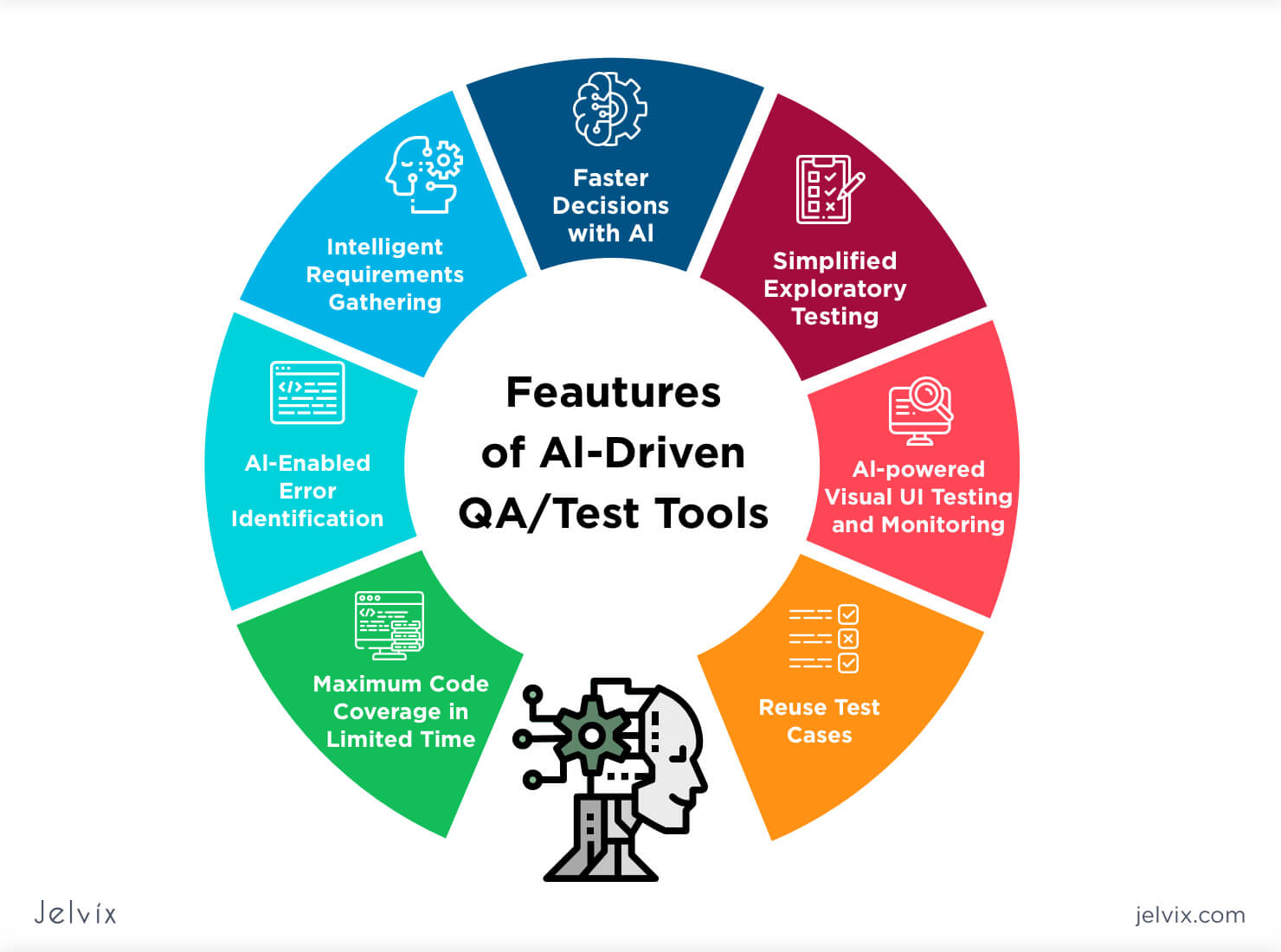
AI in software testing leverages advanced algorithms to automate repetitive tasks, analyze vast datasets, and make data-driven decisions to improve software quality. Traditional QA relies heavily on manual testing, which is time-consuming and prone to human error. AI enhances this process by enabling test automation, defect prediction, and continuous testing.
AI-powered tools can generate test cases, execute tests, and analyze results with minimal human intervention. They also adapt to changes in the software under test, reducing the need for manual updates. This shift toward AI-driven QA aligns with the broader trend of DevOps and Agile development, where speed and reliability are paramount.
#History / Background
#Early Developments
The integration of AI into software testing began in the early 2000s with the advent of basic test automation tools. Early efforts focused on keyword-driven testing and simple script-based automation. However, these methods lacked adaptability and required significant manual maintenance.
#Rise of Machine Learning
The breakthrough came with the rise of machine learning (ML) in the 2010s. ML algorithms enabled systems to learn from historical test data, improving test case generation and defect detection. Tools like Testim and Applitools emerged, using ML to enhance test stability and reduce flakiness.
#Modern AI-Driven Testing
Today, AI in testing encompasses a broader range of technologies, including computer vision for UI testing, natural language processing (NLP) for test case generation, and predictive analytics for risk assessment. The adoption of AI in QA has been accelerated by the growth of cloud computing and big data, which provide the computational power and data storage needed for AI models.
#How It Works
#Test Automation
AI-driven test automation tools use ML to create and maintain test scripts. Unlike traditional automation, which relies on fixed scripts, AI tools can adapt to changes in the application's user interface (UI) or functionality. For example, Applitools uses computer vision to detect visual regressions in web applications, while Testim employs ML to stabilize flaky tests.
#Defect Prediction
AI models analyze historical defect data to predict where new defects are likely to occur. By identifying high-risk areas, QA teams can prioritize testing efforts and allocate resources more efficiently. Techniques such as classification algorithms and anomaly detection are commonly used for this purpose.
#Test Case Generation
NLP and generative AI are used to automatically generate test cases from requirements or user stories. Tools like Test.ai can convert natural language descriptions into executable test scripts, reducing the manual effort required for test design.
#Performance Testing
AI enhances performance testing by analyzing system behavior under different load conditions. ML models can predict performance bottlenecks and suggest optimizations, enabling proactive issue resolution. Tools like LoadRunner and JMeter now incorporate AI-driven insights to improve test accuracy.
#Important Facts
- AI in testing can reduce test execution time by up to 90% compared to manual testing.
- Machine learning models require large datasets to train effectively, which can be a challenge for smaller organizations.
- AI-driven tools can detect visual regressions in UI testing with high accuracy, often outperforming human testers.
- The global AI in software testing market is projected to grow at a CAGR of 18.5% from 2023 to 2030.
- Ethical concerns, such as bias in AI models and data privacy, are significant challenges in AI-driven QA.
#Timeline
YearEvent2001Introduction of the first keyword-driven testing tools.2007Launch of Selenium, a popular open-source test automation framework.2012Google introduces PageSpeed Insights, using AI to analyze web performance.2015Applitools releases its AI-powered visual testing platform.2018Testim launches its AI-driven test automation platform.2020Functionize introduces autonomous testing, using AI to self-heal tests.2022Microsoft integrates AI into Azure DevOps for predictive test analytics.
#Related Terms
#FAQ
What does AI And Testing: Quality Assurance cover?
Explores how artificial intelligence shapes testing and quality assurance, covering practical use cases, benefits, limitations, and risks.
Why is AI And Testing: Quality Assurance important?
It helps readers understand key concepts, compare practical use cases, and evaluate how Artificial Intelligence decisions affect outcomes, risks, and implementation choices.
What should readers verify before applying this topic?
Readers should compare the benefits, limitations, data requirements, and related themes such as Testing, Quality, Assurance before using the ideas in real projects.
#References
- AI And Testing: Quality Assurance terminology and background research
- AI And Testing: Quality Assurance use cases, implementation examples, and limitations
- Artificial Intelligence best practices, standards, and risk guidance
- Testing case studies, benchmarks, and current industry analysis


Comments
No comments yet. Start the discussion with a useful note.