


#Short Answer
Explores how artificial intelligence shapes nursing and patient care, covering practical use cases, benefits, limitations, and risks.
#Infobox
Artificial intelligence in nursing Field Nursing Focus Patient care optimization, diagnostics, workflow automation Key Applications Predictive analytics, robotic assistance, virtual health assistants Emergence 21st century (accelerated post-2010) Notable Developments IBM Watson Health, AI-powered monitoring systems
Artificial intelligence in nursing (AI in nursing) refers to the integration of machine learning, natural language processing, and robotic technologies into nursing practice to enhance patient care, streamline workflows, and support clinical decision-making. AI applications in nursing span from predictive analytics for patient deterioration to robotic-assisted surgeries and virtual health assistants for patient education.
#Overview
AI in nursing represents a transformative shift in healthcare delivery, where artificial intelligence systems augment human expertise by processing vast datasets, identifying patterns, and providing real-time recommendations. Nurses, as the largest healthcare workforce, interact with AI tools daily—whether through electronic health record (EHR) systems enhanced with AI, wearable devices monitoring vital signs, or chatbots triaging patient inquiries.
The primary goals of AI integration in nursing include:
- Reducing human error in medication administration and documentation
- Enhancing early detection of patient deterioration through predictive algorithms
- Automating routine tasks (e.g., scheduling, billing) to free up time for direct patient care
- Personalizing care plans using patient-specific data trends
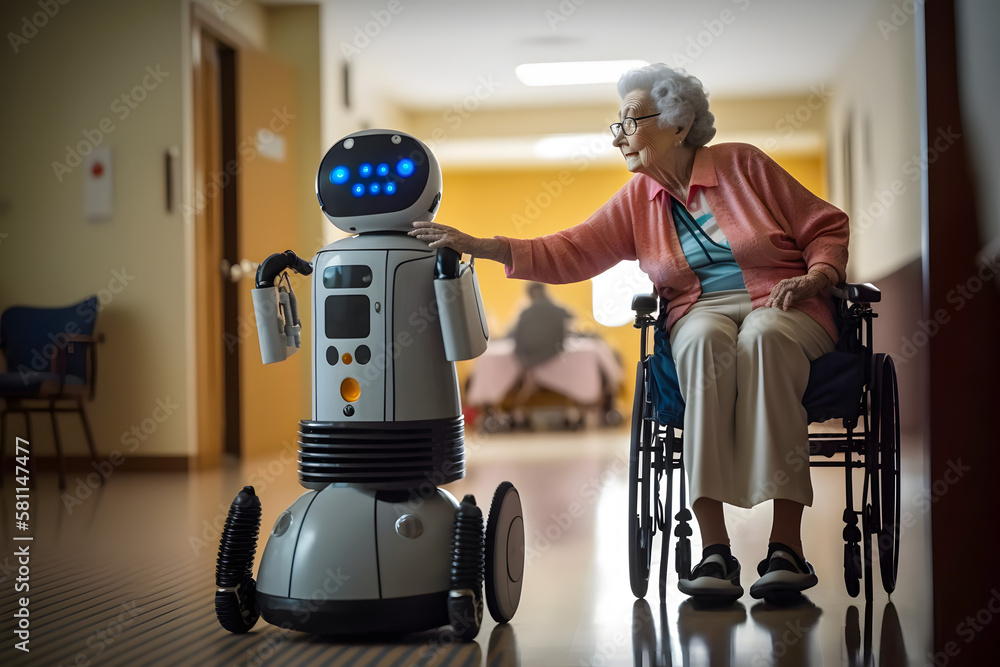
AI systems in nursing are designed to complement—not replace—human judgment, emphasizing collaboration between clinicians and technology to achieve optimal patient outcomes.
#History / Background
The conceptual foundation for AI in nursing emerged alongside the broader digital transformation of healthcare in the late 20th century. Early applications included rule-based expert systems in the 1980s, such as MYCIN (1970s), which assisted in antibiotic selection—though not nursing-specific, it laid groundwork for clinical decision support.
By the 1990s, nursing informatics began incorporating AI elements, with systems like the Nursing Minimum Data Set (NMDS) standardizing data collection. The 2000s saw the rise of EHRs with embedded clinical decision support (CDS) tools, though these were often rudimentary compared to modern AI.
A pivotal moment arrived post-2010 with the advent of machine learning and big data analytics. Projects like IBM Watson Health (launched 2011) demonstrated AI’s potential in oncology nursing, while advances in natural language processing (NLP) enabled voice-activated documentation systems. The COVID-19 pandemic (2020–2022) further accelerated AI adoption, with telehealth platforms integrating AI-driven symptom checkers and remote monitoring tools.
#How it works
#Core technologies
AI in nursing relies on several foundational technologies:
Machine learning (ML) Algorithms trained on historical patient data to predict outcomes (e.g., sepsis risk, readmission likelihood). Supervised learning uses labeled datasets (e.g., past vital signs correlated with diagnoses), while unsupervised learning identifies hidden patterns in unlabeled data (e.g., clustering patients with similar recovery trajectories). Natural language processing (NLP) Enables systems to interpret unstructured clinical notes, voice commands, or patient-reported symptoms. For example, NLP parses nursing narratives in EHRs to extract key terms like "shortness of breath" for automated flagging in CDS tools. Computer vision Analyzes medical imaging (e.g., X-rays, wound photographs) to detect abnormalities or track healing progress. In nursing, this supports remote wound care assessments via smartphone apps. Robotics Autonomous or semi-autonomous robots assist with tasks like medication dispensing (TUG robots), patient lifting (exoskeletons), or even surgical assistance (e.g., da Vinci system). Predictive analytics Combines ML with statistical models to forecast patient risks. For instance, the Epic Sepsis Prediction Model uses EHR data to alert nurses to early sepsis signs. ### Integration with nursing workflow
AI tools are embedded into existing nursing workflows through:
- EHR augmentation: AI flags abnormal lab results or suggests evidence-based interventions directly in the patient chart.
- Wearable devices: Continuous glucose monitors or ECG patches transmit real-time data to AI systems, triggering alerts for nurses if thresholds are breached.
- Virtual assistants: Chatbots (e.g., Suki AI) handle patient queries about medications or post-discharge instructions, reducing nurse workload.
- Robotic process automation (RPA): Automates repetitive tasks like prior authorization requests or inventory management for medical supplies.
#Important facts
- Adoption rates: A 2023 American Nurses Association (ANA) survey found 68% of nurses use AI tools weekly, with predictive analytics and voice-to-text documentation being the most common.
- Accuracy benchmarks: AI models for pressure ulcer detection achieve 92% sensitivity in clinical trials, comparable to human nurses in early-stage assessments.
- Regulatory oversight: The U.S. FDA has cleared over 500 AI/ML-enabled medical devices as of 2024, including several nursing-specific tools like Current Health’s remote monitoring platform.
- Cost savings: Hospitals using AI-driven patient deterioration alerts report a 20% reduction in cardiac arrest incidents and associated costs (per Journal of Medical Internet Research, 2022).
- Ethical concerns: Bias in training data (e.g., underrepresentation of minority populations) can lead to disparities in AI recommendations, prompting calls for diverse dataset inclusion.
#Timeline
Year Milestone 1970s Development of MYCIN, an early expert system influencing clinical decision support. 1990s Introduction of Nursing Minimum Data Set (NMDS) for standardized documentation. 2004 FDA approves first robotic surgical assistant (da Vinci System), indirectly benefiting perioperative nursing. 2011 IBM Watson Health launches, later applied to oncology nursing support. 2016 First FDA-cleared AI tool for diabetic retinopathy screening (IDx-DR), relevant for diabetic nursing care. 2018 Epic integrates sepsis prediction model into EHRs, adopted by major health systems. 2020 COVID-19 pandemic accelerates AI adoption in telehealth and remote monitoring. 2022 FDA releases guidance on AI/ML-based software as a medical device (SaMD), clarifying regulatory pathways for nursing tools. 2023 Meta’s Segment Anything Model (SAM) enables AI-assisted wound segmentation for nursing documentation.
#Related Terms
#FAQ
What does AI And Nursing: Patient Care cover?
Explores how artificial intelligence shapes nursing and patient care, covering practical use cases, benefits, limitations, and risks.
Why is AI And Nursing: Patient Care important?
It helps readers understand key concepts, compare practical use cases, and evaluate how Healthcare AI decisions affect outcomes, risks, and implementation choices.
What should readers verify before applying this topic?
Readers should compare the benefits, limitations, data requirements, and related themes such as Nursing, Patient, Care before using the ideas in real projects.
#References
- AI And Nursing: Patient Care terminology and background research
- AI And Nursing: Patient Care use cases, implementation examples, and limitations
- Healthcare AI best practices, standards, and risk guidance
- Nursing case studies, benchmarks, and current industry analysis
Comments
No comments yet. Start the discussion with a useful note.