

#Short Answer
Explains what readers should know about AI and leadership, including core concepts, practical uses, benefits, and risks.
#Infobox
AI and Leadership: What Executives Need to Know Field Artificial intelligence, Leadership Key People Paul Daugherty, H. James Wilson, Satya Nadella Publication Year 2020–present Notable Works Human + Machine: Reimagining Work in the Age of AI (2018), Radical AI: How Today's Leaders Can Make AI Work for Your Business (2022) Related Topics Digital transformation, Machine learning, Ethical AI, Corporate governance
AI and Leadership refers to the integration of artificial intelligence technologies into executive decision-making, organizational strategy, and workforce management. As AI reshapes industries, leaders must adapt by developing new competencies in data-driven decision-making, ethical oversight, and human-AI collaboration. This article explores the evolution, key concepts, and practical implications of AI leadership in modern organizations.
#Overview
AI leadership involves guiding organizations through the integration of artificial intelligence while maintaining ethical standards, employee well-being, and strategic alignment. Unlike traditional leadership, AI-driven leadership requires executives to:
- Understand AI capabilities and limitations
- Redesign workflows to leverage AI tools
- Address workforce concerns about job displacement
- Ensure transparency in AI decision-making processes
According to a McKinsey report, companies that combine AI adoption with strong leadership are 30% more likely to see measurable business improvements.
#History / Background
#Early Developments
The concept of AI leadership emerged alongside early AI research in the 1950s–1960s, but practical applications in executive decision-making gained traction in the 2010s with advances in machine learning and big data analytics. Key milestones include:
- 2011: IBM's Watson defeats human champions on Jeopardy!, demonstrating AI's potential in complex decision-making.
- 2016: AlphaGo's victory over a Go champion showcased AI's ability to handle unstructured decision-making.
- 2018: The publication of Human + Machine by Paul Daugherty and H. James Wilson highlighted the need for human-AI collaboration in leadership.
#Modern Integration
By 2020, AI leadership became a critical boardroom topic as organizations faced:
- Automation of routine tasks
- Rise of AI-powered analytics for strategic planning
- Ethical dilemmas in AI deployment (e.g., bias, privacy)
- Shift in required executive skill sets
Companies like Microsoft and Google established AI ethics boards to guide leadership decisions, while business schools introduced AI-focused executive education programs.
#How It Works
#Core Components
Effective AI leadership relies on several interconnected elements:
AI Literacy
Executives must understand:
- AI types: Narrow AI (task-specific) vs. General AI (human-like cognition)
- Machine learning models: Supervised, unsupervised, and reinforcement learning
- Data requirements: Quality, quantity, and bias mitigation
Strategic Alignment
Leaders must:
- Identify high-impact AI use cases (e.g., predictive maintenance, customer personalization)
- Allocate resources for AI infrastructure and talent
- Establish KPIs for AI project success
Change Management
Key strategies include:
- Communicating AI's role in augmenting (not replacing) human work
- Implementing upskilling programs for employees
- Creating cross-functional AI teams
Ethical Governance
Frameworks for responsible AI leadership involve:
- Transparency: Explaining AI-driven decisions to stakeholders
- Accountability: Assigning responsibility for AI outcomes
- Fairness: Auditing algorithms for bias and discrimination
- Privacy: Complying with regulations like GDPR and CCPA
#Important Facts
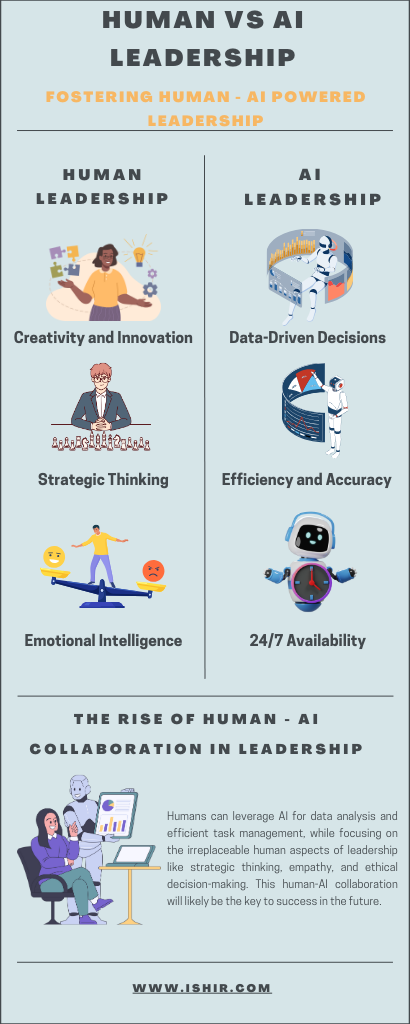 Key skills for AI-era leadership include emotional intelligence, adaptability, and data literacy. - Skill Gap: 54% of executives report a shortage of AI-skilled leaders, according to Deloitte (2023).
- ROI Drivers: Companies combining AI adoption with strong leadership see 2.5x higher revenue growth (Accenture, 2022).
- Ethical Concerns: 68% of consumers distrust AI decisions without human oversight (PwC, 2023).
- Talent Evolution: The World Economic Forum predicts 50% of all employees will need reskilling by 2025 due to AI integration.
- Regulatory Landscape: Over 60 countries have enacted AI-specific regulations as of 2024, with the EU's AI Act being the most comprehensive.
#Timeline
Year Event 1950 Alan Turing proposes the "Imitation Game" (Turing Test), laying groundwork for AI evaluation. 1956 Dartmouth Conference coins the term "artificial intelligence." 1997 IBM's Deep Blue defeats world chess champion Garry Kasparov. 2011 IBM Watson wins Jeopardy!, demonstrating AI's potential in complex decision-making. 2016 AlphaGo defeats Lee Sedol in Go, showcasing AI's strategic capabilities. 2018 Publication of Human + Machine by Daugherty and Wilson; EU releases first AI ethics guidelines. 2020 COVID-19 pandemic accelerates AI adoption in remote work and supply chain management. 2022 Publication of Radical AI by Rob Thomas and Paul Zikopoulos; U.S. releases AI Bill of Rights. 2023 Generative AI (e.g., ChatGPT) becomes mainstream, forcing executives to rethink content creation and customer interaction. 2024 EU's AI Act enters into force; major corporations establish AI ethics oversight committees.
#Related Terms
#FAQ
What does AI And Leadership: What Executives Need To Know cover?
Explains what readers should know about AI and leadership, including core concepts, practical uses, benefits, and risks.
Why is AI And Leadership: What Executives Need To Know important?
It helps readers understand key concepts, compare practical use cases, and evaluate how Business & Marketing decisions affect outcomes, risks, and implementation choices.
What should readers verify before applying this topic?
Readers should compare the benefits, limitations, data requirements, and related themes such as Leadership, Executive, Business Strategy before using the ideas in real projects.
#References
- AI And Leadership: What Executives Need To Know terminology and background research
- AI And Leadership: What Executives Need To Know use cases, implementation examples, and limitations
- Business & Marketing best practices, standards, and risk guidance
- Leadership case studies, benchmarks, and current industry analysis


Comments
No comments yet. Start the discussion with a useful note.