

#Short Answer
Explores how artificial intelligence shapes human rights and key considerations, covering practical use cases, benefits, limitations, and risks.
#Infobox
Explore the intersection of artificial intelligence and human rights, examining key considerations, impacts, and ethical challenges.
Artificial Intelligence and Human Rights Field Artificial intelligence Focus Human rights implications of AI systems Key Issues Privacy, bias, discrimination, surveillance, accountability Notable Reports UN Human Rights Council (2021), EU AI Act (2024) Related Concepts Algorithmic bias, Data privacy, Digital rights
#Overview
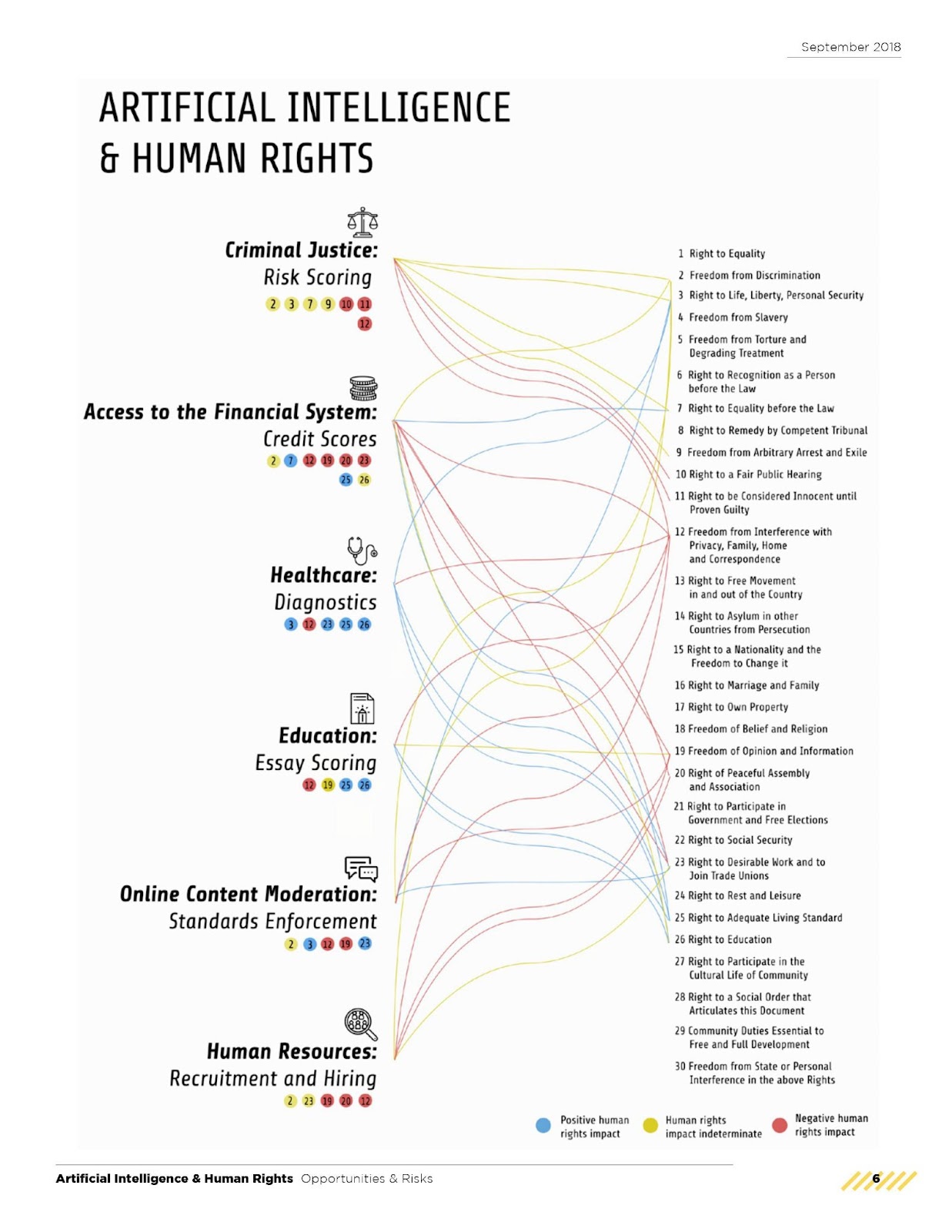
Artificial intelligence (AI) has rapidly integrated into societal infrastructures, influencing sectors such as healthcare, finance, law enforcement, and education. While AI offers transformative benefits—such as improved efficiency, predictive analytics, and personalized services—its development and deployment raise significant human rights concerns. These concerns span privacy violations, algorithmic discrimination, mass surveillance, and the erosion of democratic values. The intersection of AI and human rights necessitates a multidisciplinary approach to ensure that technological advancements align with international human rights standards, including the Universal Declaration of Human Rights (UDHR) and the International Covenant on Civil and Political Rights (ICCPR).
Key human rights frameworks emphasize the protection of individuals from harm caused by AI systems. For instance, the right to privacy (Article 12 of the UDHR) is frequently challenged by AI-driven data collection and surveillance. Similarly, the right to non-discrimination (Article 2 of the UDHR) is at risk when AI models perpetuate biases present in training datasets. As AI systems increasingly influence decision-making processes—from hiring practices to criminal sentencing—the need for transparency, accountability, and ethical oversight becomes paramount. Regulatory bodies and civil society organizations are advocating for policies that balance innovation with human rights protections, ensuring that AI serves the public good without compromising fundamental freedoms.
#History / Background
#Early Developments
The conceptual foundations of AI date back to the mid-20th century, with early work by pioneers such as Alan Turing, who proposed the "Turing Test" in 1950 to assess machine intelligence. However, the ethical implications of AI were not widely discussed until the late 20th century. In 1998, the OECD established guidelines for AI research, emphasizing the need for ethical considerations. The first major human rights-focused discussions emerged in the early 2000s, as AI began to permeate critical sectors like finance and law enforcement.
#21st Century Expansion
The proliferation of big data, cloud computing, and machine learning in the 2010s accelerated AI adoption, bringing human rights concerns to the forefront. High-profile cases of algorithmic bias—such as the COMPAS system used in U.S. criminal sentencing—highlighted how AI could reinforce systemic discrimination. In 2016, the UN Human Rights Council issued a landmark report on the impact of AI on privacy and freedom of expression. Subsequent years saw increased scrutiny from regulators, with the European Union introducing the General Data Protection Regulation (GDPR) in 2018, which includes provisions for automated decision-making and profiling.
In 2021, the UN Human Rights Council adopted a resolution recognizing the human rights risks posed by AI, calling for global standards to mitigate harm. Meanwhile, civil society organizations, such as Amnesty International and Human Rights Watch, have documented cases of AI-enabled surveillance in authoritarian regimes, raising alarms about the weaponization of technology against dissenters. The COVID-19 pandemic further accelerated AI deployment in areas like contact tracing and vaccine distribution, underscoring the need for ethical safeguards in crisis-response technologies.
#How It Works
#AI Systems and Human Rights Impacts
AI systems operate through complex algorithms that process vast datasets to make predictions, classifications, or decisions. These systems can be broadly categorized into supervised learning, unsupervised learning, and reinforcement learning. Each approach presents unique human rights challenges:
- Supervised Learning: Relies on labeled datasets to train models, which can embed historical biases. For example, facial recognition systems trained on predominantly light-skinned datasets may perform poorly on darker-skinned individuals, leading to misidentification and wrongful accusations.
- Unsupervised Learning: Identifies patterns in unlabeled data, which can inadvertently reveal sensitive personal information, such as health conditions or political affiliations, without consent.
- Reinforcement Learning: Used in autonomous systems like self-driving cars, it raises questions about accountability when AI-driven decisions result in harm.
#Key Mechanisms of Harm
AI systems can infringe on human rights through several mechanisms:
- Data Collection and Surveillance: AI-powered surveillance tools, such as facial recognition and predictive policing, enable mass monitoring, chilling freedom of expression and association. In China, the "Social Credit System" uses AI to rank citizens based on behavior, penalizing dissent.
- Algorithmic Bias: Biases in training data can lead to discriminatory outcomes in hiring, lending, and criminal justice. For instance, AI tools used in U.S. healthcare have been found to underestimate the pain levels of Black patients.
- Lack of Transparency: "Black box" AI models, where decision-making processes are opaque, undermine the right to a fair trial and due process. The EU AI Act classifies high-risk AI systems as those requiring transparency and human oversight.
- Autonomous Decision-Making: AI systems that make life-altering decisions—such as parole eligibility or loan approvals—raise concerns about accountability. Without clear lines of responsibility, victims of AI-driven harm may struggle to seek redress.
#Important Facts
- Global AI Regulation: As of 2024, over 60 countries have introduced AI-related legislation, with the EU's AI Act being the most comprehensive, categorizing AI systems into unacceptable risk, high risk, limited risk, and minimal risk.
- Facial Recognition Bans: Several U.S. cities, including San Francisco and Boston, have banned government use of facial recognition technology due to privacy and bias concerns.
- Algorithmic Accountability: The Algorithmic Accountability Act (proposed in the U.S.) would require companies to assess AI systems for bias and discrimination.
- Human Rights Impact Assessments: Tools like the Algorithm Assessment developed by the UN High Commissioner for Human Rights help organizations evaluate AI's compliance with human rights standards.
- AI in Warfare: Autonomous weapons systems, or "killer robots," raise ethical questions about the delegation of life-and-death decisions to machines, with over 30 countries calling for a ban on such systems.
#Timeline
Year Event 1950 Alan Turing proposes the "Turing Test," laying groundwork for AI ethics discussions. 1998 OECD establishes guidelines for AI research, emphasizing ethical considerations. 2016 UN Human Rights Council releases a report on AI's impact on privacy and freedom of expression. 2018 GDPR comes into effect in the EU, introducing provisions for automated decision-making. 2020 Global protests against racial bias in AI systems, following high-profile cases like facial recognition misidentifications. 2021 UN Human Rights Council adopts a resolution recognizing AI's human rights risks and calling for global standards. 2023 EU reaches a political agreement on the AI Act, the first major comprehensive AI regulation. 2024 Multiple countries, including Brazil and Canada, introduce AI legislation inspired by the EU AI Act.
#Related Terms
#FAQ
What does AI And Human Rights: Key Considerations cover?
Explores how artificial intelligence shapes human rights and key considerations, covering practical use cases, benefits, limitations, and risks.
Why is AI And Human Rights: Key Considerations important?
It helps readers understand key concepts, compare practical use cases, and evaluate how AI Ethics decisions affect outcomes, risks, and implementation choices.
What should readers verify before applying this topic?
Readers should compare the benefits, limitations, data requirements, and related themes such as Human, Right, Key before using the ideas in real projects.
#References
- AI And Human Rights: Key Considerations terminology and background research
- AI And Human Rights: Key Considerations use cases, implementation examples, and limitations
- AI Ethics best practices, standards, and risk guidance
- Human case studies, benchmarks, and current industry analysis


Comments
No comments yet. Start the discussion with a useful note.