

#Short Answer
Artificial Intelligence (AI) refers to the simulation of human intelligence in machines, enabling them to perform tasks such as learning, reasoning...
#Infobox
A comprehensive overview of the evolution of artificial intelligence from 1950 to 2025, including key milestones, technological advancements, and future trends.
#Overview
Artificial Intelligence (AI) refers to the simulation of human intelligence in machines, enabling them to perform tasks such as learning, reasoning, problem-solving, perception, and language understanding. The evolution of AI spans over seven decades, marked by alternating periods of rapid advancement and stagnation, known as "AI winters." From early theoretical foundations to modern deep learning systems, AI has transformed industries, economies, and daily life. Today, AI technologies underpin applications in healthcare, finance, transportation, and entertainment, with ongoing research pushing the boundaries of what machines can achieve.
#History / Background
The history of AI can be divided into several distinct phases, each characterized by technological breakthroughs, theoretical shifts, and societal impacts.
#Early Concepts and Foundations (Pre-1956)
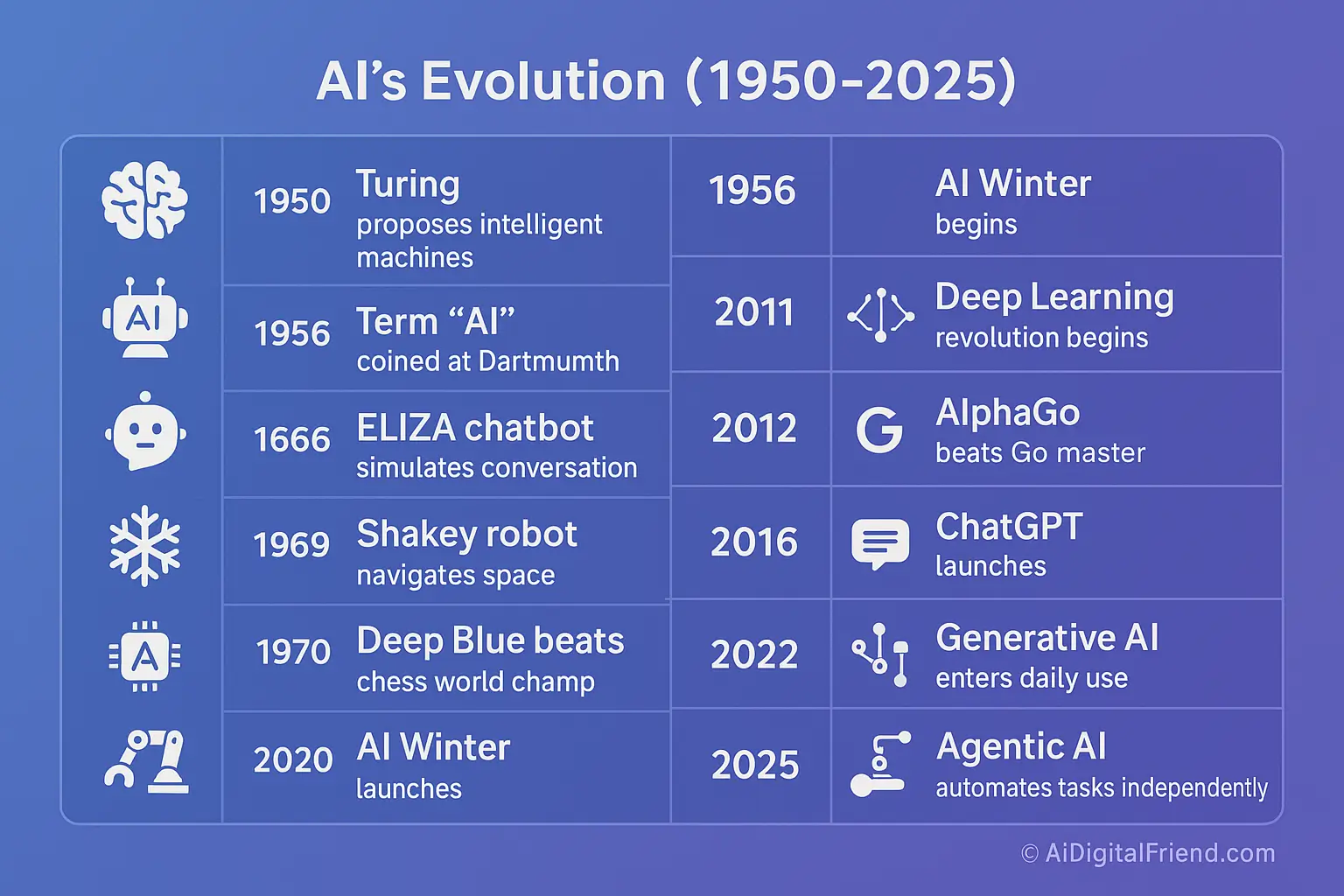
The origins of AI trace back to ancient myths and philosophical inquiries about human cognition. In the 20th century, key developments laid the groundwork for AI as a formal discipline. In 1936, Alan Turing introduced the concept of a universal machine capable of performing any computation, now known as the Turing machine. His 1950 paper "Computing Machinery and Intelligence" proposed the Turing Test as a criterion for machine intelligence. Concurrently, Warren McCulloch and Walter Pitts developed artificial neurons, simulating the biological brain's structure.
#Birth of AI (1956)
The term "Artificial Intelligence" was coined in 1956 during the Dartmouth Conference, organized by John McCarthy, Marvin Minsky, Nathaniel Rochester, and Claude Shannon. This event is widely regarded as the official birth of AI as a field of study. Early AI programs, such as the Logic Theorist (1956) and the General Problem Solver (1957), demonstrated symbolic reasoning capabilities. However, optimism was tempered by the realization that solving real-world problems required more than symbolic manipulation.
#AI Winters and Renaissances (1974–Present)
The first AI winter (1974–1980) occurred due to unmet expectations and limited computational power. Funding cuts followed, but research continued in specialized areas like expert systems. The second AI winter (1987–1993) was triggered by the failure of large-scale AI projects and the rise of more practical software solutions. However, the mid-1990s marked a renaissance with advancements in machine learning, particularly neural networks. IBM's Deep Blue defeated world chess champion Garry Kasparov in 1997, showcasing AI's potential in complex decision-making.
The 21st century ushered in the era of big data and deep learning. Breakthroughs in neural network architectures, such as convolutional neural networks (CNNs) and recurrent neural networks (RNNs), enabled significant progress in image and speech recognition. The introduction of AlexNet in 2012 revolutionized computer vision, while Google's AlphaGo defeated a human Go champion in 2016, demonstrating AI's ability to master highly complex games.
#How It Works
AI systems operate through a combination of algorithms, data, and computational power. The core methodologies include symbolic AI, machine learning, and deep learning.
#Symbolic AI
Symbolic AI, also known as "good old-fashioned AI" (GOFAI), relies on predefined rules and logical representations. It uses knowledge bases and inference engines to solve problems by manipulating symbols according to formal logic. While effective for rule-based tasks, symbolic AI struggles with ambiguity and real-world complexity.
#Machine Learning
Machine learning (ML) enables systems to learn from data without explicit programming. It encompasses supervised learning, unsupervised learning, and reinforcement learning. In supervised learning, models are trained on labeled datasets to make predictions. Unsupervised learning identifies patterns in unlabeled data, while reinforcement learning trains agents to maximize rewards through trial and error.
#Deep Learning
Deep learning, a subset of machine learning, utilizes artificial neural networks with multiple layers (hence "deep"). These networks, inspired by the human brain, consist of interconnected nodes (neurons) that process and transform data. Convolutional neural networks (CNNs) excel in image recognition, while transformers, introduced in 2017, power modern natural language processing (NLP) models like BERT and GPT. Deep learning's success hinges on large datasets and high-performance computing resources.
#Important Facts
- Turing Test: Proposed by Alan Turing in 1950, it assesses a machine's ability to exhibit intelligent behavior indistinguishable from a human's.
- Moore's Law: The observation that the number of transistors on a microchip doubles approximately every two years, driving computational advancements.
- Big Data: The proliferation of data from digital sources has fueled AI's growth, enabling more accurate and robust models.
- Ethical Concerns: AI raises ethical issues such as bias, privacy, job displacement, and autonomous weapons, prompting global discussions on regulation.
- AGI vs. Narrow AI: Artificial General Intelligence (AGI) aims to replicate human-level intelligence across all tasks, while Narrow AI focuses on specific applications.
- Explainable AI (XAI): Efforts to make AI systems more transparent and interpretable, addressing the "black box" problem in deep learning.
#Timeline
- A subset of AI focused on building systems that learn from data.
- Computational models inspired by the human brain, used in deep learning.
- The intersection of AI and linguistics, enabling machines to understand and generate human language.
- AI techniques for interpreting and analyzing visual information from the world.
- The design and application of robots, often incorporating AI for autonomy and decision
making.
- A type of ML where agents learn by interacting with an environment to maximize rewards.
- AI systems capable of creating new content, such as text, images, or music.
- Techniques to make AI decisions more interpretable and transparent.
- Hypothetical AI with human
level cognitive abilities across all domains.
- AI systems designed for specific tasks, as opposed to general intelligence.
#Related Terms
#FAQ
What does AI And Evolution: Improving Over Time cover?
Explores how artificial intelligence shapes evolution and improving over time, covering practical use cases, benefits, limitations, and risks.
Why is AI And Evolution: Improving Over Time important?
It helps readers understand key concepts, compare practical use cases, and evaluate how Artificial Intelligence decisions affect outcomes, risks, and implementation choices.
What should readers verify before applying this topic?
Readers should compare the benefits, limitations, data requirements, and related themes such as Evolution, Improving, Over before using the ideas in real projects.
#References
- AI And Evolution: Improving Over Time terminology and background research
- AI And Evolution: Improving Over Time use cases, implementation examples, and limitations
- Artificial Intelligence best practices, standards, and risk guidance
- Evolution case studies, benchmarks, and current industry analysis



Comments
No comments yet. Start the discussion with a useful note.